


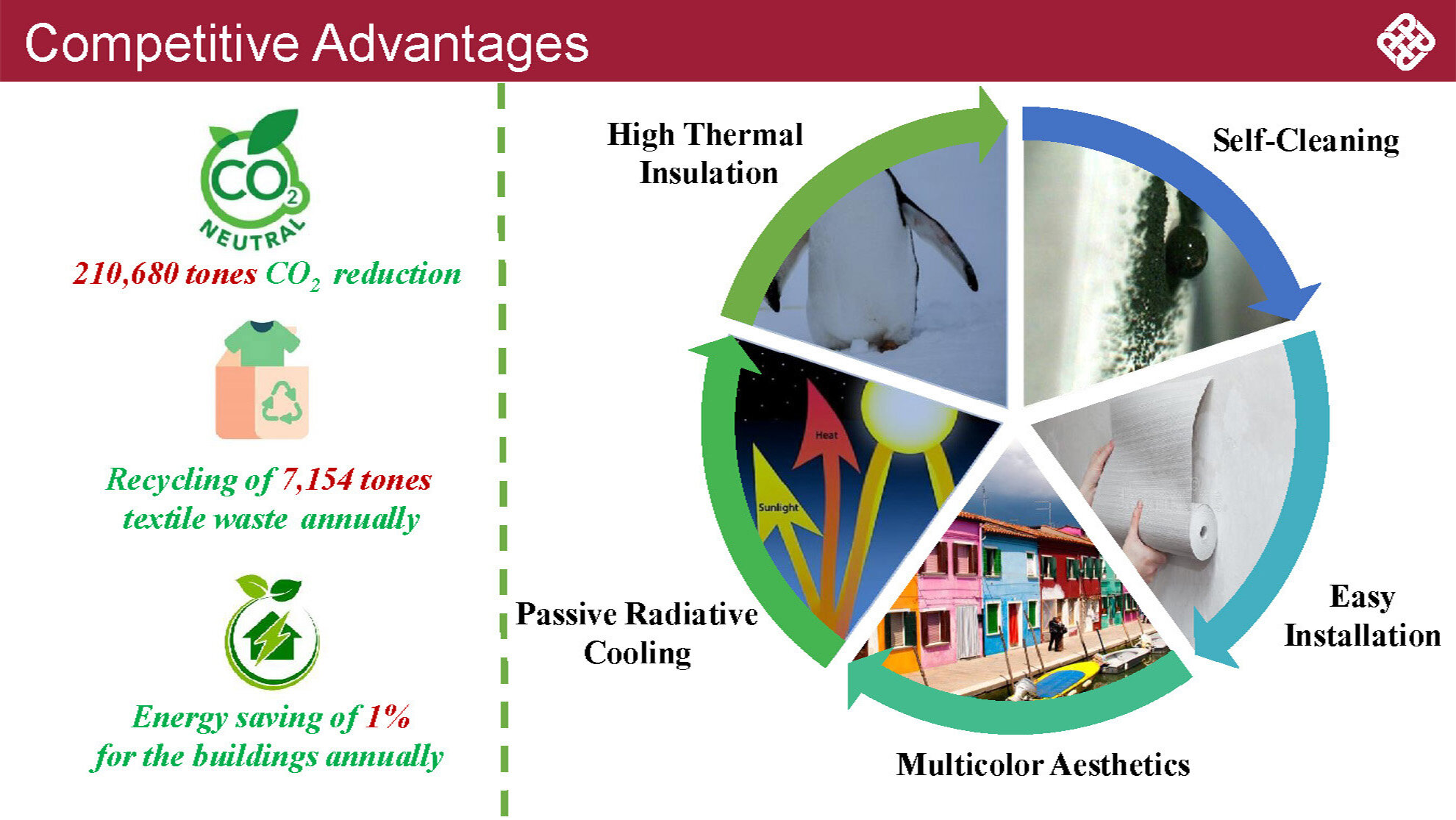
Textiles account for 10% of carbon dioxide (CO2) emissions, while 85% of textile waste is simply sent to landfill or incinerated. Buildings in Hong Kong generate 60% of CO2 emissions and air conditioners consume 30% of energy. Therefore, providing an attractive technology to recycle textile waste and save building energy simultaneously holds high promise for carbon reduction.
Dr. Dahua Shou, Limin Endowed Young Scholar in Advanced Textiles Technologies, Assistant Professor in School of Fashion and Textiles of the Hong Kong Polytechnic University (PolyU) has led a research project to create multi-functional, value-added “building clothing” (BC) from textile waste for carbon reduction.
Textile waste, often consisting of blended yarns, is difficult to recycle due to the challenges and high cost of sorting, depolymerization, and dissolution. Dr. Shou’s research titled, “Development of multi-functional building clothing using textile waste for energy saving and waste reduction,” proposes collecting textile waste to develop a sustainable building envelope for thermal insulation and radiative cooling by a mass production method.
The reuse of textile waste as thermal insulation for sustainable buildings will be an effective green technology that synergistically combines two crucial components in achieving carbon neutrality in Hong Kong: textile waste recycling and building energy saving.
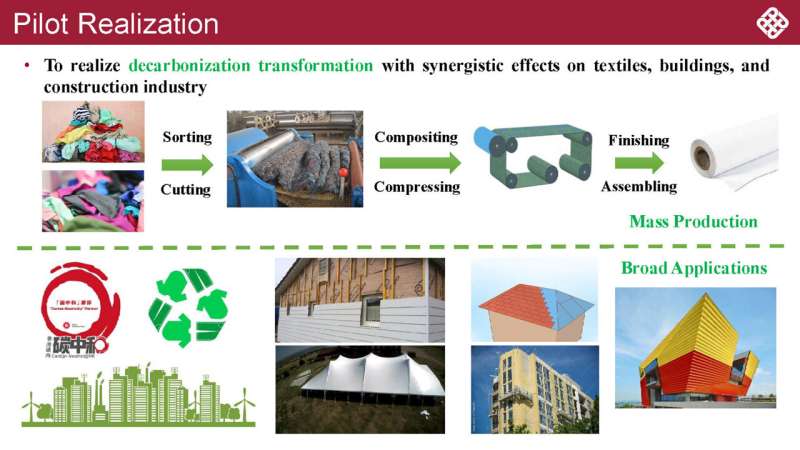
By leveraging photon engineering, nature-inspired design, and heat transfer optimization, the proposed “building clothing” will excel in managing the temperature of buildings.
In addition to minimizing thermal conductivity, the textile-reinforced hierarchical microstructures and colorants will selectively reflect solar heat, including visible light (VIS) and near-infrared (NIR), while emitting thermal radiation in the long-wave infrared (LWIR) spectrum. Furthermore, it effectively repels water and dirt on the surface, ensuring consistent performance and robustness.
This multi-functional “building clothing,” enhanced with multi-color aesthetics, is highly durable, lightweight, and flame-resistant, making it compatible with a variety of scenarios such as residential and factory buildings, village houses, stilt houses, substations, container apartments, curtains, canopies, and tents.
The reuse of textile waste as thermal insulation for sustainable buildings is an effective green technology that synergistically combines two crucial components in achieving carbon neutrality in Hong Kong: textile waste recycling and building energy saving.
Hong Kong Polytechnic University
Read the full article here


