


Weather-dependent environmental energy harvesting of solar heat, wind energy, and rain energy towards carbon sustainability and net zero is critical in the post-pandemic world, where economic activities gradually recover with ever-increasing electricity demands. Ubiquitous ambient energy sources, such as solar illuminations, wind fluctuations, ground heat, humidity variations, and raindrops, are typically season-/climate-dependent and present as sunny/cloudy/rainy weather and diurnal cycles.
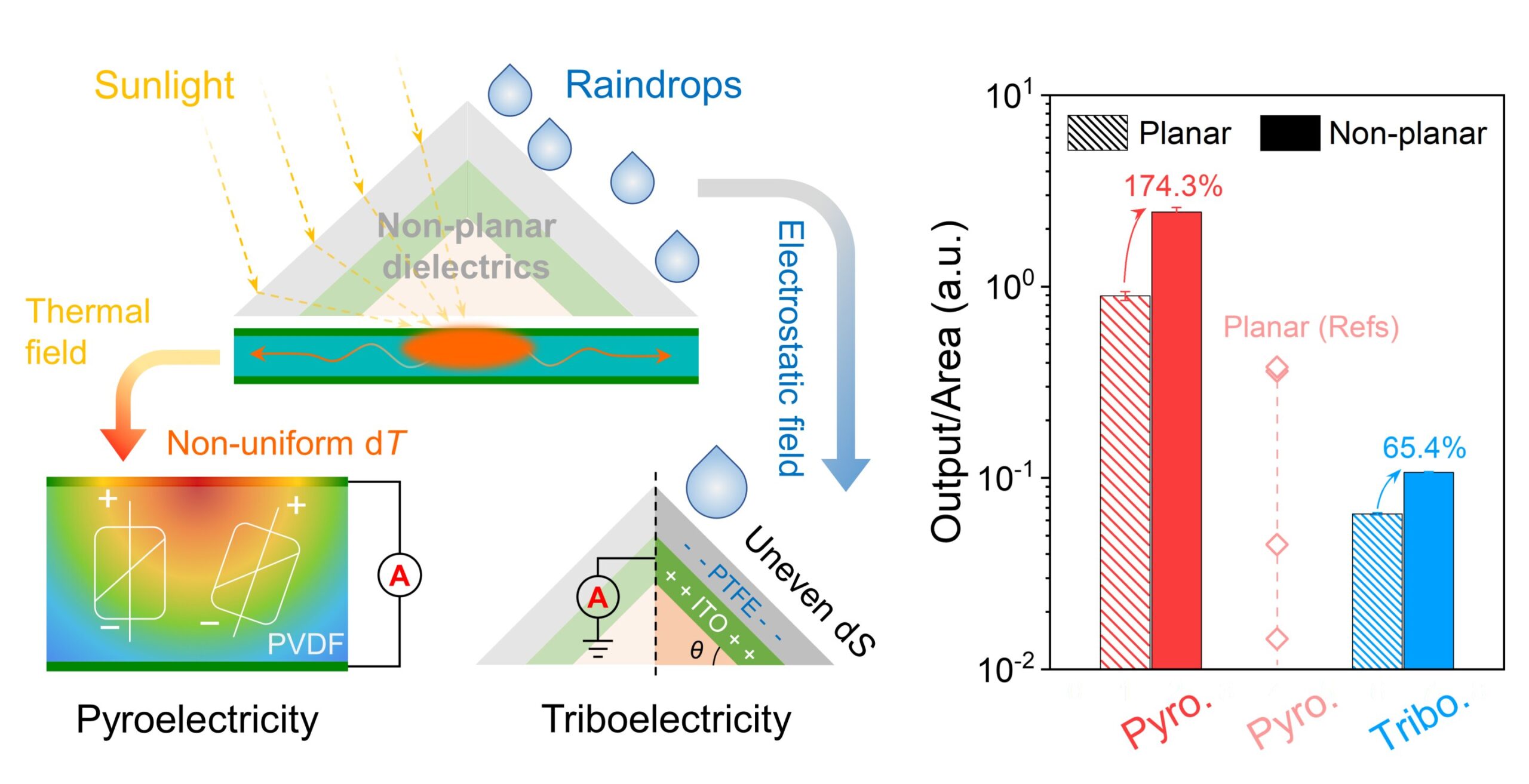
Recently, the output power density from 10 to 1000 μW m-2 for sole solar heat harvesting using pyroelectrics has been realized. However, these conventional planar devices capture the solar heat homogenously, limited by simultaneous and uniform thermal field propagation across the entire device, thus resulting in low temporal temperature variation and polarization change.
Meanwhile, this flat dielectric is not feasible for raindrop-based triboelectricity generation since the electrostatic induction and triboelectrification depend on the temporal water droplet sliding area variation during the liquid-solid contact/separation process.
To circumvent these impediments, other energy harvesting alternatives employing non-planar or curved bulk dielectrics to attain inhomogeneous local heat and electrostatic field propagation towards enhanced pyroelectricity, and triboelectric output must be developed for weather-adaptive energy recovery.
A new study led by Prof. Jiaqing He (Southern University of Science and Technology) and Prof. Ghim Wei Ho (National University of Singapore) resulted in an article published in National Science Review. In it, Yi Zhou and lab directors He and Ho explain how the non-flat or non-planar dielectrics with high degrees of structure freedom contribute to weather-adaptive environmental energy harvesting, for instance, on sunny, cloudy, night, and rainy days.
The team presents a new paradigm to “kill two birds with one stone” by harnessing non-planar dielectrics to overcome the independence of traditional environmental heat and raindrop energy harvesters. They found the non-planar multi-layer dielectrics confine the local solar heat propagation along the in-plane direction, thus increasing non-uniform spatial polarization and pyroelectricity.
Meanwhile, this non-planar configuration with curved architecture and textured morphology promotes the water droplet spreading and separation, thereby boosting the overall induced electrostatic charges towards enlarged triboelectricity.
Consequently, without consuming additional solar heat and raindrop energies, or tailoring dielectrics properties, the non-planar generator consists of widely used plastics (fluoropolymer and Teflon), enabling cost-effective solar heat and raindrop energy harvesting with an output power increment of 174.3% and 65.4%, respectively, according to lab measurement.
Together with scalable manufacturing techniques, the researchers also performed outdoor in-situ tests on sunny, cloudy, night, and rainy days for all-weather energy harvesting. “These results not only pave a new way for environmental heat/rain recovery but also for inspiration in other high-entropy energy upcycling,” Yi Zhou says.
More information:
Yi Zhou et al, Non-planar dielectrics derived thermal and electrostatic field inhomogeneity for boosted weather-adaptive energy harvesting, National Science Review (2023). DOI: 10.1093/nsr/nwad186
Science China Press
Read the full article here


