

Close Menu
  • Home
  • News
  • Startups
  • Innovation
  • Industry
  • Business
  • Green Innovations
  • Venture Capital
  • Market Data
    • Economic Calendar
    • Stocks
    • Commodities
    • Crypto
    • Forex
Facebook X (Twitter) Instagram
[gtranslate]
Facebook X (Twitter) Instagram YouTube
Innovation & Industry
Banner
  • Home
  • News
  • Startups
  • Innovation
  • Industry
  • Business
  • Green Innovations
  • Venture Capital
  • Market Data
    • Economic Calendar
    • Stocks
    • Commodities
    • Crypto
    • Forex
Login
Innovation & Industry
Green Innovations

Hand-held tube containing aluminum foil balls produces enough electricity to power LED array when shaken

News RoomNews RoomAugust 15, 2023No Comments3 Mins Read
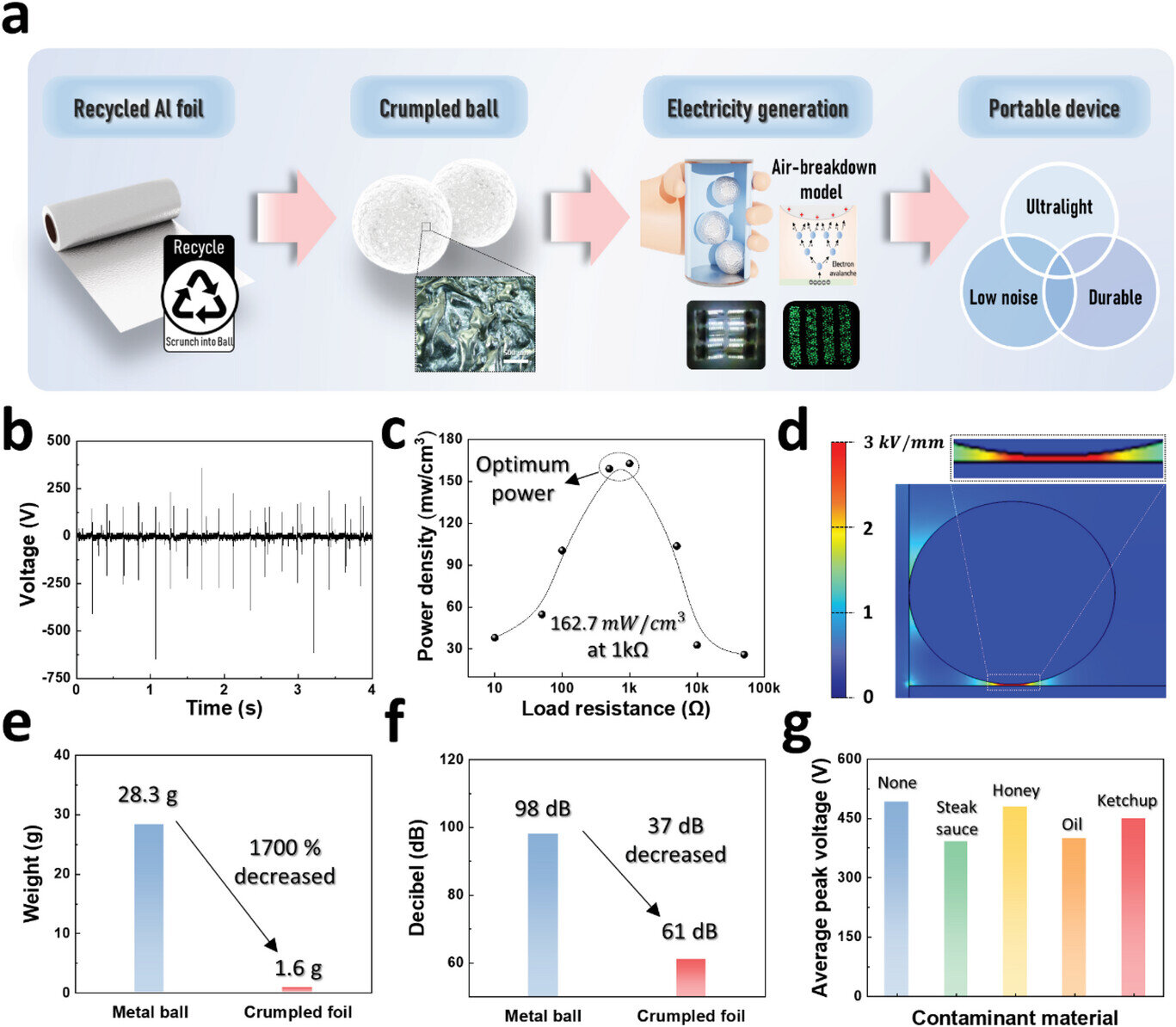
Concept and character of the RFCB-TENG. a) Schematic process diagram of a portable RFCB-TENG. b) Voltage output for 4 s. c) Peak power density according to external load resistances. d) Simulation results when the ball touched the PTFE and generated an electrostatic discharge. e) Weight of an equal volume metal ball and crumpled foil. f) Operating decibels for the metal ball and crumpled foil-based TENGs. g) Average peak voltages of the RFCB-TENG with kitchen contaminants. Credit: Advanced Science (2023). DOI: 10.1002/advs.202301609

A team of mechanical engineers from Chung-Ang University, Massachusetts General Hospital, LS Materials and Yonsei University has found that a hand-held cylinder containing crumpled aluminum foil balls is capable of producing enough electricity when shaken to light a small LED grid. In their paper published in the journal Advanced Science, the group describes other materials used in the cylinder and possible uses for such a device.

Prior research has shown that a wide variety of materials can be used to generate static electricity, and that some constructions can capture that electricity. Researchers have suggested such devices could be useful as the power needs of personal electronics decrease. In this new effort, the researchers have looked to aluminum foil as a material for generating static electricity and capturing it to power an external device.

The device the team built is shaped as a cylinder with a cap on the top and bottom—about the size of a Pringle’s can. The tube was made using an acrylic substrate covered with a polytetrafluoroethylene layer. The caps, which serve as electrodes, were made of aluminum. The team then crumpled three wads of aluminum foil into balls and placed them inside the tube.


Credit: Advanced Science (2023). DOI: 10.1002/advs.202301609

To create electricity, team members held the tube in one hand and shook it. This caused the aluminum balls to run into each other and to rub against the walls of the cylinder, producing static electricity. That electricity was then passed through the cap, where it was transferred via wires to an external device.

The research team found that the device was capable of producing enough electricity to power a 500-LCD light grid and also a 30-watt lamp. Notably, such a device could be attached to another moving device as a way to replace its reliance on hand power—connecting it to a windmill, for example, or a water mill. Such devices could also be used in tandem with other similar devices to increase the amount of electricity generated.

More information:
Jin‐ho Son et al, Recycled, Contaminated, Crumpled Aluminum Foil‐Driven Triboelectric Nanogenerator, Advanced Science (2023). DOI: 10.1002/advs.202301609

© 2023 Science X Network


Read the full article here

Related Articles

Neutron scattering study points the way to more powerful lithium batteries

Green Innovations April 16, 2024

Researchers can help shipowners achieve ambitious climate targets

Green Innovations April 16, 2024

Solar energy can uplift rural Ethiopians, but is hard to come by

Green Innovations April 16, 2024

A timer can shorten your shower even when you have no incentive to save water

Green Innovations April 16, 2024

High electric bills threaten California’s clean future: This plan could help

Green Innovations April 16, 2024

New insight about the working principles of bipolar membranes could guide future fuel cell design

Green Innovations April 16, 2024
Add A Comment
Leave A Reply Cancel Reply

Copyright © 2026. Innovation & Industry. All Rights Reserved.
  • Privacy Policy
  • Terms of use
  • Press Release
  • Advertise
  • Contact

Type above and press Enter to search. Press Esc to cancel.

Sign In or Register

Welcome Back!

Login to your account below.

Lost password?