


Today’s commercial solar panels can convert about 15% to 20% of the sunlight they absorb into electrical energy—but they could be much more efficient, according to researchers at Soochow University. The next generation of solar cells has already demonstrated 26.1% efficiency, they said, but more specific research directions are needed to make such efficiency the standard and expand beyond it.
They published their review of the current state of research on high-efficiency perovskite solar cells and their recommendations for future work in Energy Materials and Devices.
“Metal halide perovskite solar cells are a new type of high-performance solar cell,” said first author Fengren Cao, researcher in Soochow University’s School of Physical Science and Technology. “They exhibit excellent photoelectric properties and have the potential for high efficiency and low cost, making them a promising candidate for future solar energy applications.”
The metal halide perovskite in these solar cells is a calcium titanium oxide-like organic material that operates as a light-absorbing semiconductor to capture incidental sunlight and convert it to energy.
“Perovskite solar cells offer high efficiency, exceeding 26% in laboratory conditions; low cost, using relatively inexpensive materials and simple manufacturing processes; flexibility, as they can be made on flexible substrates—such as plastic or metal foils—enabling the development of lightweight, flexible photovoltaic devices; and they can be scaled up to larger sizes,” Cao said. “They have extraordinary potential as the next generation of photovoltaic technology.”
However, Cao noted that only a few research teams have developed perovskite solar cells capable of 25% efficiency or more.
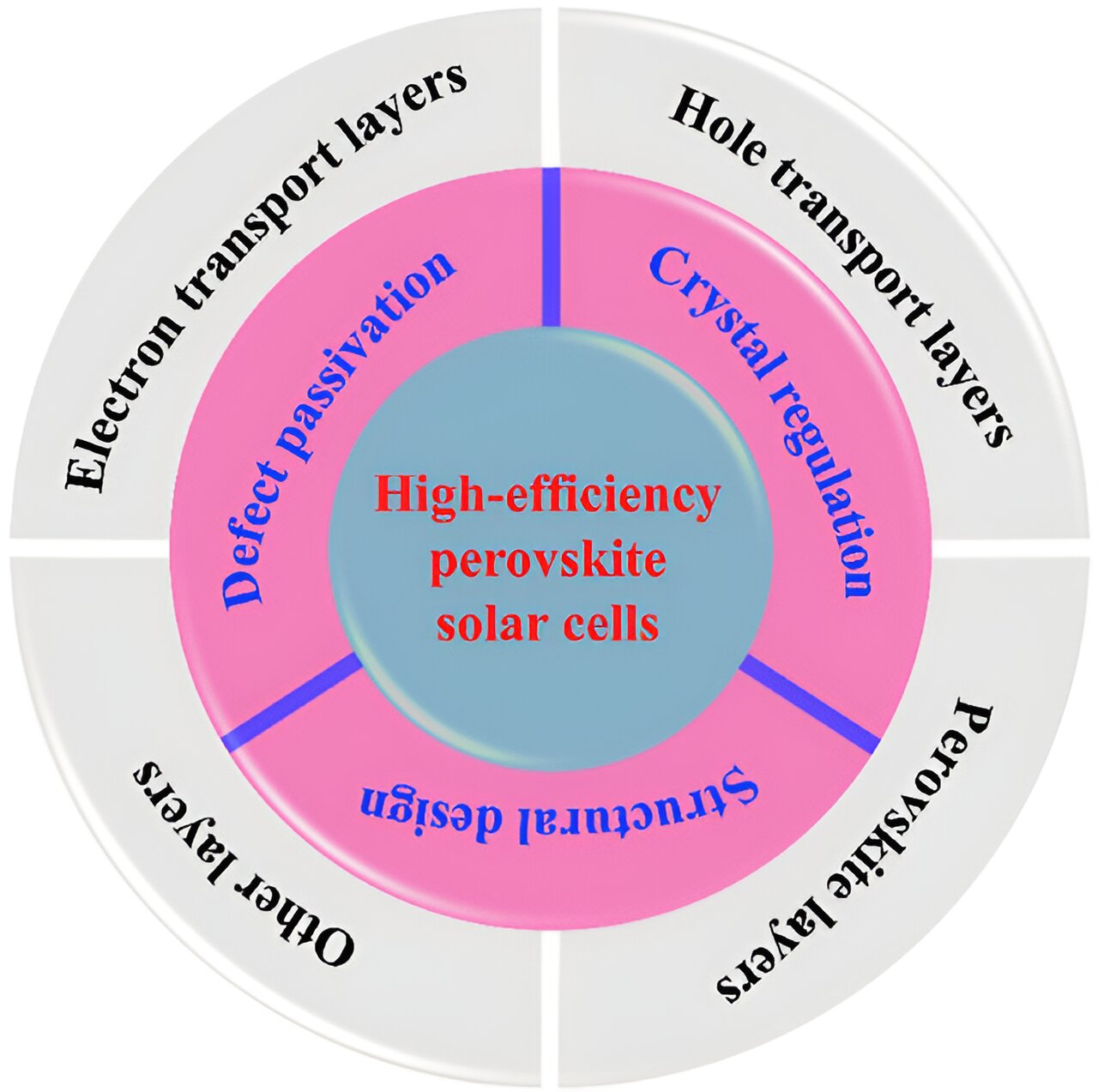
“Over the past years, many strategies have been adopted to improve the efficiency of perovskite solar cells,” Cao said. “But achieving more than 25% efficiency is not yet common. As such, in this paper, we summarize recent developments in high-efficiency perovskite solar cells and highlight their effective strategies in crystal regulation, interface passivation, and structural design of component layers.”
These strategies could effectively address the main causes of low efficiency, which are preparation process-induced defects and an unsuitable band structure, according to Cao. The band structure refers to the energy levels of electrons in the material: Too low, and the cell cannot properly or efficiently convert sunlight into energy; too high, and the cell faces the same issue.
Cao also noted that other types of solar cells could be combined to construct “tandem solar cells” that could work together to break the efficiency limits of a single type of solar cell. In addition, Cao said, fabrication methods for larger components need to be optimized to achieve the same efficiencies as the methods to fabricate small areas less than a 10th of a square centimeter.
“We believe that perovskite solar cells are one class of the most promising solar cells, and these efforts will ensure they can be commercialized and industrialized in the future,” Cao said, explaining that additional research would also address such challenges as tolerance to defects and issues related to stability. “The future of perovskite solar cells is incredibly exciting, and the potential for further advancements is vast.”
More information:
Fengren Cao et al, Perovskite solar cells with high-efficiency exceeding 25%: a review, Energy Materials and Devices (2024). DOI: 10.26599/EMD.2024.9370018
Provided by
Tsinghua University Press
Read the full article here


