


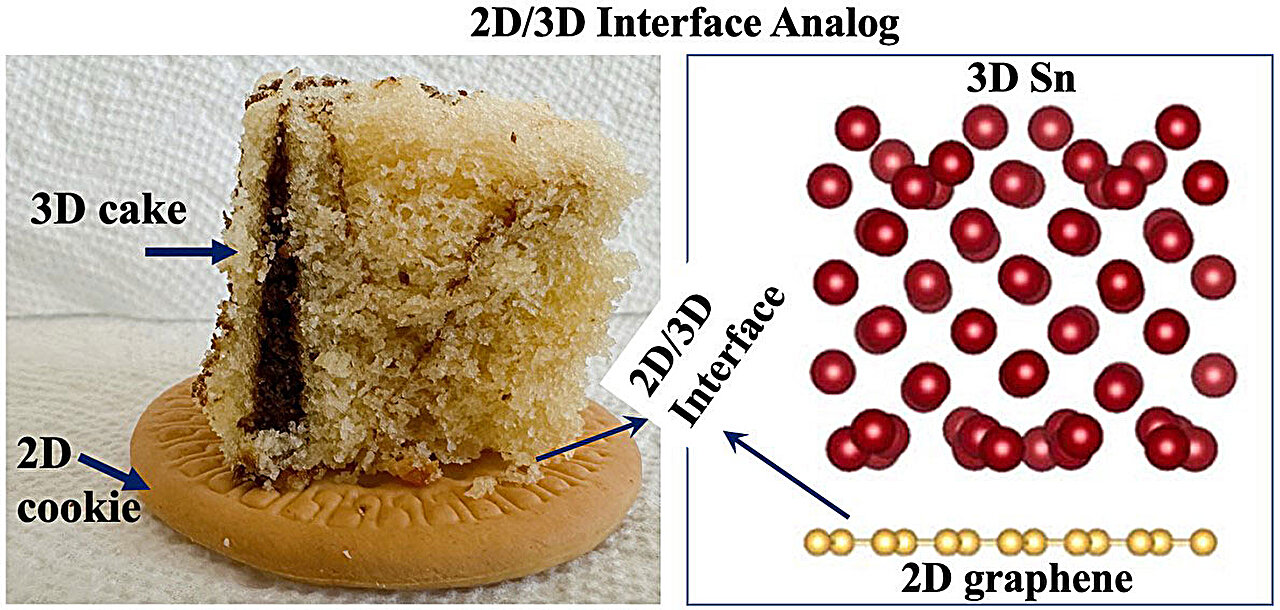
Doing an experiment with a cake on a cookie sounds simple. But when researchers from the New Jersey Institute of Technology (NJIT) developed a unique dataset for combining 2D graphene and 3D tin, the process was all but simple—it required a great deal of computing power.
“When two different materials are in contact, the interface between the materials is critical—cakes and cookies are like 3D and 2D materials,” said Dibakar Datta, assistant professor in NJIT’s Department of Mechanical and Industrial Engineering.
“A cake on a cookie is like a 3D/2D heterostructure and if the cake/cookie interface is too strong, the cake will stick to the cookie—in contrast, a weak interface makes the intersection lose and that’s why it is essential to study how strongly the interface is connected.”
For their study, the NJIT researchers turned to Expanse at San Diego Supercomputer Center at UC San Diego. Using the high performance computing resource, the researchers investigated the interface between graphene and tin systems with a machine learning (ML) method trained by calculations from a computational quantum mechanical modeling method called density functional theory (DFT).
The study resulted in a hard, sturdy efficient material that the researchers say can be used for applications in devices such as biosensors, solar panels, batteries, electronics and artificial muscles. The scientists’ findings have been published in the Journal of Electrochemical Energy Conversion and Storage.
“One of the best application cases of graphene and interface systems is in sodium-ion batteries, where the presence of graphene interface can alleviate mechanical stresses upon sodium intercalation in otherwise high capacity-low stability tin anode,” said Vidushi Sharma, NJIT graduate student at the time of the study and now a research scientist at IBM Accelerated Materials Discovery.
“Unique lattice distortions, interface strength and physicochemical attributes characterize each interface and an atomistic understanding of these interfaces provides guidelines for system designs.”
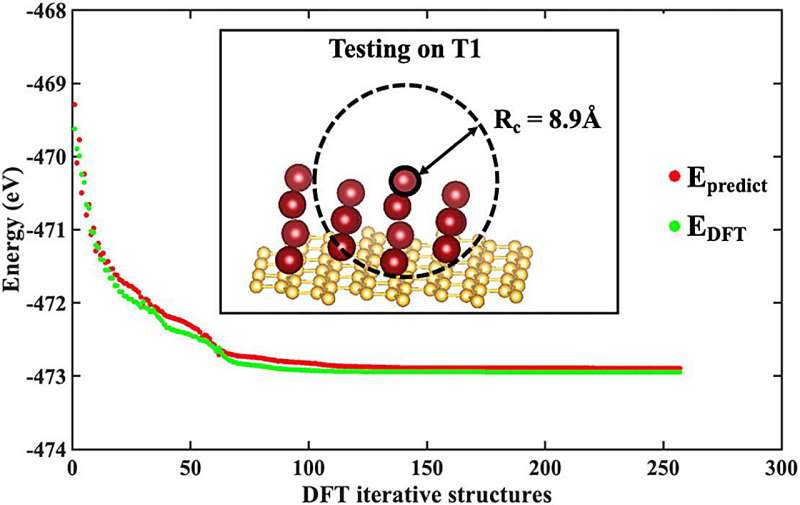
Sharma explained that even though ML methods can ease simulations of such complex interfaces, data requirements typically present significant barriers that delay the adoption of ML techniques in AI-assisted, 2D heterostructure material development and discovery. But with the help of Expanse, the lack of a sizable dataset was compensated with advanced sampling and modeling approaches.
“Significant barriers delay the adoption of ML techniques in artificial intelligence-assisted material development and discovery—due to extensive computational demands, simulation data for interface systems is especially hard to gather,” Datta said, adding that the computational power of Expanse enabled faster simulation times for their complex interface systems.
Notably, this is not the first time the scientists have used SDSC resources for their materials science work. Datta explained that the current research was inspired by previous work the team conducted on supercomputers at SDSC. The prior studies also looked at implications of 2D/3D interfaces in the energy storage domain. Their earlier work considered the potential of 2D material-based heterostructures that solve several issues in energy storage systems, such as electrical isolation of active particles, interface failure, volume expansion and power density.
“For example, flexible 2D material such as graphene acts as a flexible conductive binder with active material particles to allow easy expansion and contraction by escaping mechanical failures,” Datta said. “Now that we have several studies behind us, we will continue to work on incorporating additional materials such as silicon with graphene.”
According to Datta, the research team’s overall goal is to generate a large database with interface systems to be shared with the materials science research community.
“Using this future database, we will refine our existing models as many important interface properties need further study, such as interfacial slip, fracture and stress generation at the interface,” Datta said. “Our Expanse-generated models will be available for the worldwide scientific community for faster prediction of interfacial property of any nanoscale interface.”
More information:
Vidushi Sharma et al, Developing Potential Energy Surfaces for Graphene-Based 2D–3D Interfaces From Modified High-Dimensional Neural Networks for Applications in Energy Storage, Journal of Electrochemical Energy Conversion and Storage (2022). DOI: 10.1115/1.4054781
Provided by
San Diego Supercomputer Center
Read the full article here


