


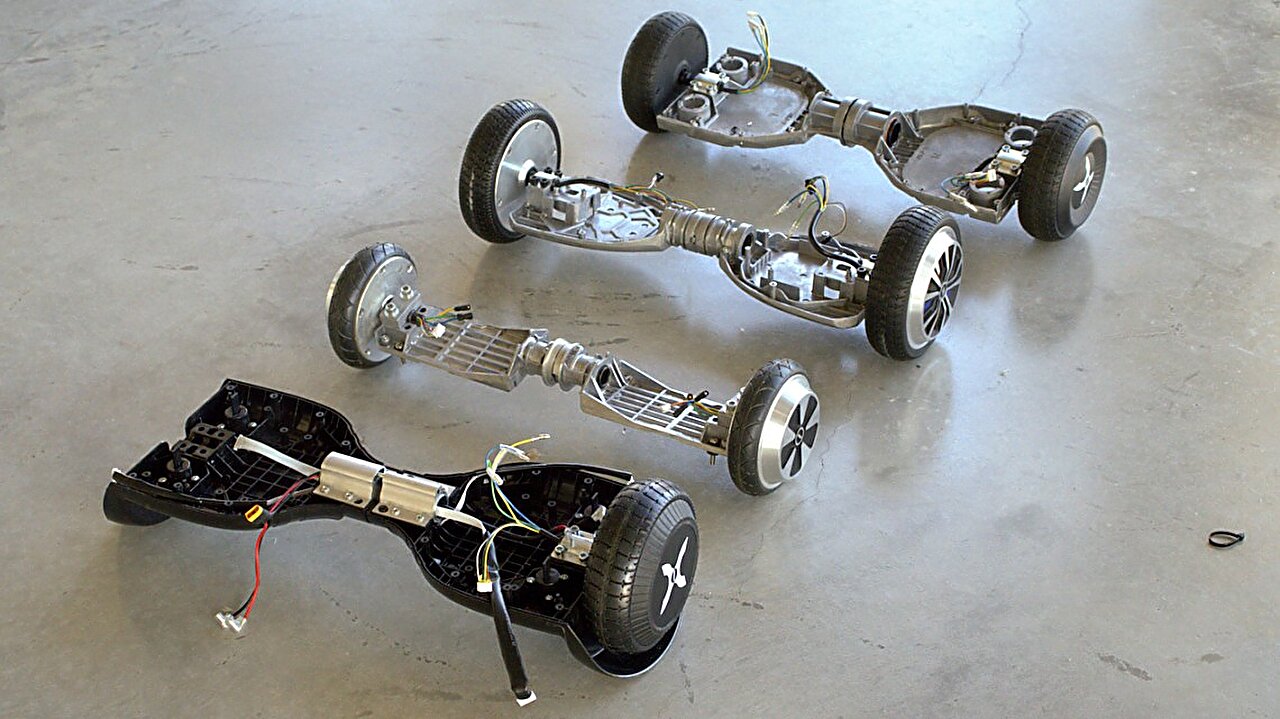
To Ilan Mandel, a Cornell robotics researcher and builder, the math didn’t add up. How could a new, off-the-shelf hoverboard cost less than the parts that compose it?
“This becomes an ambient frustration as a designer—the incredible cheapness of products that exist in the world, and the incredible expenses for prototyping or building anything from scratch,” said Mandel, a doctoral student in the field of information science, based at Cornell Tech.
While sourcing wheels and motors from old hoverboards to build what would become a fleet of trash robots in New York City, Mandel inadvertently uncovered the subject of his newest research, “Recapturing Product as Material Supply: Hoverboards as Garbatrage,” which received an honorable mention at the Association for Computing Machinery conference on Designing Interactive Systems in July.
Wendy Ju, associate professor at the Jacobs Technion-Cornell Institute at Cornell Tech and the Technion, and a member of the Department of Information Science in the Cornell Ann S. Bowers College of Computing and Information Science, co-authored the paper.
“For the large part, we design and manufacture as if we have an infinite supply of perfectly uniform materials and components,” Ju said. “That’s a terrible assumption.”
Building on work in human-computer interaction that aims to incorporate sustainability and reuse into the field, the Cornell pair introduces “garbatrage,” a framework for prototype builders centered around repurposing underused devices.
Mandel and Ju use their repurposing of hoverboards—the hands-free, motorized scooters that rolled in and out of popularity around 2016—as a test case to highlight the economic factors that create opportunities for garbatrage. They also encourage designers to prioritize material reuse, create more circular economies and sustainable supply chains, and, in turn, minimize electronic waste, or e-waste.
The time is ripe for a practice like garbatrage, both for sustainability reasons and considering the global supply shortages and international trade issues of the last few years, the researchers said.
“I think that there’s a real need to appreciate the heterogeneity of hardware that we are surrounded by all the time and look at it as a resource,” Mandel said. “What is often deemed as garbage can be full of value and can be made useful if you are willing to do some bridge work.”
From old desktop computers, smartphones and printers to smart speakers, Internet of Things appliances, and e-vaping devices, most of today’s e-waste has workable components that can be repurposed and used in the prototypes that become tomorrow’s innovations, researchers said.
Instead, these devices—along with their batteries, microcontrollers, accelerometers, motors and LCD displays—become part of the estimated 53 million metric tons of e-waste produced globally each year. Nearly 20% of it is properly recycled, but it’s unclear where the other 80% goes, according to a report from the UN’s Global E-waste Monitor 2020. Some ends up in developing countries, where people burn electronics in open-air pits to salvage any valuable metals, poisoning lands and putting public health at risk.
“Designers are a kind of node of interaction between massive scales of industrialization and end users,” Mandel said. “I think that designers can take that role seriously and use it to leverage e-waste in a way that promotes sustainability, beyond just asking the consumer to reflect more on their own practices.”
More information:
Ilan Mandel et al, Recapturing Product as Material Supply: Hoverboards as Garbatrage, Proceedings of the 2023 ACM Designing Interactive Systems Conference (2023). DOI: 10.1145/3563657.3596128
Cornell University
Read the full article here


