


A Dartmouth Engineering-led study published in Joule has reported the discovery of an entirely new high-performance material for solar absorbers—the central part of a solar cell that turns light into electricity—that is stable and Earth-abundant. The researchers used a unique high-throughput computational screening method to accelerate the discovery process and were able to quickly evaluate approximately 40,000 known candidate materials.
“This is the first example in the field of photovoltaics where a new material has been found through this type of approach with an experimental follow-up,” said Geoffroy Hautier, Dartmouth’s Hodgson Family Associate Professor of Engineering. “Most people study one or two materials at a time, and we looked at 40,000.”
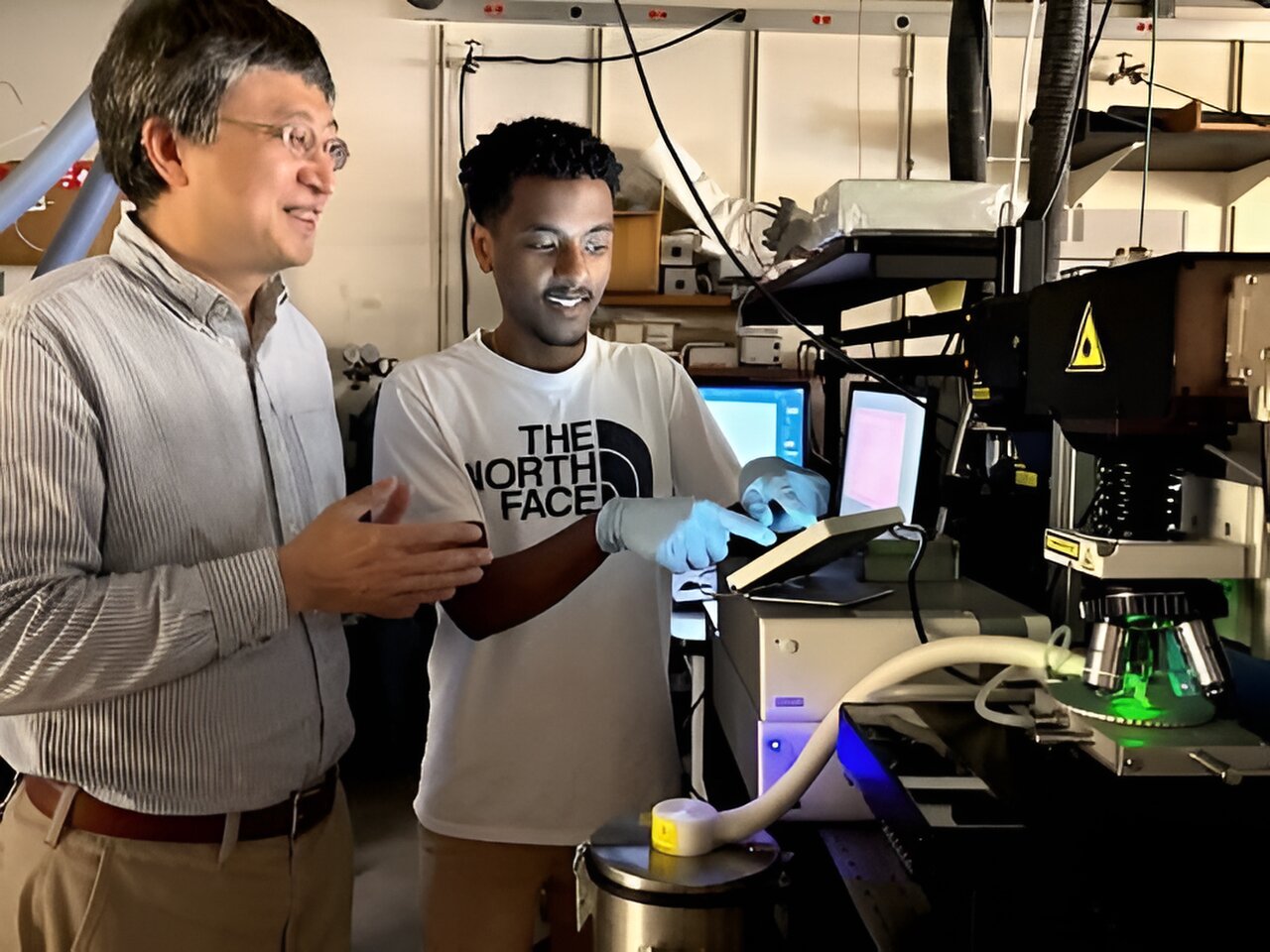
Dartmouth researcher Zhenkun Yuan is first author on the study with co-authors including research associate Yihuang Xiong, engineering Ph.D. candidates Gideon Kassa and Andrew Pike, and engineering professors Hautier and Jifeng Liu—as well as researchers from eight other partner institutions.
The solar absorber material was confirmed in the lab to be not only promising in its ability to efficiently transform light into electricity, but also highly stable in both air and water.
“You can put it out for six months and it will stay the same,” Hautier said. “When you don’t have to worry about moisture and air contamination, that significantly reduces your costs.”
The study points out that normally, finding new solar materials is tedious and slow with an overwhelming number of options to even begin to consider.
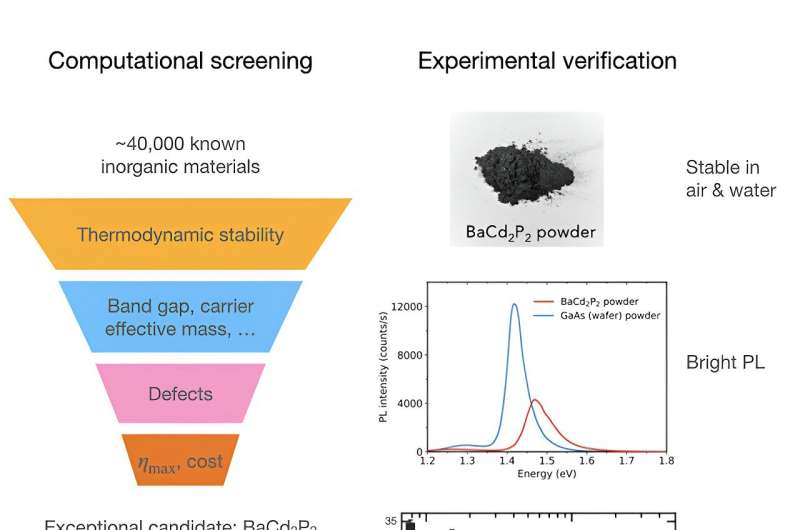
“We’ve been building a database of known materials—both naturally occurring and man-made—for a long time,” Hautier explained. “That’s giving us the capability to rapidly screen and make decisions on what may or may not be useful. We weren’t able to screen for stability, but we could narrow it down to approximately 20 reasonable solar materials—among the thousands and thousands of possibilities—and after talking with our colleagues, we had a feeling this one would be stable.”
The team plans to continue to improve the tools for even better screening, as well as explore the entire family of materials they call “Zintls,” which could lead to enhancements and optimizations of the discovered material.
“There are a lot of opportunities around further characterizing this material and understanding it better, such as how it absorbs light and how to make it as a thin film,” said Liu, who conducts and oversees materials testing in his lab. “Collaboration is crucial. It takes a whole community of thinkers and many different skills to make it all work—computing, experimentation, fabrication, characterization, optimization—and you need to put all that together in a team.”
“We won’t have it as a solar panel tomorrow,” Hautier said, “but we think this family of materials is exceptional and worth looking at.”
More information:
Zhenkun Yuan et al, Discovery of the Zintl-phosphide BaCd2P2 as a long carrier lifetime and stable solar absorber, Joule (2024). DOI: 10.1016/j.joule.2024.02.017
Dartmouth College
Read the full article here


