


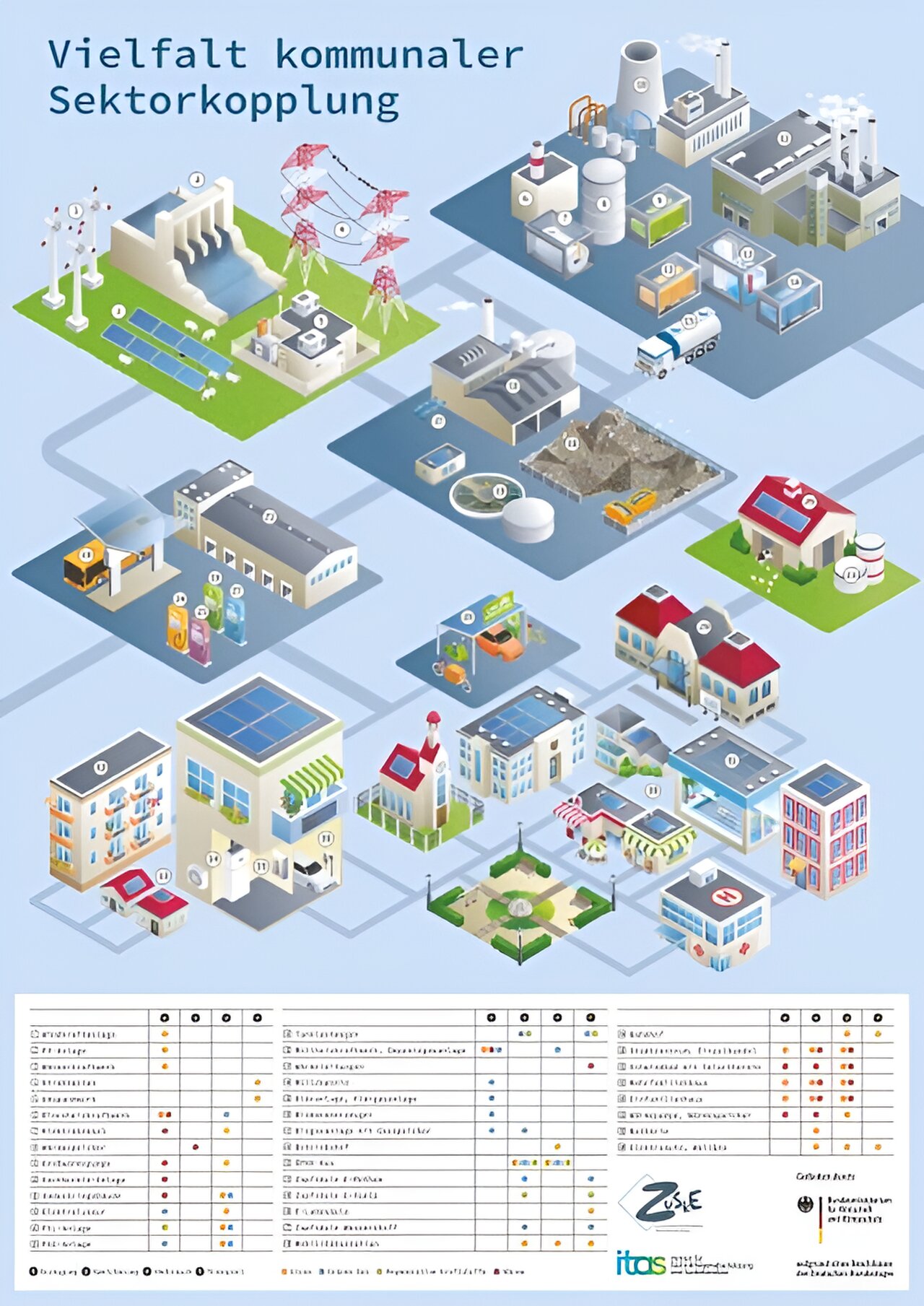
Municipalities as the smallest administrative units play a major role in the implementation of the energy transition. They can support citizens in better using the heat from waste water or they can make the equipment of new buildings with photovoltaic facilities mandatory in order to increase the use of renewable energy sources.
Technology assessment experts of Karlsruhe Institute of Technology (KIT) launched the ZuSkE project to find ways of planning and implementing coupling of the power, heat and transport sectors. They cooperated closely with the municipalities of Berlin, Freilassing, and Walldorf. The project team compiled a catalog of 100 tested measures to provide orientation and developed tools to support municipalities. The study is published in the journal Energy Research & Social Science.
“The energy transition is made by humans who live and work in cities and municipalities. It is therefore logical to make the energy transition start on the local level,” says Dr. Dirk Scheer. He conducts research at KIT’s Institute of Technology Assessment and Systems Analysis (ITAS) and coordinated the project “ZuSkE: Die Zukunft der Sektorkopplung auf kommunaler Ebene” (ZuSkE: Future Sector Coupling on the Municipal Level).
“As we are going to replace fossil energy sources by electricity, we can no longer treat the different sectors separately,” Scheer adds. The project was aimed at developing approaches as to how municipalities can couple the transport, heat and electricity sectors such that rapid and efficient decarbonization can be achieved.
Municipalities are energy suppliers and regulatory authorities, and they can bring the parties involved together
To this end, the researchers cooperated with representatives of politics, utility companies, administration, industry and citizens from Berlin, Freilassing, and Walldorf. The result: Municipalities have a number of options to push sector coupling. “Utilities can increasingly use geothermal sources, expand district heating systems, or install power-to-gas systems to use excessive power from wind or solar facilities for heat supply,” says Ines Jendritzki, ITAS, member of the ZuSkE project team.
As municipalities own and run big properties, they can set a good example and use solar power systems in their buildings and connect them to charging stations for their electric vehicle fleets. Municipal councils can adopt the corresponding legal framework conditions and push the procurement of cargo bikes or develop a municipal heating plan. “Not least, cities and municipalities can make the relevant partners meet as a basis for change,” Jendritzki says.
Catalog of 100 tested measures for orientation
According to the researchers, it is of crucial importance that every municipality develops packages of coordinated measures that are tailored to local conditions. To facilitate this, they compiled information material to help municipalities embark on sector coupling.
The published catalog lists 100 already tested sector coupling measures. It is intended to provide orientation and to help the municipalities develop own transformation strategies. The researchers conceived a strategy box, a didactic tool for representatives of municipalities to design energy transition strategies. A “10 points plan” has been set up to illustrate the central steps of municipal sector coupling, from the first status analysis to the development of a transformation pathway to an adequate communication strategy.
More information:
Lisa Schmieder et al, Municipalities as change agents? Reconsidering roles and policies in local energy sector-coupling, Energy Research & Social Science (2023). DOI: 10.1016/j.erss.2023.103210
Karlsruhe Institute of Technology
Read the full article here


