


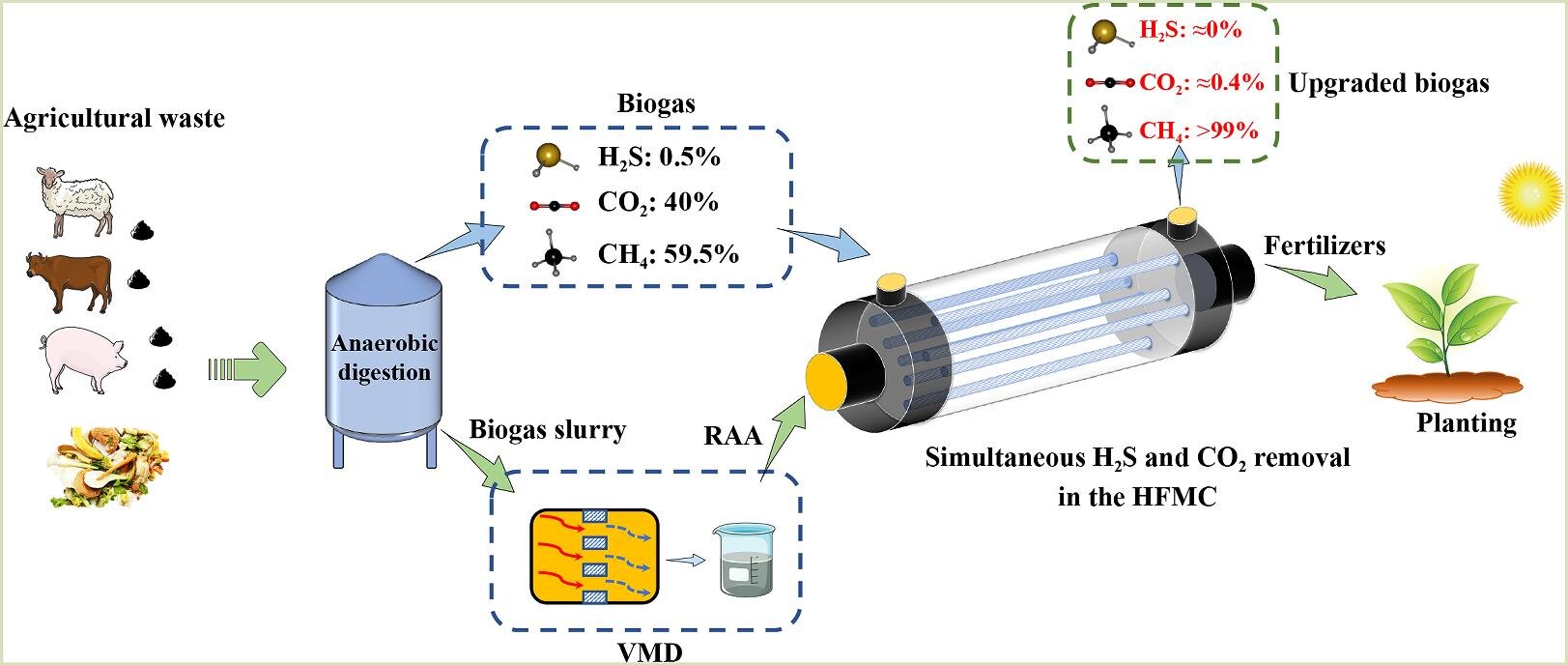
Biogas is usually produced by anaerobic digestion of organic waste such as animal manures and straw offcuts. This is a typical source of green renewable energy and can be used as a fuel for power generation and heat production.
China has owned large scale of biogas production, with an annual output of about 15 billion m3 biogas, and biogas development and utilization provide a new option for coping with the energy crisis. Factually, biogas contains about 60% CH4 and about 40% CO2, and other trace impurities such as H2S and H2O.
The presence of CO2 in biogas greatly reduces combustion performance, and H2S in biogas also causes a corrosion for pipelines and equipment. Hence, these impurities must be removed to increase the share of methane in the product, in which this gas removal process is also known as biogas upgrading.
The emergence of biogas upgrading technology can not only increase the economic income on biogas plants, but also reduce greenhouse gas emissions. In theory, since biogas has long been considered a typical carbon-neutral fuel, capturing, utilizing and storing CO2 from biogas is expected to achieve negative carbon emissions.
At present, many mature biogas upgrading technologies include pressurized water scrubbing, pressure-swing adsorption, chemical absorption, membrane separation and cryogenic technology. Among them, water scrubbing and pressure-swing adsorption can simultaneously remove CO2 and H2S from biogas, while they have the extreme disadvantage of high CH4 loss (between 2% and 20%).
It is well known that the greenhouse effect of CH4 is about 21 times that of CO2. Therefore, many researchers have focused on the chemical absorption method, which presents negligible loss of CH4 and a high reaction rate. Coincidentally, because the chemical reaction between the absorbent and the acid gas can form a stable salt, the chemical absorption process has addressed the problems of high system energy consumption and CO2 absorbent loss.
In order to solve the problems of the above chemical absorption method, Prof. Shuiping Yan and his team propose a renewable ammonia aqueous absorbent from biogas slurry (a byproduct of anaerobic digestion) combining with the principle of green energy engineering. CO2-rich renewable ammonia aqueous absorbent can be used as an ammonium nitrogen fertilizer to directly apply into farmland, thus avoiding the problems on traditional chemical absorbents.
Their study is published in the journal Frontiers of Agricultural Science and Engineering.
The team members achieved efficiently simultaneous removal of CO2 and H2S from biogas by using renewable ammonia aqueous solvent in a gas-liquid membrane contactor.
Compared with the typical physical absorption (H2S removal efficiency: 48%), the 0.1 mol·L−1 NH3 renewable ammonia aqueous solvent could remove 97% H2S from biogas, and the removal efficiency of H2S is less affected by impurities in this absorbent.
When the renewable ammonia aqueous solution was adjusted to 0.5 mol·L−1 NH3, the biogas could be purified to the pipeline for biomethane.
Moreover, the optimum operating conditions for the simultaneous removal of CO2 and H2S in the hollow fiber membrane contactor were determined through exploring the influence of various operating parameters such as temperature and gas-liquid flow rate during the membrane absorption process, which provided a specific theoretical basis and technical support for the green development of biogas upgrading process.
More information:
Valorization of biogas through simultaneous CO2 and H2S removal by renewable aqueous ammonia solution in membrane contactor, Frontiers of Agricultural Science and Engineering (2022). DOI: 10.15302/J-FASE-2022473
Provided by
Higher Education Press
Read the full article here


