


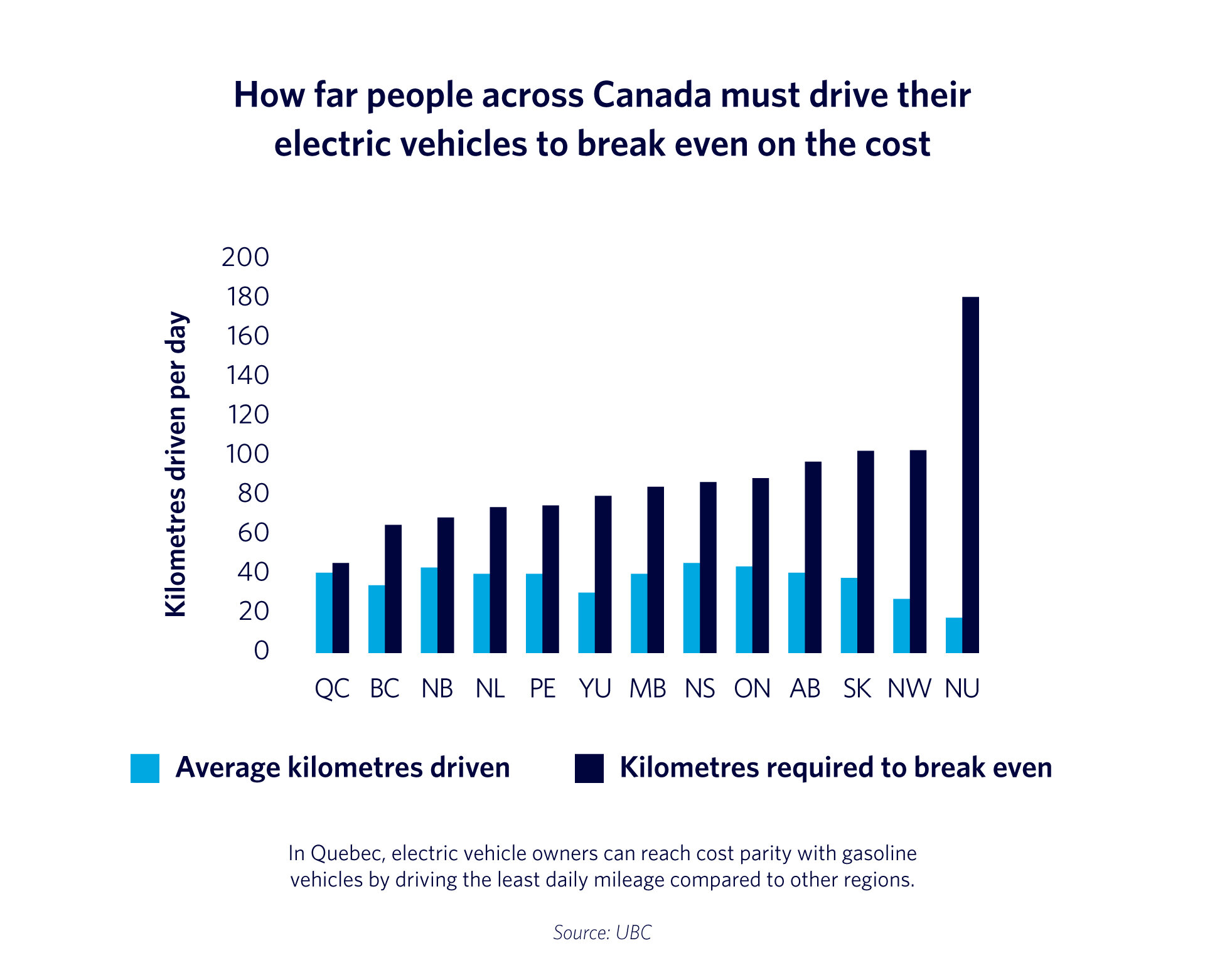
Electric vehicles are a critical part of Canada’s climate strategy, but a new UBC study highlights how it’s cheaper in some regions than others to drive electric—making it more challenging for certain households to make the switch.
Location, location, location
The researchers analyzed how far people need to drive their electric car to break even on the cost, factoring in the impacts of tax rebates and tax rates, charging costs, typical distance households travel in a region, and electricity costs—all of which vary from region to region.
They found Quebec had the biggest advantage, followed by B.C. and Manitoba, while Nunavut came up last.
“In Quebec, an electric car owner must travel at least 46 kilometers per day to come out ahead in comparison with owning a traditional car. In Nunavut, this number rises to 180 kilometers,” says study author Bassam Javed, a Ph.D. candidate at the Institute for Resources, Environment and Sustainability (IRES).
Small is beautiful
These results suggest that if you’re looking to make the switch to electric, choosing a smaller, basic EV can realize more savings than a luxury electric car, says study author Dr. Amanda Giang, a professor in the Department of Mechanical Engineering at IRES.
As the cost of switching to EVs will be higher in some places and for some households, targeted interventions will be needed to address the affordability gap. Dr. Giang added, “Canada needs to take many paths towards clean and affordable transportation for all, which means not only supporting transitions to EVs, but also public transit and active transport.”
The study is published in the journal Environmental Research: Infrastructure and Sustainability.
More information:
Bassam Javed et al, Variability in costs of electrifying passenger cars in Canada, Environmental Research: Infrastructure and Sustainability (2024). DOI: 10.1088/2634-4505/ad253e
University of British Columbia
Read the full article here


