


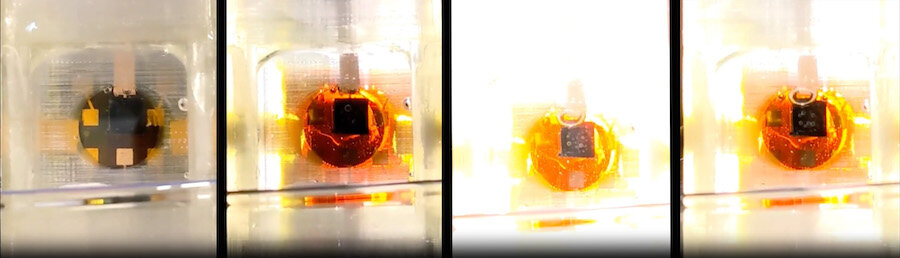
Rice University engineers can turn sunlight into hydrogen with record-breaking efficiency thanks to a device that combines next-generation halide perovskite semiconductors with electrocatalysts in a single, durable, cost-effective and scalable device.
The new technology is a significant step forward for clean energy and could serve as a platform for a wide range of chemical reactions that use solar-harvested electricity to convert feedstocks into fuels.
The lab of chemical and biomolecular engineer Aditya Mohite built the integrated photoreactor using an anticorrosion barrier that insulates the semiconductor from water without impeding the transfer of electrons. According to a study published in Nature Communications, the device achieved a 20.8% solar-to-hydrogen conversion efficiency.
“Using sunlight as an energy source to manufacture chemicals is one of the largest hurdles to a clean energy economy,” said Austin Fehr, a chemical and biomolecular engineering doctoral student and one of the study’s lead authors. “Our goal is to build economically feasible platforms that can generate solar-derived fuels. Here, we designed a system that absorbs light and completes electrochemical water-splitting chemistry on its surface.”
The device is known as a photoelectrochemical cell because the absorption of light, its conversion into electricity and the use of the electricity to power a chemical reaction all occur in the same device. Until now, using photoelectrochemical technology to produce green hydrogen was hampered by low efficiencies and the high cost of semiconductors.
“All devices of this type produce green hydrogen using only sunlight and water, but ours is exceptional because it has record-breaking efficiency and it uses a semiconductor that is very cheap,” Fehr said.
The Mohite lab and its collaborators created the device by turning their highly-competitive solar cell into a reactor that could use harvested energy to split water into oxygen and hydrogen. The challenge they had to overcome was that halide perovskites are extremely unstable in water and coatings used to insulate the semiconductors ended up either disrupting their function or damaging them.
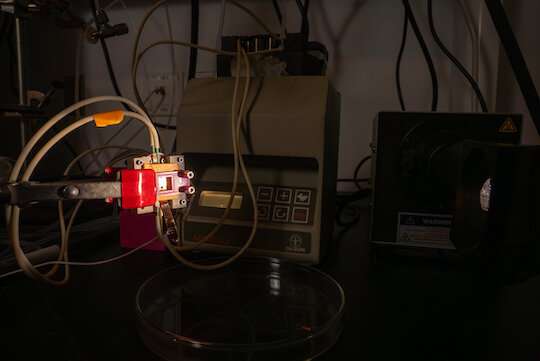
“Over the last two years, we’ve gone back and forth trying different materials and techniques,” said Michael Wong, a Rice chemical engineer and co-author on the study.
After lengthy trials failed to yield the desired result, the researchers finally came across a winning solution.
“Our key insight was that you needed two layers to the barrier, one to block the water and one to make good electrical contact between the perovskite layers and the protective layer,” Fehr said. “Our results are the highest efficiency for photoelectrochemical cells without solar concentration, and the best overall for those using halide perovskite semiconductors.
“It is a first for a field that has historically been dominated by prohibitively expensive semiconductors, and may represent a pathway to commercial feasibility for this type of device for the first time ever,” Fehr said.
The researchers showed their barrier design worked for different reactions and with different semiconductors, making it applicable across many systems.
“We hope that such systems will serve as a platform for driving a wide range of electrons to fuel-forming reactions using abundant feedstocks with only sunlight as the energy input,” Mohite said.
“With further improvements to stability and scale, this technology could open up the hydrogen economy and change the way humans make things from fossil fuel to solar fuel,” Fehr added.
More information:
Austin M. K. Fehr et al, Integrated halide perovskite photoelectrochemical cells with solar-driven water-splitting efficiency of 20.8%, Nature Communications (2023). DOI: 10.1038/s41467-023-39290-y
Rice University
Read the full article here


