


Hydrogen gas is the smallest and lightest of all known molecules, and its colorless and odorless nature makes it easy to leak. Also, when concentrated above 4% in a confined space, it poses a risk of ignition or explosion.
In order for hydrogen to become a major player in the future energy industry, it is essential to ensure safety via ultra-sensitive gas detection technology across all elements of gas-dealing processes, such as gas production, storage, and transportation. However, conventional gas-leakage sensors using electric signals are prone to yield electrical sparks, which can cause an explosion of leaked hydrogen gas.
In addition, the mainstream electrode-based contact sensors affect the effective signal stability depending on the device’s contact state showing weak signal fidelity. Thus, it is desirable for achieving stable, non-explosive via non-contact mode detection to remove any possible dangers to develop a secure device that does not lead to disaster situations.
A Korea Institute of Science and Technology (KIST) team, led by Dr. Minah Seo of the Sensor Systems Research Center & KU-KIST Graduate School and Prof. Yong-Sang Ryu of School of Biomedical Engineering, College of Health Sciences, Korea University, has developed a non-contact terahertz light sensor. This can detect hydrogen gas leaks as small as 0.25% in real-world environments at room temperature and pressure, which is the global top level of limit-of-detection performance via optical detection methods.
The work has been published in the journal Advanced Materials.
Spectroscopy is a non-contact observation method of measuring changes in the value of optical constants of an analytic sample. In this method, changes in the reacting substance are observed non-invasively, by measuring variations in the optical properties when the reacting substance encounters hydrogen gas.
Terahertz electromagnetic waves have a very wide frequency band, which makes them sensitive to the natural vibrations of gas molecules, and can be utilized in spectroscopy to resolve minute unique information and differences in molecules such as various gases, DNA, and amino acids. However, due to the low probability of interaction with trace amounts of hydrogen gas and the lack of technology to amplify the signal of terahertz waves, it has been difficult to utilize them in practice.
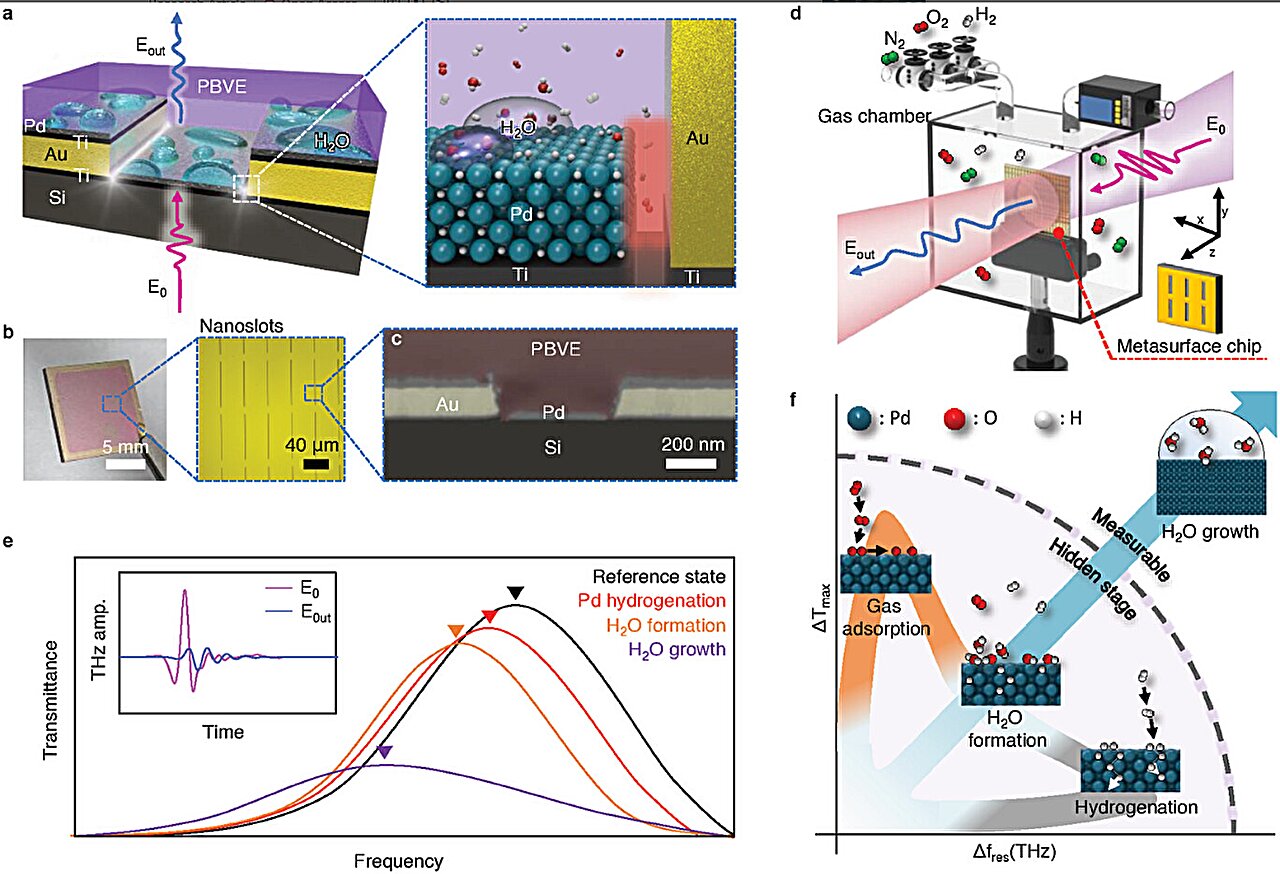
The research team focused on the property of hydrogen permeating into palladium metal, and devised a research strategy to address this through the interaction of light and matter. The researchers developed a gas-detection sensing platform that can sensitively measure changes in terahertz optical signals caused by trace amounts of gas, using metamaterials that have the ability to amplify signals in specific bands of electromagnetic waves.
More information:
Jinwoo Lee et al, Advancements of Intense Terahertz Field Focusing on Metallic Nanoarchitectures for Monitoring Hidden Interatomic Gas‐Matter Interactions, Advanced Materials (2023). DOI: 10.1002/adma.202308975
National Research Council of Science and Technology
Read the full article here


