


A research team, led by Dr. Hosun Shin from the Interdisciplinary Materials Measurement Institute at the Korea Research Institute of Standards and Science and Professor Jae Yong Song’s team from the Department of Semiconductor Engineering at Pohang University of Science and Technology has developed a long-life organic electrode that has potential to expedite the commercialization of next-generation secondary batteries.
Electrodes in lithium-ion secondary batteries, commonly used in electric vehicles and other applications, predominantly comprise inorganic materials such as nickel, cobalt, manganese, and aluminum. These mineral resources have limited reserves, and their supply can become unstable depending on the international geopolitical situation.
Organic-based electrodes are considered a key technology for next-generation secondary batteries, capable of addressing the aforementioned drawbacks. Organic materials can be synthesized in large quantities, offering excellent cost competitiveness compared to inorganic materials, which require the mining of finite resources. Additionally, they have the advantage of being lightweight and flexible in relation to their capacity.
However, organic electrodes easily dissolve in the electrolyte solution within the battery when ionized during charging and discharging, leading to the rapid degradation of the battery’s lifespan. To address this issue, a solution involving the chemical optimization of the structure of organic molecules was proposed. Its complicated process and low yield, however, render it impractical as an alternative.
The long-life organic electrode developed by the KRISS-POSTECH joint research team has significantly enhanced the lifespan of batteries using nano-composite materials. Its key advantage lies in the production method; being produced by physical mixing makes it more practical for commercialization than previously proposed chemical approaches.
The key to this technology is the fabrication of the nanocomposite material. Among the candidate materials for the organic electrodes, the research team chose DMPZ, a material with high energy density, and PTCDA, a material with excellent electrochemical stability. The research team carried out an experiment with this composite made by cryo-milling, and the results showed that the mutual charge transfer of the two materials helped maintain an electrically neutral state.
Approximately 90% of the initial capacity was retained after 650 cycles of charge and discharge, and outstanding performance was observed even during high-speed charging and discharging. On the other hand, the DMPZ-only electrode exhibited a 20% decrease in lifespan within the first five charge and discharge cycles.
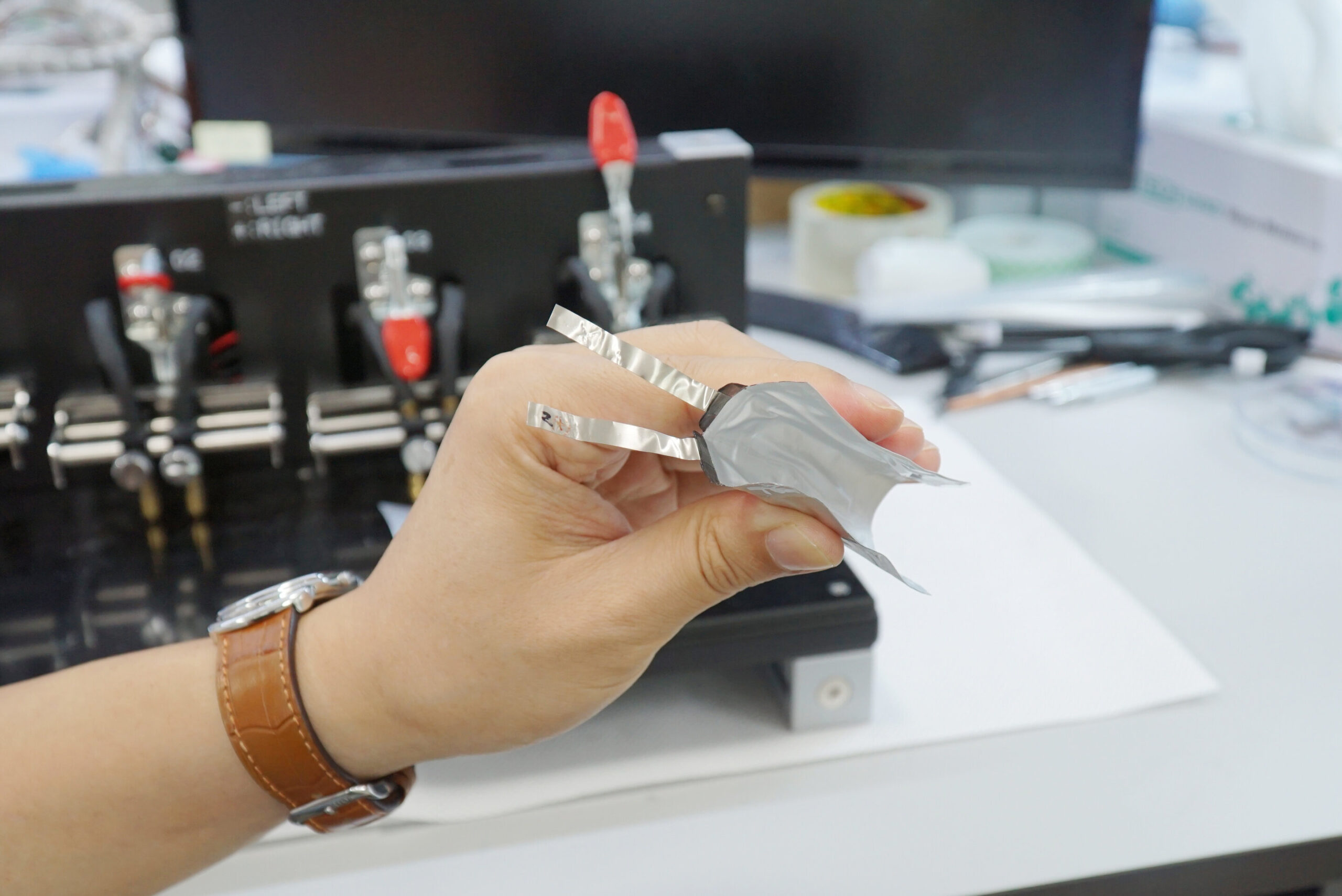
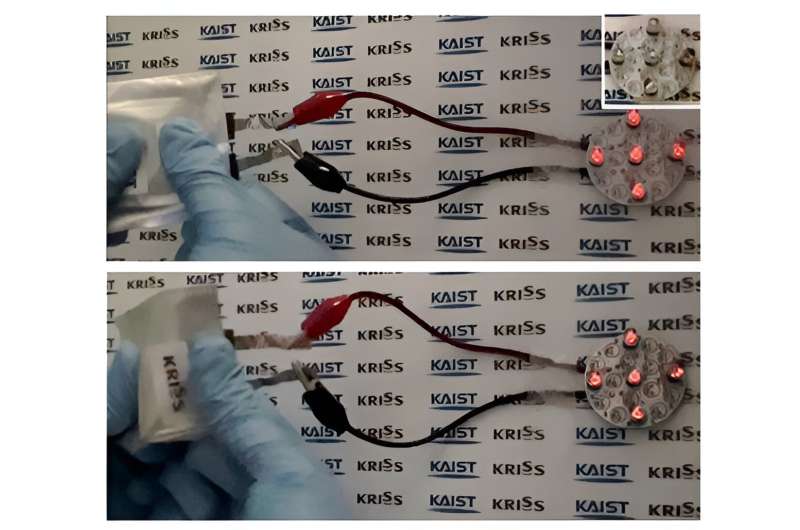
Furthermore, the research team has successfully developed a pouch-type battery using the long-life organic electrode, demonstrating the potential contribution of their work to the commercialization of flexible lithium secondary batteries.
In addition to its application to secondary batteries, this new achievement can contribute to various fields, for example, water electrolysis and gas sensors, by enhancing the electrochemical stability and lifespan of organic-based electrodes.
Dr. Hosun Shin, the leader of the KRISS Smart Devices Team, stated, “For a successful transition to green energy, it is crucial to drive innovation in materials to surpass the limitations of existing secondary batteries. We anticipate that our work will expedite the commercialization of next-generation secondary batteries and encourage future research on organic electrodes across various fields.”
The study is published in the journal Energy Storage Materials.
More information:
Jihye Park et al, Spontaneous electrochemical stabilization of nanostructured organic electrodes by field-induced charge-transfer, Energy Storage Materials (2023). DOI: 10.1016/j.ensm.2023.102896
National Research Council of Science and Technology
Read the full article here


