


The field of solar cells has witnessed exponential development over the past decades. Evaluating the performance of solar cells has been simple because all devices can be compared given a single metric, the efficiency, which is measured under standardized conditions.
Photovoltaic cells can also be applied to convert the thermal radiation emitted by any hot source into electricity, for example, to recover the waste heat dissipated by industrial processes. In that case, they are referred to as thermophotovoltaic (TPV) cells.
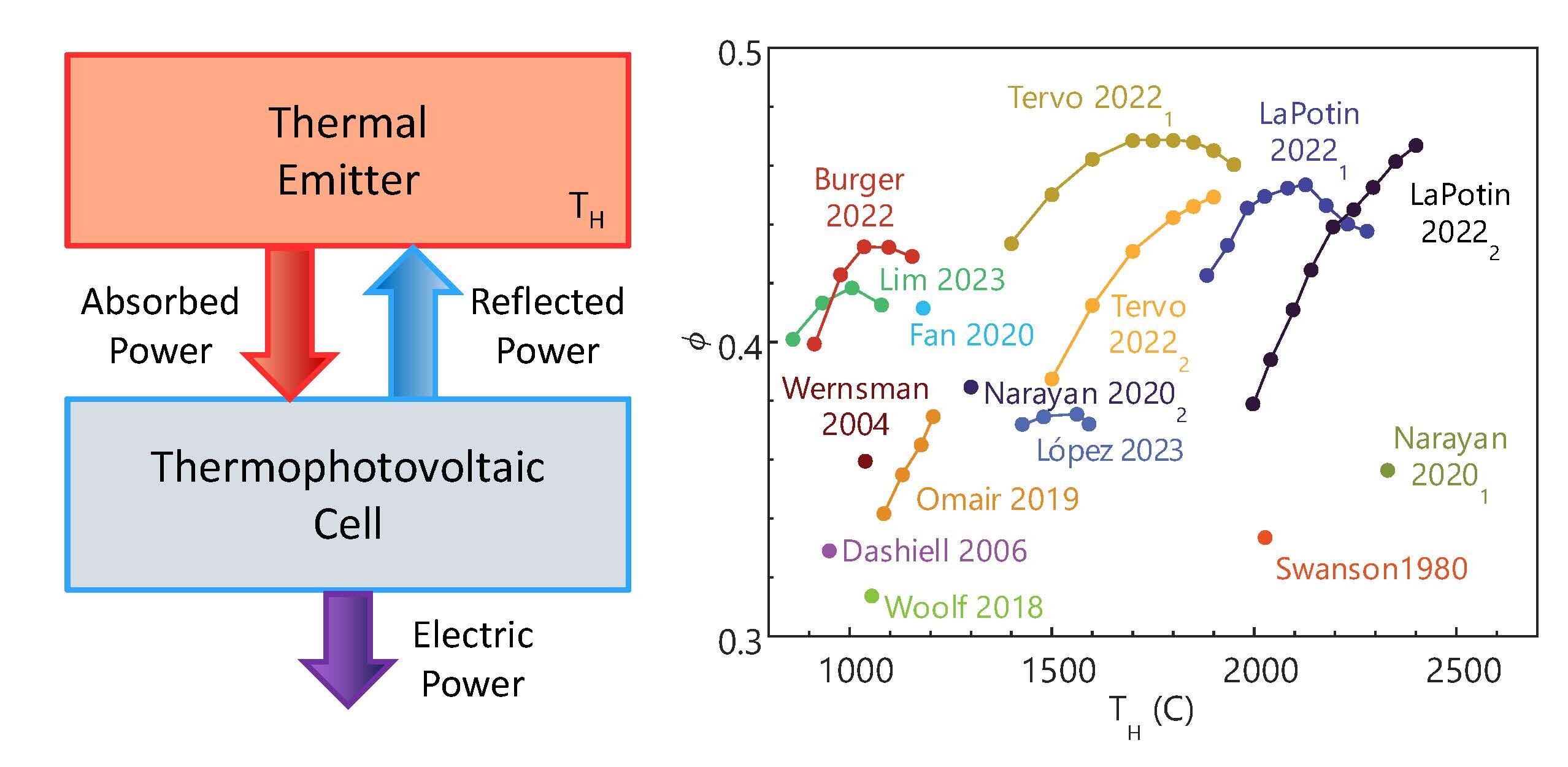
Unlike solar cells, TPV devices are assessed along two independent metrics: power density and efficiency. The power density describes how much electricity a TPV cell generates per unit area, while the efficiency is the ratio between the electric power output and the absorbed heat flux. Assessing the performance of TPV devices requires accounting for both these metrics at the same time.
The comparison of TPV devices is further complexified by the absence of standardized operating conditions, such as the source temperature. As a result, experimental results have been generally compared only along one metric at a time and without regard for their specific operation conditions.
In a recent work published in Journal of Photonics for Energy, Maxime Giteau, Michela F. Picardi, and Georgia T. Papadakis from ICFO (Spain) propose a universal figure of merit (FOM) to assess the performance of TPV devices.
The introduced FOM, based on thermodynamics considerations, alleviates the temperature dependence and accounts for the fundamental trade-off between power density and efficiency in TPV devices. The work offers a comprehensive metric for evaluating TPV performance and enables the classification of previously reported experimental results.
This classification offers a clear picture of a TPV device’s overall performance, helping researchers and engineers see which devices are top-notch and which ones might need improvement—a bit like giving grades to different TPV devices based on how well they balance power density and efficiency.
Giteau remarks, “As the TPV field continues to grow with significant performance advancements, this figure-of-merit can serve as a metric to track progress, especially as devices get closer to operating at their thermodynamic limits.”
More information:
Maxime Giteau et al, Thermodynamic figure of merit for thermophotovoltaics, Journal of Photonics for Energy (2024). DOI: 10.1117/1.JPE.14.042402
Read the full article here


