


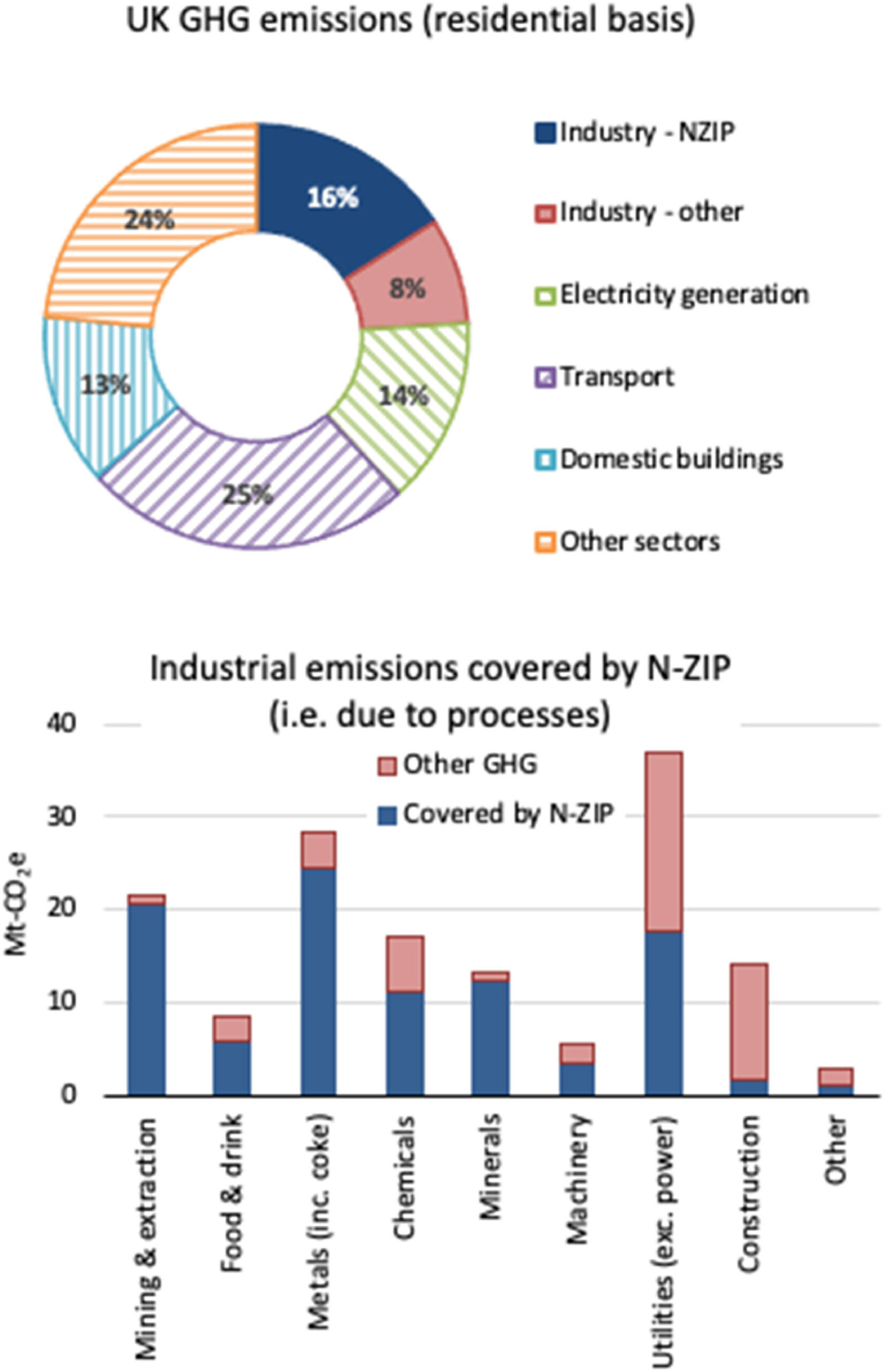
Decarbonizing U.K. industrial processes to reach Net Zero goals could be achieved with price increases of just 0.8%, academics from the University of Bath’s Institute for Sustainability have found.
Using the U.K. as a case study, the researchers from Bath and the University of Leeds investigated illustrative scenarios for distributing the costs of decarbonizing industry.
They took projections of the costs of implementing suitable low-carbon technologies that cover all U.K. industrial processes from analysis of a model produced for the U.K.’s Climate Change Committee. This included technology options such as electrification, fuel switching to hydrogen, and carbon capture and storage (CCS). They then assessed the effect of distributing these costs in three ways: the respective industrial sectors absorbing them, consumers paying for them through higher prices, or companies that profit from the supply chain enabled by these activities sharing their costs.
There is a pressing need to decarbonize industry to help reach Net Zero as it produces one third of global greenhouse emissions.
Dr. Sam Cooper, a lecturer in Bath’s Department of Mechanical Engineering and one of the authors of the study, says, “Many industrial sectors—manufacturing, construction, food and drink, and mining—could absorb these costs with a relatively modest impact on their profits (or gross operating surplus) of 2% to 7% by 2050.
“Others, including metal production, cement and minerals and waste treatment might find this option more challenging, but even in these cases the effect on profits would be less than the fluctuation they have experienced over the last decade—the equivalent cost would be 15% to 46% of profits.
“On the other hand, if each sector can pass on any cost increases to their customers, the average final price increases would be less than 0.8% by 2050.”
Prices rises could be shared evenly
The study also considered how people in different income groups and with different spending patterns would face price increases, finding that rises would be shared evenly. Underlying this is the finding that the price of some product groups would increase more than others—for example housing would go up less than 0.5%, but household goods would rise by more than 3%.
For many products, the effect of price increases on international competitiveness is likely to be lost in the noise of other effects.
However, especially for bulk materials (e.g., metals, cement, ceramics, plastics and bulk chemicals) protection from competitors that do not face decarbonization costs might be necessary, for example, through a border carbon adjustment like the EU’s new CBAM scheme.
Potential improvements tied to investment cycles
Dr. Steve Allen, senior lecturer in Bath’s Department of Architecture and Civil Engineering, Associate Director of the Institute for Sustainability and one of the authors of the study, pointed out that “a key to achieving these relatively low costs is taking the opportunity to improve the energy- and resource-efficiency of processes when the low-carbon technologies are adopted. The potential for these improvements is typically tied to investment cycles and so it is important that any opportunities here are not missed.”
The analysis used novel adaptations from an economic approach called ‘input-output analysis’, this applies to sectoral averages and so individual companies may find the transition harder or easier. The study considers the costs of decarbonizing the industrial processes themselves, and excludes other costs that industry might face, such as changes to transport or electricity costs. However, it provides a first assessment that these costs are manageable at a societal level.
The study, “Meeting the costs of decarbonizing industry—The potential effects on prices and competitiveness (a case study of the UK),” is published in the journal Energy Policy. Its findings could influence industrial decarbonization policies and the support they provide as the issue increasingly leads the policymaking agenda.
Dr. Cooper added, “This work adds to the evidence that decarbonizing industrial processes can be managed without prohibitive price increases for consumers. However, overcoming other challenges relating to infrastructure, technology supply chains and investment risks, will require coordinated support.”
More information:
Samuel J.G. Cooper et al, Meeting the costs of decarbonising industry—The potential effects on prices and competitiveness (a case study of the UK), Energy Policy (2023). DOI: 10.1016/j.enpol.2023.113904
University of Bath
Read the full article here


