


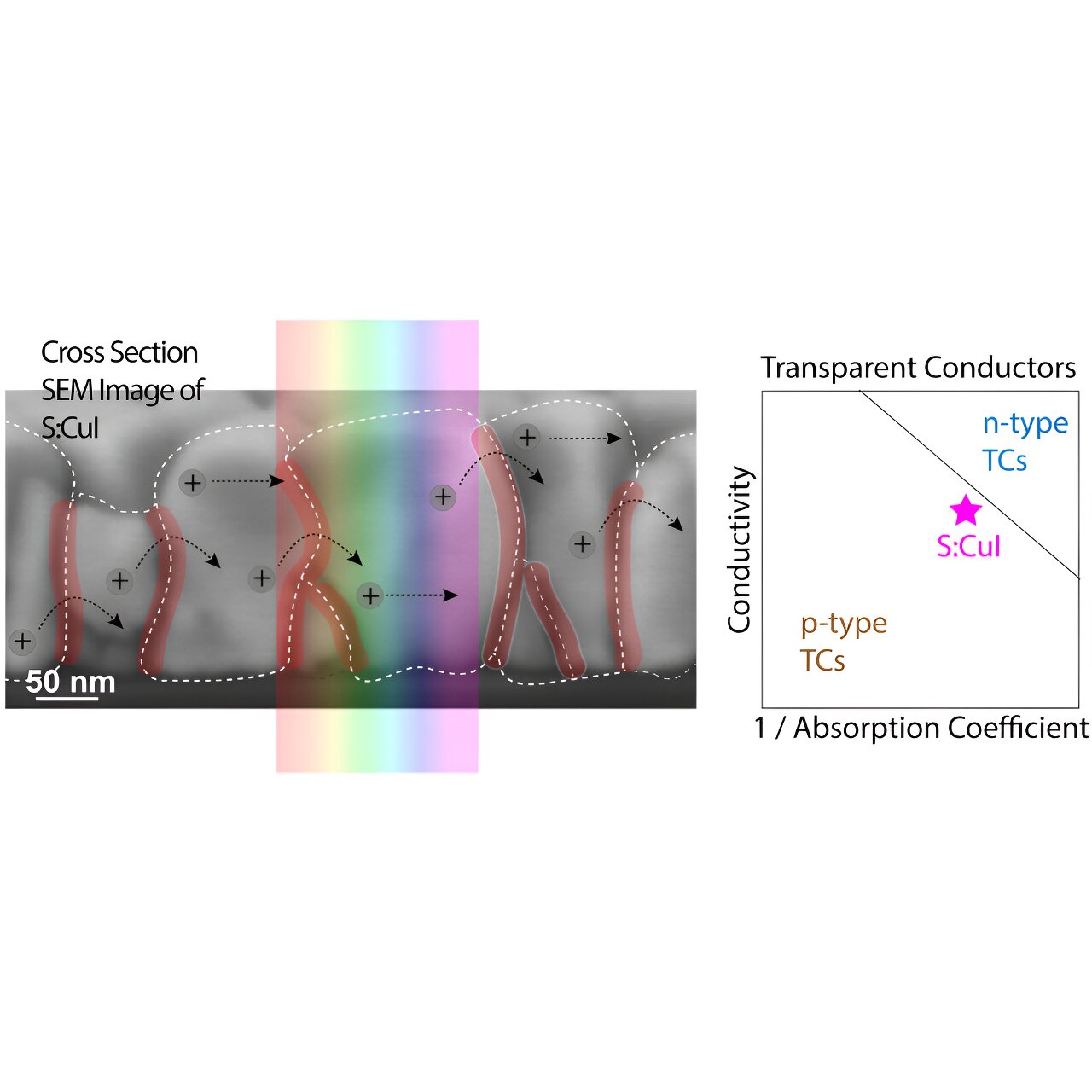
Transparent conductors are essential for many devices, such as touch screens and solar cells. Copper iodide (CuI) can conduct electricity while staying see-through but is not as good as some other materials. Researchers from the University of Twente managed to improve the conductivity of CuI while keeping 75% of its transparency. By adding a tiny bit of sulfur, their new material moves us one step closer to fully transparent electronic devices.
There are two types of transparent conductors: p-type and n-type. The combination of both types makes it possible to create fully transparent devices. This can include innovations like see-through smartphones and, windows with incorporated translucent solar panels thereby blending aesthetics and functionality. But, so far, the p-types are falling short in terms of conductivity when compared to their n-type counterparts.
That’s why researchers are looking for ways to improve the p-type’s conductivity. They want to make them as good at conducting electricity as the n-types. The material CuI is a well-known p-type transparent conductor.
Researchers from the University of Twente found out that adding a tiny bit of sulfur (3%) increased CuI’s conductivity by more than five times. The material significantly enhanced its ability to conduct electricity and lets almost all the light through. In fact, it’s so good that it lets over 75% of the visible light pass through it.
Sulfur functionality
Thin films of CuI with sulfur are made with a process called pulsed laser deposition. Sulfur induces ‘defects’ in the material. These defects—or more specifically, copper vacancies—act like a source of free holes and contribute to the electrical conductivity of the material. While studying the sulfur-doped CuI, the researchers found out dual functionality of sulfur.
First of all, sulfur acts as a catalyst in promoting copper vacancies. Secondly, the high distribution of sulfur in grain boundaries leads to mixed phases in the material. Both make the material even better at conducting electricity. This discovery brings us closer to new types of transparent electronic devices.
The research is published in the journal Matter.
More information:
Adeem Saeed Mirza et al, The role of sulfur in sulfur-doped copper(I) iodide p-type transparent conductors, Matter (2023). DOI: 10.1016/j.matt.2023.10.003
University of Twente
Read the full article here


