


Fuel cells are seen as a promising source of green energy, with the potential to revolutionize various industries including transportation and power generation. They produce electricity through a chemical reaction whose only byproducts are water and heat.
To date, most research in this area has focused on cells that use platinum as the catalyst driving that chemical reaction. However, there is a scarcity of the material, it’s costly, and it’s not particularly stable when used for this application. Coming up with a commercially viable product has proven challenging.
Now researchers from Western University have discovered that integrating other metals—palladium and cobalt—with platinum reduces the amount of platinum that is required to produce energy, and results in a more stable catalyst for fuel cells.
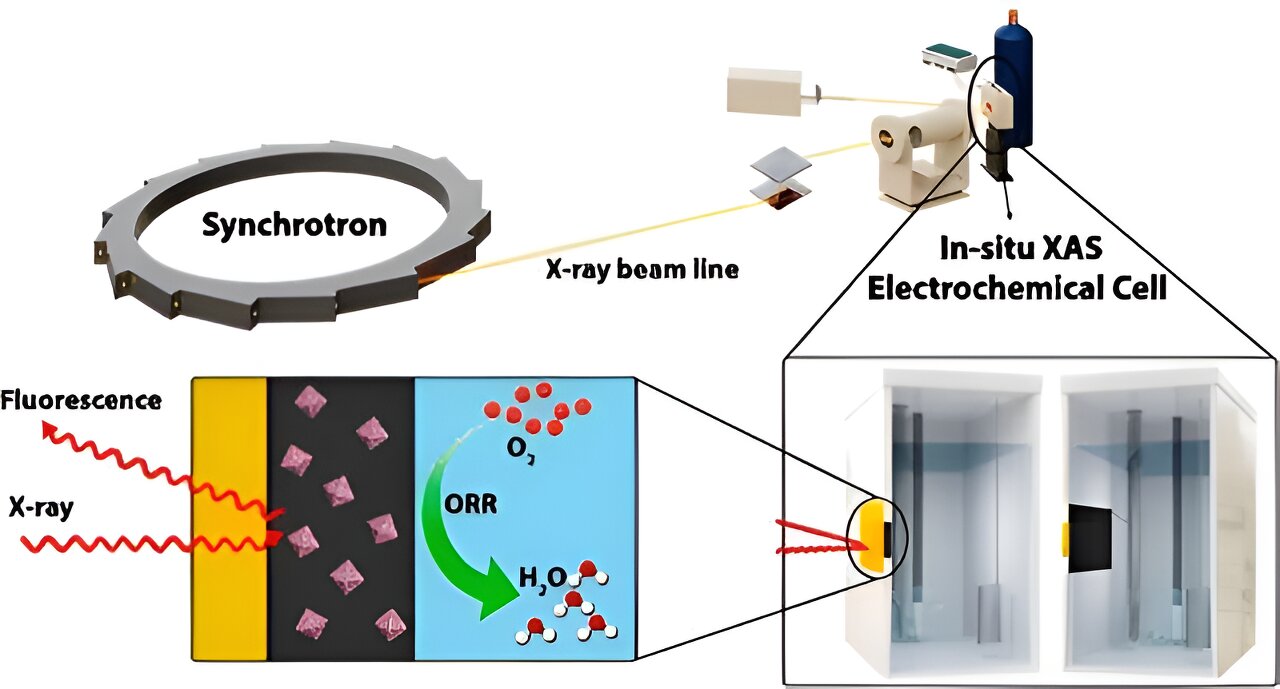
Their new study was published recently in the Journal of Physical Chemistry C. Tsun-Kong (T.K.) Sham, Xueliang (Andy) Sun, Ali Feizabadi and their collaborators at Western’s Department of Chemistry and Department of Mechanical & Materials Engineering used the Canadian Light Source (CLS) at the University of Saskatchewan (USask) to develop and test their novel approach.
“At CLS, we successfully conducted real-time analysis of these new nanomaterials, providing insights into the binding of oxygen with platinum and the impact of electron transfer between platinum and other metals in the catalyst on its efficiency and performance,” says Ali Feizabadi, a member of the Western team.
“By enhancing the catalytic performance of platinum and improving the durability of the catalyst, we are not only reducing the reliance on scarce and expensive materials but also increasing the overall efficiency and lifespan of proton-exchange membrane fuel cell (PEMFC)s. This breakthrough has the potential to make fuel cells more economically viable and environmentally friendly, driving the broader adoption of clean energy technologies.”
The group is enthusiastic about the stable results produced in the study and what it means for the commercialization of an alternative energy source.
“Our research represents a significant step toward sustainable energy solutions,” says Feizabadi. “It addresses the limitations of fuel cells by increasing their efficiency, reducing costs, and improving their environmental impact. By mitigating these challenges, we hope to accelerate the global transition to clean energy and contribute to the fight against climate change.”
More information:
Ali Feizabadi et al, Cobalt-Doped Pd@Pt Core–Shell Nanoparticles: A Correlative Study of Electronic Structure and Catalytic Activity in ORR, The Journal of Physical Chemistry C (2023). DOI: 10.1021/acs.jpcc.3c04274
Canadian Light Source
Read the full article here


