


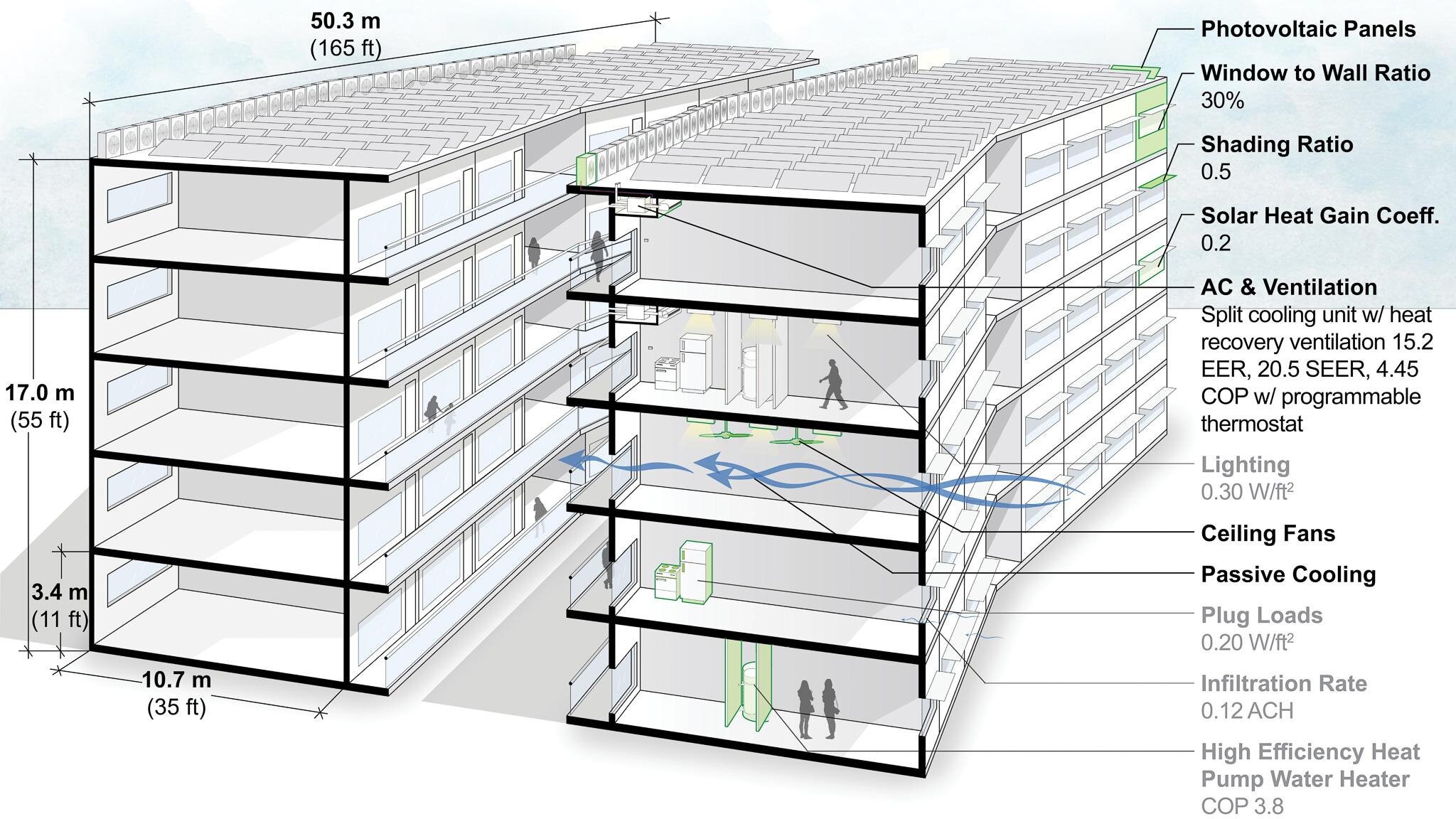
Multifamily buildings in Honolulu without air conditioning will become increasingly warmer in the decades to come with “comfort levels” dropping by 42% by 2080 without interventions.
That’s according to a University of Hawaiʻi at Mānoa study that delves into the future challenges to unconditioned (no control of the temperature or humidity) multifamily buildings. The research is contributing to the Honolulu Climate Change Commission’s forthcoming guidance document on urban heat.
“The findings on poorer thermal comfort negatively impact health and productivity, particularly for populations who cannot afford air conditioning,” said the authors including UH Associate Professor Wendy Meguro who has a joint appointment with the School of Architecture and Hawaiʻi Sea Grant, UH Climate Adaptation Specialist Josephine Briones and CannonDesign’s Building Performance Group Leader Elliot J. Glassman.
The baseline of present-day Honolulu weather was used to determine “comfort level,” which is considered comfortable 88% of the time without fans and 96% of the time with fans. The study simulated a conceptual design for two multifamily, five-story residential buildings with an exterior walkway and 40 one-bedroom units each.
The greenhouse gases emitted globally impact the future outdoor temperatures, and this study uses several possible future weather files.
In one scenario, global greenhouse gas emissions peak around 2040, then decline. In another scenario, emissions continue to rise through the year 2100. Projections indicate a significant decrease in comfort levels in the future, dropping to 75% in 2050 and 58% in 2080 without fans given the latter scenario with higher emissions and hotter temperatures.
The study also provides proactive design strategies that can be implemented immediately. For example, the inclusion of ceiling fans is anticipated to maintain comfort levels between 85–91% in 2050 and 71–90% in 2100.
Incorporating ceiling fans
The study was supported and conducted through the UH Mānoa School of Architecture’s Environmental Research and Design Lab and the Hawaiʻi Sea Grant Center for Smart Building and Community Design.
The study utilized one building’s energy model to project the future conditions of a prototypical, unconditioned multifamily building. The study suggests that design strategies and the use of ceiling fans can be effective tools in mitigating the adverse effects of increasing heat.
“Although the research focuses on one specific building, the design strategy recommendations apply widely to future residential buildings in Honolulu and the process may be replicated for different building types,” said the authors.
Reliance on air conditioning poses economic challenges
The study also emphasizes the potential increase in energy consumption if air conditioning becomes the default solution for combating rising temperatures. If air conditioning were installed today and only used for part of the year, the multifamily building’s energy use would be expected to rise by as much as 32% by 2080. This poses a greater energy burden for low-income households, strains the electrical grid, and requires more renewable energy systems.
The findings emphasize the importance of immediate actions, including sizing and orienting the building on a site to have long south and north facades, providing shading on the exterior of the building (particularly at windows to block direct sunlight), using high-performance windows to limit heat, limiting the window area, encouraging natural airflow and using ceiling fans. The design strategies proposed will enhance thermal comfort and align with the broader goal of reducing the reliance on fossil fuel.
More information:
“Estimating Thermal Comfort and Energy Use with Future Warmer Weather” is available online at pp. 391–398: www.arcc-arch.org/wp-content/u … ceedingsFINAL-PW.pdf
University of Hawaii at Manoa
Read the full article here


