


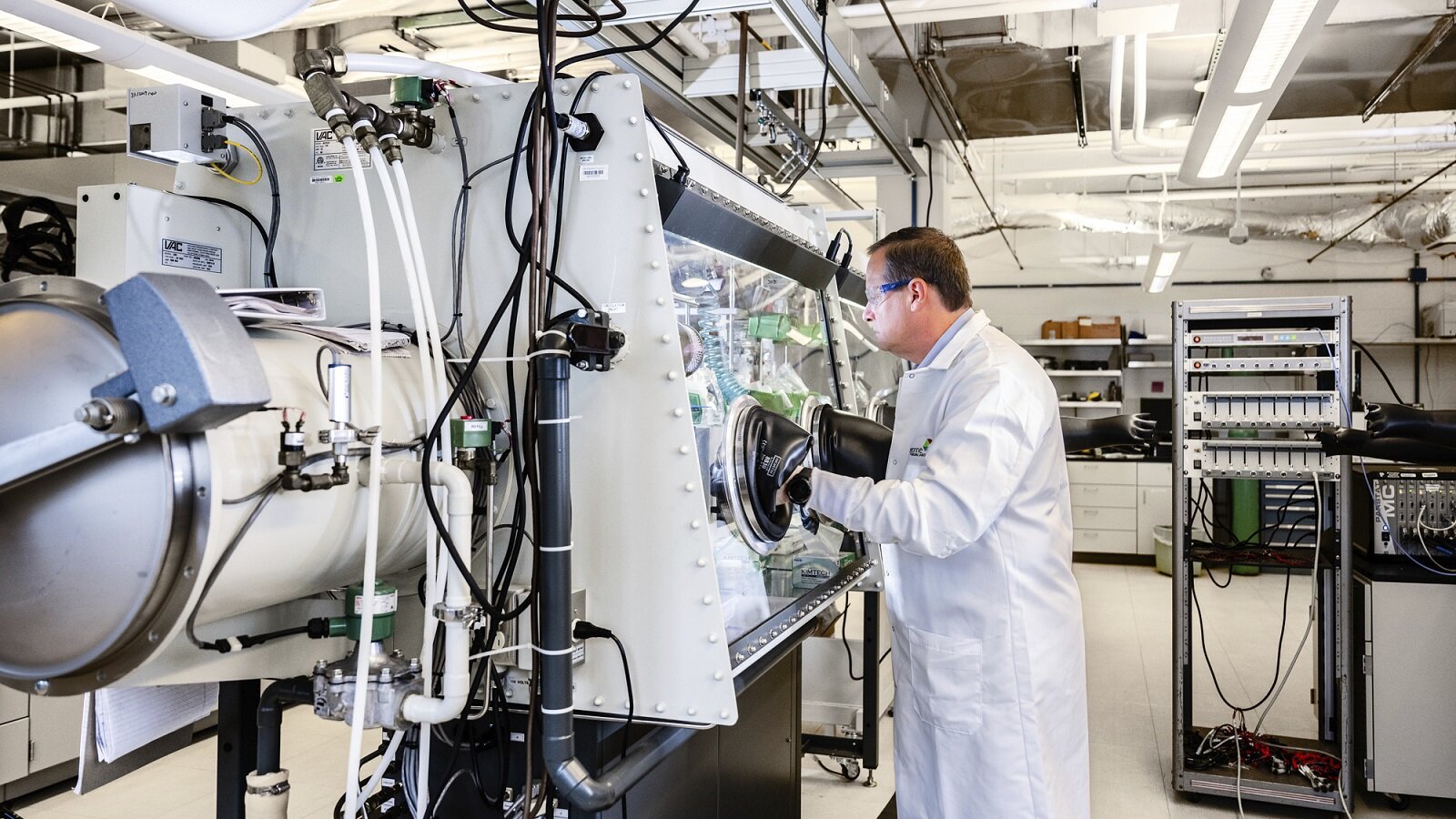
New cathode material for sodium-ion batteries is inspired by earlier work at Argonne that led to the lithium-ion batteries in the Chevy Volt and Bolt. It could help the supply of low-cost and abundant elements for electric vehicle batteries.
As most shoppers looking for a new vehicle know, electric vehicles typically carry a relatively hefty price tag. A primary contributor to this expense are the lithium-ion batteries that power the vehicle. Significantly reducing that cost would bring us closer to transportation solutions that are eco- and wallet-friendly.
Researchers at the U.S. Department of Energy’s (DOE) Argonne National Laboratory have invented and patented a new cathode material that replaces lithium ions with sodium and would be significantly cheaper. The cathode is one of the main parts of any battery. It is the site of the chemical reaction that creates the flow of electricity that propels a vehicle.
“Our estimates suggest that a sodium-ion battery would cost one-third less than a lithium-ion one,” said Christopher Johnson, senior chemist and Argonne distinguished fellow. “Our battery program at Argonne has been studying sodium-ion batteries for well over a decade now, and our design for the cathode structure makes sodium-ion batteries an appealing alternative for budget-friendly and more sustainable electric vehicles.”
The innovative breakthrough by Johnson’s research team stems from his prior research with two other Argonne Distinguished Fellows—Michael Thackeray (retired) and Khalil Amine—on a new cathode material for lithium-ion batteries. That cathode is now part of the batteries that power the Chevy Volt and Bolt, as well as other electric vehicles.
The earlier cathode material is a lithium nickel-manganese-cobalt (NMC) oxide with a structure in which the atoms are arranged in layers. This structure allows easy insertion and extraction of lithium ions between the layers. These ions thus can move freely from the cathode to anode and back to charge and discharge the battery.
Drawing insights from the earlier research, Johnson’s team invented a layered oxide cathode tailored for sodium-ion batteries. This variation on the NMC cathode is a sodium nickel-manganese-iron (NMF) oxide with a layered structure for efficient insertion and extraction of sodium. The absence of cobalt in the cathode formula mitigates cost, scarcity and toxicity concerns associated with that element.
The team’s interest in sodium-ion batteries stems from their many advantages. Two are sustainability and cost. Sodium is far more naturally abundant and easily mined than lithium. It is thus a fraction of the cost per kilogram and much less susceptible to price fluctuations or disruptions in the supply chain.
Furthermore, besides sodium, the cathode material predominantly contains iron and manganese. Both elements are globally abundant and not on the endangered list.
Another benefit is that sodium-ion batteries can retain their charging capability at below freezing temperatures. This addresses one of the notable drawbacks of existing lithium-ion batteries. Also working in favor of sodium-ion batteries is that the technology for battery management and manufacturing already exists. This is because their design closely resembles that of lithium-ion batteries.
“There is one catch to this wonder battery,” noted Johnson. “Sodium metal is about three times heavier than lithium, and that adds considerably to the battery weight.” The additional weight also translates into a shorter driving range.
To date, this shortcoming has hindered sodium-ion batteries from making inroads into the electric vehicle market. Compared with other sodium-ion technology, however, the team’s cathode has much higher energy density, enough to power electric vehicles for a driving range of about 180-200 miles on a single charge.
Johnson emphasized that while the sodium-ion battery might not appeal to those seeking long driving ranges, it could attract budget-conscious consumers, particularly urban dwellers whose daily driving rarely exceeds this distance.
Another shortcoming of earlier sodium-ion batteries is a short cycle life. But with the team’s cathode material, battery cells can be charged and discharged the same number of cycles as their lithium-ion counterparts.
“We have now transitioned from the laboratory phase and are poised to subject our cathode to testing within battery cells similar to those in an actual electric vehicle battery,” Johnson said. This testing will be done in Argonne’s Cell Analysis, Modeling and Prototyping Facility.
“From there, we hope the NMF cathode will follow the trajectory of our NMC cathode and be chosen for manufacturing,” Johnson said. His team is also working to develop different materials for the two other main components of a battery—the electrolyte and anode—to boost energy density even further.
Sodium-ion batteries have another possible application besides transportation. In particular, they are well suited to the storage of renewable energy for use in an electric grid, where battery weight is less of an issue and low-temperature operation a plus. Batteries for grids are a fast-growing market for batteries.
Argonne’s dedication to sustainable energy solutions is underscored by this technological leap. Sodium-ion batteries could alleviate concerns about the available supply of low-cost elements for future vehicle batteries.
Argonne National Laboratory
Read the full article here


