


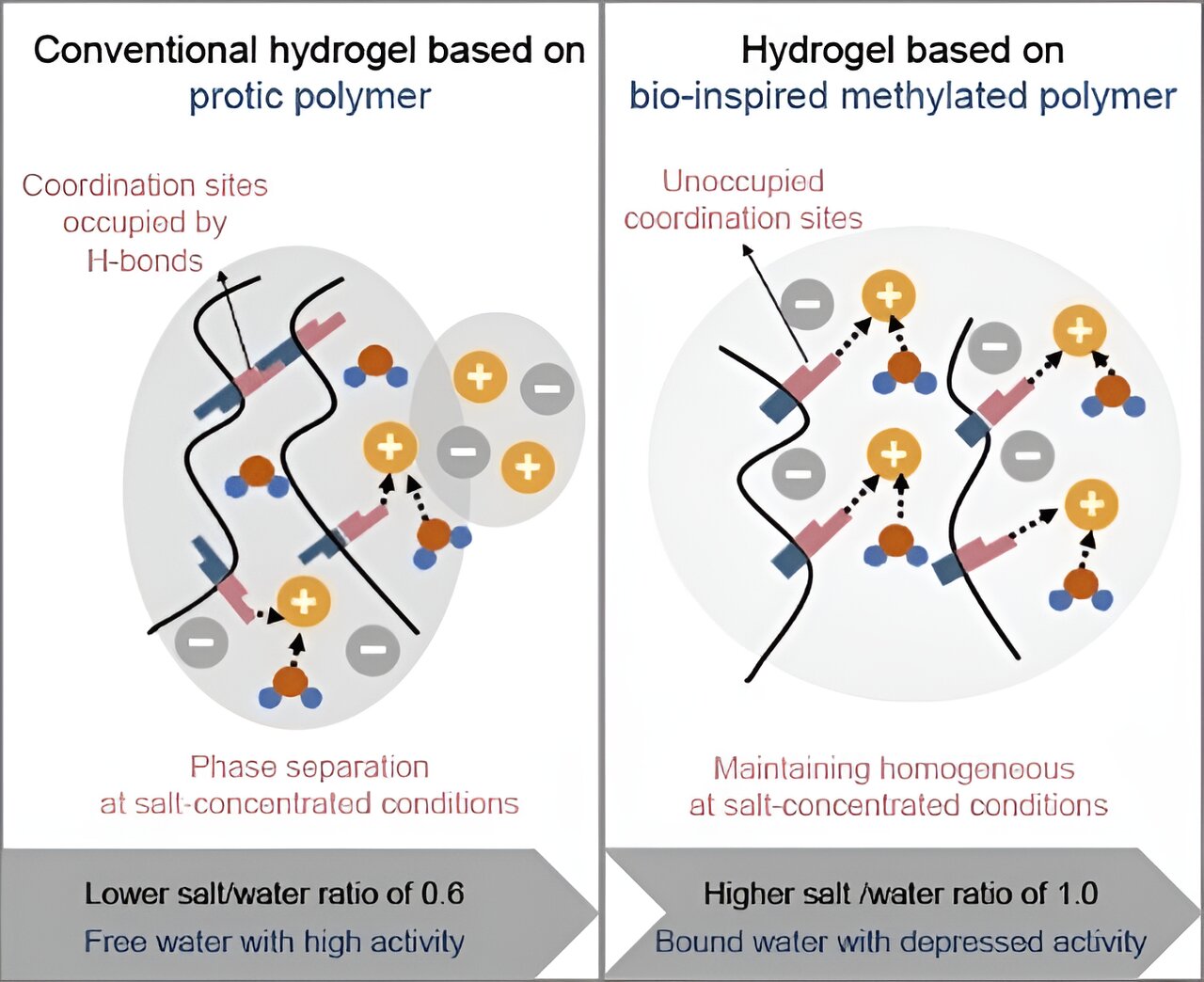
Flexible aqueous batteries, such as those used in portable electronics, often contain a hydrogel electrolyte containing water and salt. Using a chemical modification inspired by nature, a team of Chinese researchers have now significantly increased the salt stability of hydrogels used in sodium-ion batteries. A simple methylation of the hydrogel’s structural polymer prevented salting-out and improved battery capacity and cycling performance, the team report in the journal Angewandte Chemie International Edition.
Sodium-ion batteries are a promising alternative to lithium-ion batteries, since they contain cheaper and more eco-friendly materials than Li-ion batteries. However, new batteries require the development of many new components, all of which have to be adapted to the sodium ion. One of the most essential components is the electrolyte, which in the case of thin, flexible batteries, is often in the form of a hydrogel. These flexible, water-containing materials absorb dissolved sodium salts and can conduct ions.
Despite the suitability of hydrogels, an as-yet unsolved problem is phase separation and salting out at the high salt concentrations needed for a broad electrochemical stability window. Guanglei Cui and colleagues from the Chinese Academy of Sciences in Qingdao, China, have now succeeded in modifying a hydrogel for a sodium-ion battery to make it absorb considerably more salt in a stable and secure manner.
To achieve this, they turned to a technique also employed in nature for the regulation of water- and salt-binding in large biomolecules: methylation. In proteins, methylation causes the “capping” of amine and amide groups, which become less accessible for water molecules that play a role in cross-linking within the protein structure and the dissolution of salt ions.
As the polyamide polymers used for hydrogels also contain amide groups, their extensive cross-linking through water molecules can cause salting out, which leads to the breakdown of the electrolyte. With this in mind, the team compared a hydrogel made of a common polyamide to a hydrogel made of a polyamide with methylated amide groups. The latter was able to absorb significantly more salt than the original variant. Even at record-high salt concentrations, the hydrogel electrolyte remained transparent and stable.
The higher salt content means that the electrochemically usable voltage range of the cell can be expanded. In addition, the team did not observe any signs of disintegration at the electrodes, better cycling stability and the assembled battery cell achieved a greater capacity than the non-methylated variant. It was even possible to use inexpensive aluminum foil as a current collector in this system.
The authors suggest that simple polyamide methylation could also be suitable for other technologies, for example, in drug development, to make hydrogels more resistant to salts and therefore more stable.
More information:
Tingting Liu et al, A Bio‐Inspired Methylation Approach to Salt‐Concentrated Hydrogel Electrolytes for Long‐Life Rechargeable Batteries, Angewandte Chemie International Edition (2023). DOI: 10.1002/anie.202311589
Read the full article here


