


While lithium-ion batteries currently dominate the industry, serious concern remains about the limited availability of lithium used in these batteries. Conversely, sodium-ion batteries provide a more sustainable alternative due to the tremendous abundance of salt in our oceans, thereby potentially providing a lower-cost alternative to the rapidly growing demand for energy storage.
Currently most sodium-ion batteries contain a liquid electrolyte, which has a fundamental flammability risk. In contrast, Sodium (Na) Super Ionic Conductor (NASICON) materials are non-flammable solid-state electrolytes with high ionic conductivity and superior chemical and electrochemical stability.
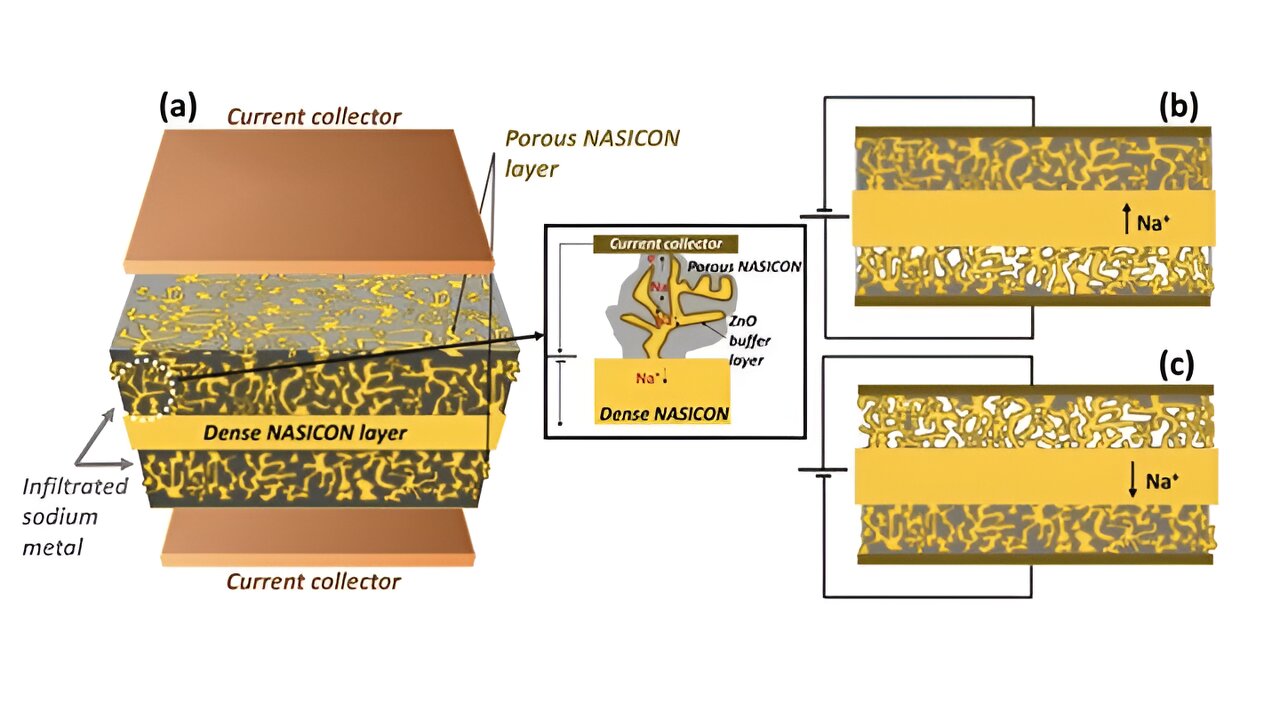
Researchers within the University of Maryland’s A. James Clark School of Engineering, have now developed a NASICON-based solid-state sodium battery (SSSB) architecture that outperforms current sodium-ion batteries in its ability to use sodium metal as the anode for higher energy density, cycle it at record high rates, and all with a more stable ceramic electrolyte that is not flammable like current liquid electrolytes.
Dr. Eric Wachsman, Distinguished University Professor and Director of the Maryland Energy Innovation Institute notes, “Sodium opens the opportunity for more sustainable and lower cost energy storage while solid-state sodium-metal technology provides the opportunity for higher energy density batteries. However, until now no one has been able to achieve the high room temperature solid-state sodium-metal cycling rates we have achieved here.”
The unique 3D electrolyte architecture was recently published in Energy & Environmental Science and provides the promise of high energy density and commercially viable solid-state sodium batteries. The successful demonstration of both stable sodium cycling at high current densities and full cell cycling with thin 3D structured ion-conducting NASICON solid-electrolytes are a significant advancement towards sustainable and more economical energy storage technology.
More information:
Prem Wicram Jaschin et al, High-rate cycling in 3D dual-doped NASICON architectures toward room-temperature sodium-metal-anode solid-state batteries, Energy & Environmental Science (2023). DOI: 10.1039/D3EE03879C
University of Maryland
Read the full article here


