


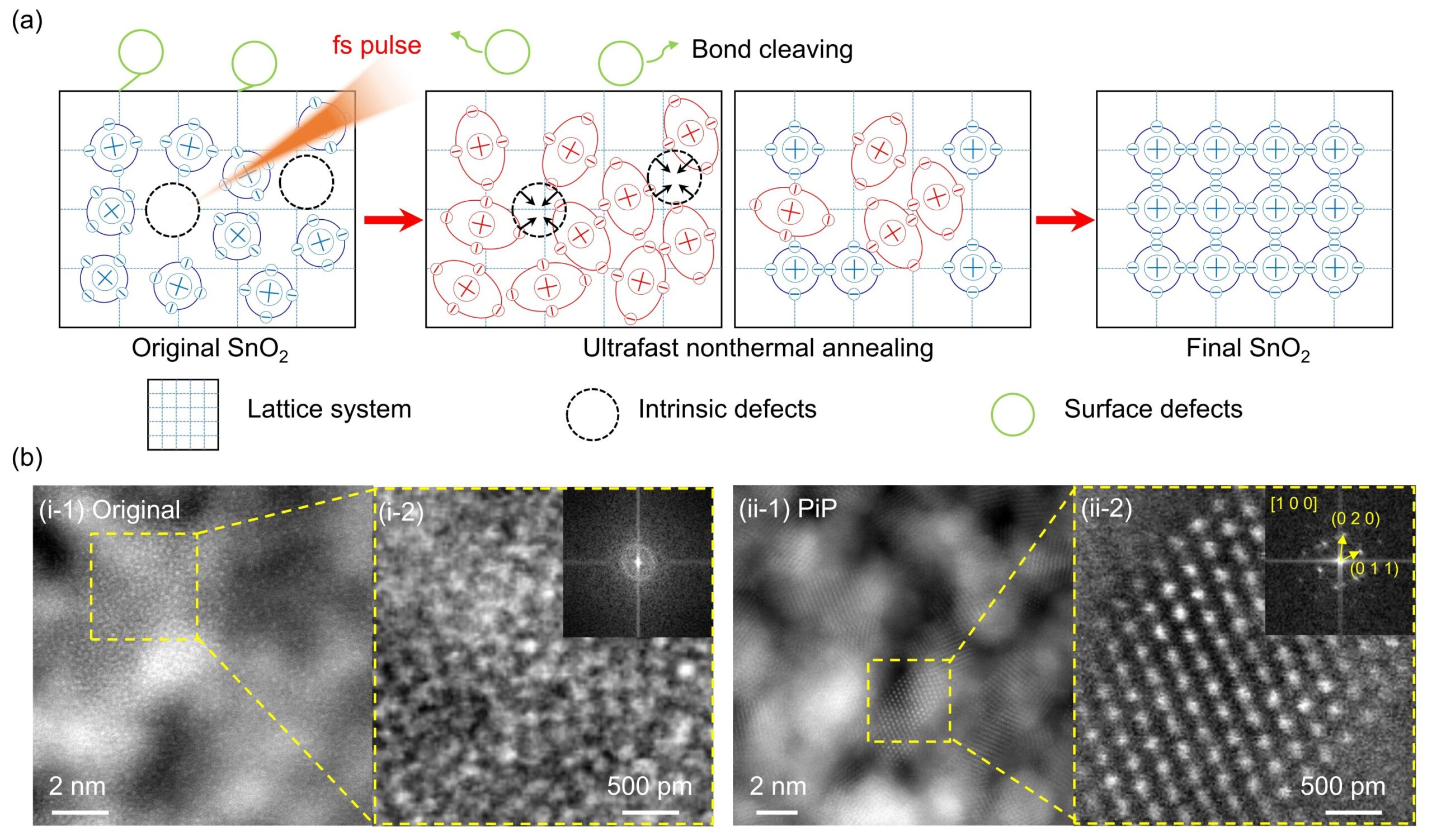
SnO2 has been widely used as electron transport layers (ETLs) for efficient perovskite solar cells (PSCs) due to its high transparency, high electron mobility, and favorable band alignment. PSCs based on chemical bath deposition (CBD)-prepared SnO2 have demonstrated the best performance so far.
However, the intrinsic defects and surface defects that are unavoidably formed in the SnO2 during CBD generate massive trap states near the conduction band and result in carrier recombination at the SnO2/perovskite interface.
There are many approaches to passivate the defects in the SnO2, the most widely used of which are thermal annealing and subsequent interface modification. Both processes require high-temperature treatment for a long time, which is time-consuming, energy-consuming, and unsuitable for flexible substrates.
In response to this challenge, the Center of Femtosecond Laser Manufacturing for Advanced Materials and Devices led by Prof. Xuewen Wang (State Key Laboratory of Advanced Technology for Materials Synthesis and Processing, Wuhan University of Technology) developed a novel photoexcitation-induced passivation (PiP) strategy for SnO2 nanoparticle-based ETLs by using a home-built femtosecond laser annealing system with a high-power femtosecond laser and a polygon scanning head.
“The laser beam scanning speed can go up to more than 100 m s-1, which ensures to anneal a 5 cm × 5 cm sample in 30 s and a 10 cm × 10 cm sample in 60 s, much more efficient than conventional heating techniques,” Wang says.
High-resolution transmission electron microscope analyses of SnO2 before and after the PiP were conducted by Nianyao Chai and Ruohan Yu. The team found that the PiP process leads to the SnO2 undergoing a transformation from the amorphous phase to the crystalline phase, thus improving the crystallinity of SnO2.
Other surface and optoelectronic characterization techniques also show a better defect passivation of the SnO2 film after the Pip treatment. “The PiP process is achieved by ultrafast intensive excitation after laser pulse energy deposition in tens of femtoseconds, followed by the electron-electron and electron-phonon scattering processes,” Mai explains.
Nianyao Chai and Xiangyu Chen demonstrated the generality of this technique and its suitability to different perovskite absorber layers. The team fabricated two representative perovskites-based PSCs and achieved power conversion efficiency (PCE) of 24.14% and 22.75%, respectively. To show the ability to transfer this technique to larger area devices, the team fabricated perovskite solar modules consisting of six subcells connected in series and obtained a PCE of 20.26%.
“Our PiP technique has been demonstrated to be a universal and scalable approach in different types of PSCs and PSMs and shows significantly enhanced performance both in PCE and stability. This study establishes a new approach towards the commercialization of efficient low-temperature manufacturing of PSCs,” Wang says.
The findings are published in the journal National Science Review.
More information:
Nianyao Chai et al, Photoexcitation-induced passivation of SnO2 thin film for efficient perovskite solar cells, National Science Review (2023). DOI: 10.1093/nsr/nwad245
Science China Press
Read the full article here


