


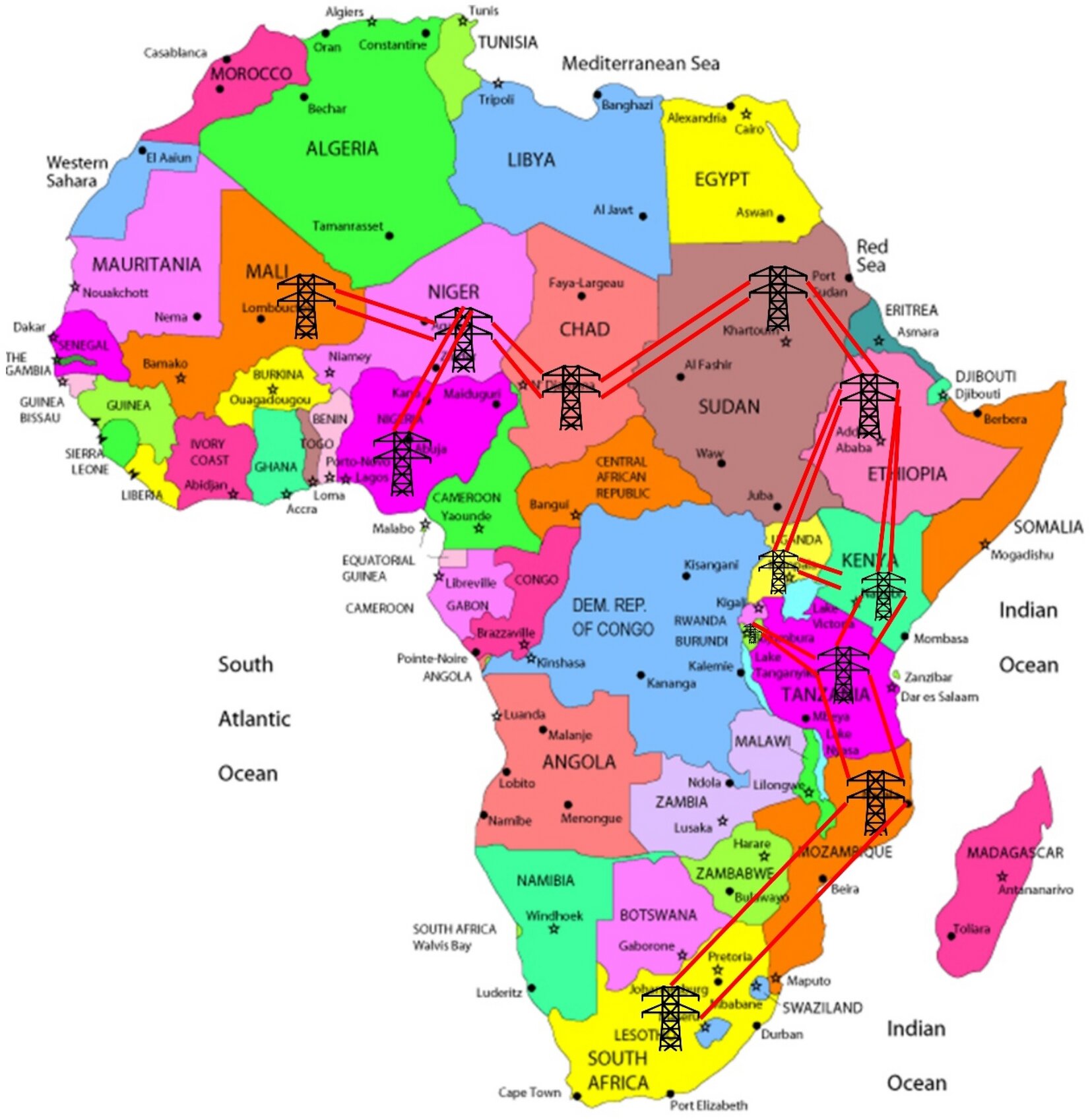
A team of economists and engineers from China, Turkey and Nigeria has published a proposal based on simulations to build a sub-Saharan Africa electrical grid across 12 countries. In their paper published in the journal Scientific Reports, the group outlines which countries would be involved, factors that would be used to build such a grid, and estimated costs.
Africa’s unique history and natural geography and resources has led to conditions that exist today—a huge continent with a huge population, with many people living in poverty. Prior research has suggested that one of the factors preventing the development of many countries in Africa is lack of access to electricity. In this new effort, the research team looked at the factors involved in building an electrical grid across 12 countries.
The proposed grid would traverse northern parts of the continent, horizontally, then move south near the East Coast, including countries all the way to South Africa. Countries included would be South Africa, Mozambique, Burundi, Tanzania, Kenya, Uganda, Ethiopia, Sudan, Chad, Nigeria, Niger and Mali. To come up with estimates on the costs involved for building such a grid, the team first considered multiple scenarios that involved methods of producing the electricity based on types of renewable resources, versus using as many as possible of the coal-fired plants that currently exist.
The team then input all the relevant data into the EnergyPLAN simulator—a system that was first developed in 2000 and that has been updated and used for multiple projects in Africa. The team also gave the simulator a timetable for implementation of such a grid—either by 2030 or by 2040.
Based on the simulations, the researchers found that total electricity demand for the grid would be approximately 700 TWh/yr for 2030 and 800 TWh/yr for 2040. They noted that hourly demand on the grid would range from 40 to 120 GW. The system also showed costs ranging from approximately a half-trillion dollars to just under 3 trillion.
The researchers suggest that their simulation could be used in consideration for a much larger project by entities, such as China, that have been active in smaller projects in Africa. They also note that such a project would not only improve the lives of people living in Africa, but could perhaps eventually result in a large return on investment as new regions in Africa become business or trading partners.
More information:
Mustapha Mukhtar et al, Juxtaposing Sub-Sahara Africa’s energy poverty and renewable energy potential, Scientific Reports (2023). DOI: 10.1038/s41598-023-38642-4
© 2023 Science X Network
Read the full article here


