


To satisfy the growing demands of the electronics industry, engineers and material scientists are trying to continuously improve the performance of battery technologies. Lithium (Li) metal batteries, batteries with a metallic Li anode, are among the most well-known and widely investigated battery solutions.
While these batteries have been around for decades, researchers have recently been trying to improve their performance using nanoengineering techniques, as well as alternative solid or liquid electrolytes. The design of new promising electrolytes could help to significantly enhance the stability and extending the lifecycle of Li metal battery cells.
Researchers at Stanford University recently introduced a new strategy to design high-entropy electrolytes for Li metal batteries. This strategy, outlined in a paper in Nature Energy, allowed them to identify promising electrolytes that significantly improve the cycling stability of batteries at high current densities.
“Recent advances in electrolytes have greatly improved cyclability by enhancing electrochemical stability at the electrode interfaces, but concurrently achieving high ionic conductivity has remained challenging,” Sang Cheol Kim, Jingyang Wang and their colleagues wrote in their paper. “We report an electrolyte design strategy for enhanced lithium metal batteries by increasing the molecular diversity in electrolytes, which essentially leads to high-entropy electrolytes.”
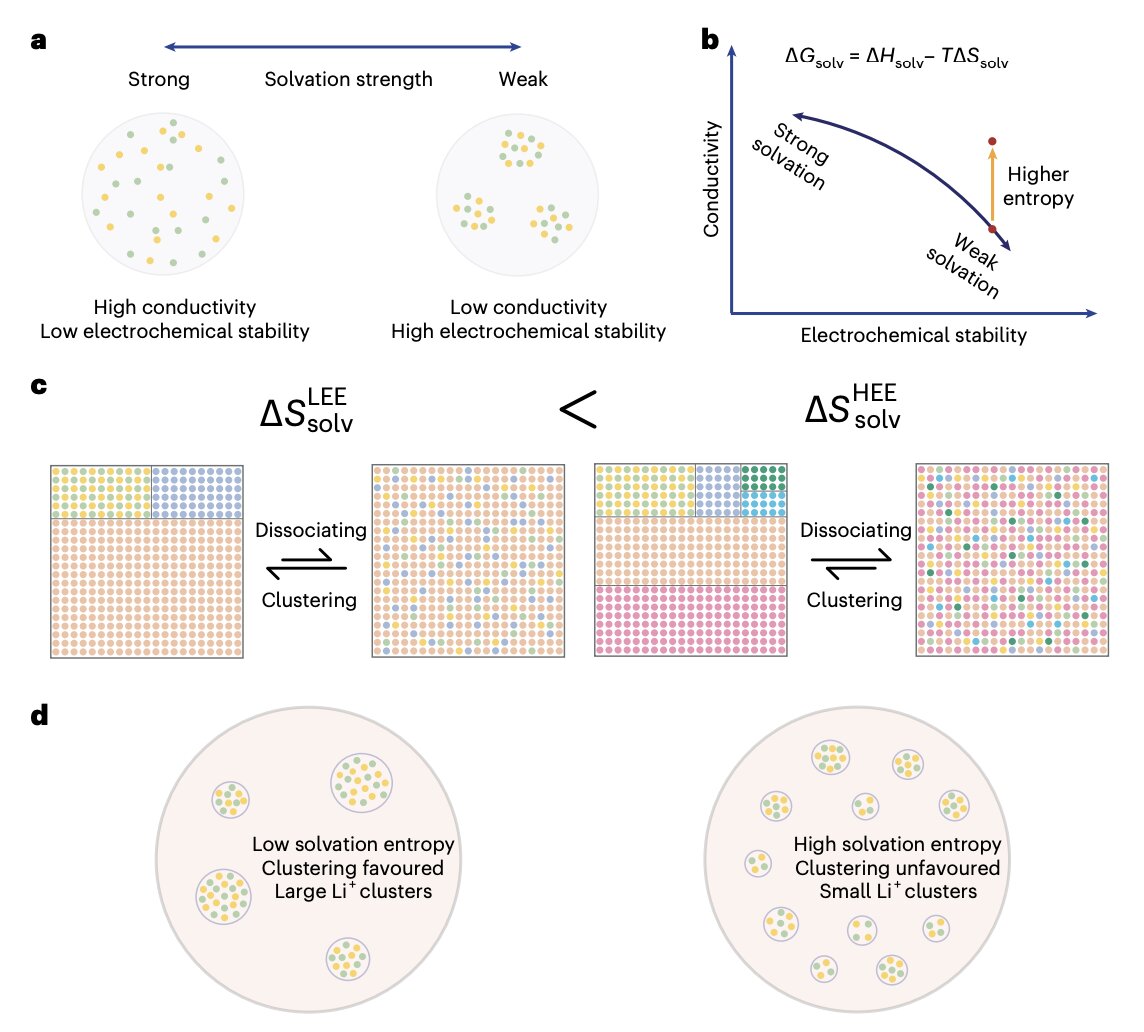
The key objective of the recent work by Kim, Wang and their colleagues was to facilitate the design of electrolytes with improved ion transport capabilities that do not compromise the stability of Li metal batteries. To do this, they introduced a strategy that can be used to modulate the structures of solvents in weakly solvating electrolytes with extensive ion clustering in them.
As part of their study, they applied their proposed strategy using X-ray scattering techniques and running molecular dynamics (MD) simulations (i.e., computer-based simulations of molecular systems). This allowed them to identify characteristics that make electrolytes for Li metal batteries particularly favorable, both in terms of stability and ionic conductivity.
“We find that, in weakly solvating electrolytes, the entropy effect reduces ion clustering while preserving the characteristic anion-rich solvation structures, which is characterized by synchrotron-based X-ray scattering and molecular dynamics simulations,” Kim, Wang and their researchers wrote in their paper.
“Electrolytes with smaller-sized clusters exhibit a twofold improvement in ionic conductivity compared with conventional weakly solvating electrolytes, enabling stable cycling at high current densities up to 2C (6.2 mA cm−2) in anode-free LiNi0.6Mn0.2Co0.2 (NMC622)||Cu pouch cells. The efficacy of the design strategy is verified by performance improvements in three disparate weakly solvating electrolyte systems.”
The new approach proposed by Kim, Wang and their colleagues could soon help to design a wide range of promising electrolytes for Li metal batteries, contributing to the ongoing quest to improve their performance. These better performing batteries in turn power a wide range of electronics, including electric or hybrid vehicles, medical equipment, and other advanced technologies.
“We envision that this work can spur efforts to develop HEEs that can push lithium metal batteries closer to practical applications and to broadly develop high-entropy solutions with superior properties for various applications,” the researchers wrote.
More information:
Sang Cheol Kim et al, High-entropy electrolytes for practical lithium metal batteries, Nature Energy (2023). DOI: 10.1038/s41560-023-01280-1
© 2023 Science X Network
Read the full article here


