


The Fraunhofer Institute for Solar Energy Systems ISE has developed and successfully commissioned the world’s first medium-voltage string inverter for large-scale power plants. By feeding power into the medium-voltage grid, the “MS-LeiKra” project team has demonstrated that PV inverters are technically capable of handling higher voltage levels.
The benefits for photovoltaics include enormous cost and resource savings for passive components and cables. The device lays the foundation for a new system concept for the next generation of large-scale PV power plants, which can also be applied to wind turbines, electric mobility and industrial applications.
Modern PV string inverters have an output voltage of between 400 VAC and 800 VAC. Although the output of power plants is steadily growing, voltage has not yet been in-creased. There are two reasons for this: First, building a highly efficient and compact inverter based on silicon semiconductors is a challenge. Second, there are currently no PV-specific standards that cover only the low-voltage range (max. 1,500 VDC / 1,000 VAC).
In a project for the German Federal Ministry for Economic Affairs and Climate Action (BMWK), Fraunhofer ISE, in collaboration with Siemens and Sumida, has developed an inverter that enables the output voltage to be increased to the medium-voltage range (1,500 V) at 250 kVA. The key to this is the use of silicon carbide semiconductors, which have a higher blocking voltage.
The research team has also implemented a more efficient cooling concept using heat pipes, which reduces the amount of aluminum required.
Thinner cables offer huge savings potential
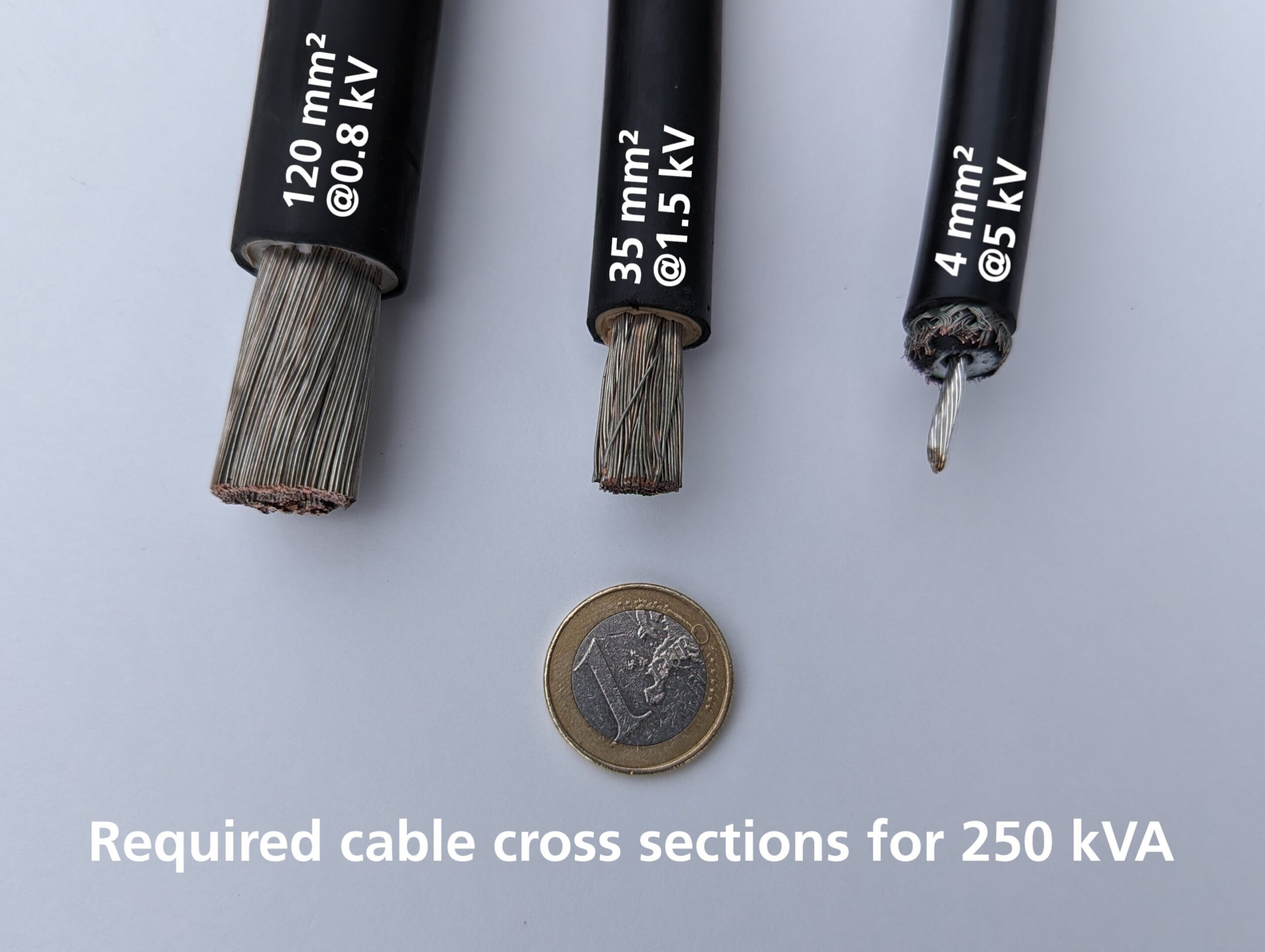
An average photovoltaic power plant requires dozens of kilometers of copper cables. Increasing the voltage generates significant savings potential: At today’s possible output voltage of 800 VAC, a 250 kVA string inverter requires cables with a minimum cross section of 120 mm². By increasing the voltage to 1,500 VAC, the cable cross section can be reduced to 35 mm². This in turn cuts copper consumption by around 700 kilograms per kilometer of cable.
“Our resource analyses show that in the medium term, the electrification of the energy system will lead to copper becoming scarce. Increasing the voltage allows us to save valuable resources,” says Prof. Dr. Andreas Bett, Director of the Fraunhofer Institute for Solar Energy Systems ISE.
With the “MS LeiKra” project, they are leaving the scope of low-voltage (<1000 VAC / <1500 VDC) standards. There are currently no PV-specific standards for this range. This is why the project team is also working on the standards that would result from increasing the voltage.
Having fed power into the medium-voltage grid successfully, the research team is now looking for solar farm developers and grid operators to test the power plant concept in the field.
Besides photovoltaics, moving beyond low voltage is also of interest for other applications, such as wind turbines, where the growing system capacities also require cables with large cross sections. The same is true for the charging infrastructure for large electric vehicles and vehicle fleets, and for industrial grids, where medium-voltage inverters could save a lot of material if cable cross sections could be reduced.
Provided by
Fraunhofer-Institut für Solare Energiesysteme ISE
Read the full article here


