


In a new study, researchers have developed a method for capturing carbon dioxide from the atmosphere, powered by clean and relatively inexpensive geothermal energy.
Their findings, published in the journal Environmental Research Letters, reveal that by combining direct air carbon dioxide capture technologies (DACC) and geothermal energy, large-scale carbon dioxide (CO2) removal systems could potentially be supplied with enough energy to remove carbon dioxide from the atmosphere and safely store it underground.
Emitted when humans burn fossil fuels for things like heat, electricity and transportation, carbon dioxide accounts for the majority of greenhouse gases emitted by human activities in the atmosphere. Because this accumulation is one of the main drivers of climate change, efforts to address the excess have focused on methods for extracting carbon dioxide, either at the original source of emission or directly from the air.
“Carbon removal technologies are especially helpful in mitigating climate change because we can capture types of emissions that would be hard to cap in other ways,” said Martina Leveni, lead author of the study and a postdoctoral scholar in civil, environmental and geodetic engineering at The Ohio State University. “So we thought, could we combine technologies that could be beneficial to one another to meet this goal more efficiently?”
Typical DACC methods can be expensive and require energy to operate, adding more greenhouse gases to the atmosphere, said Leveni. But she set out to investigate if it was possible to integrate the recycled carbon dioxide into the system to make it more efficient.
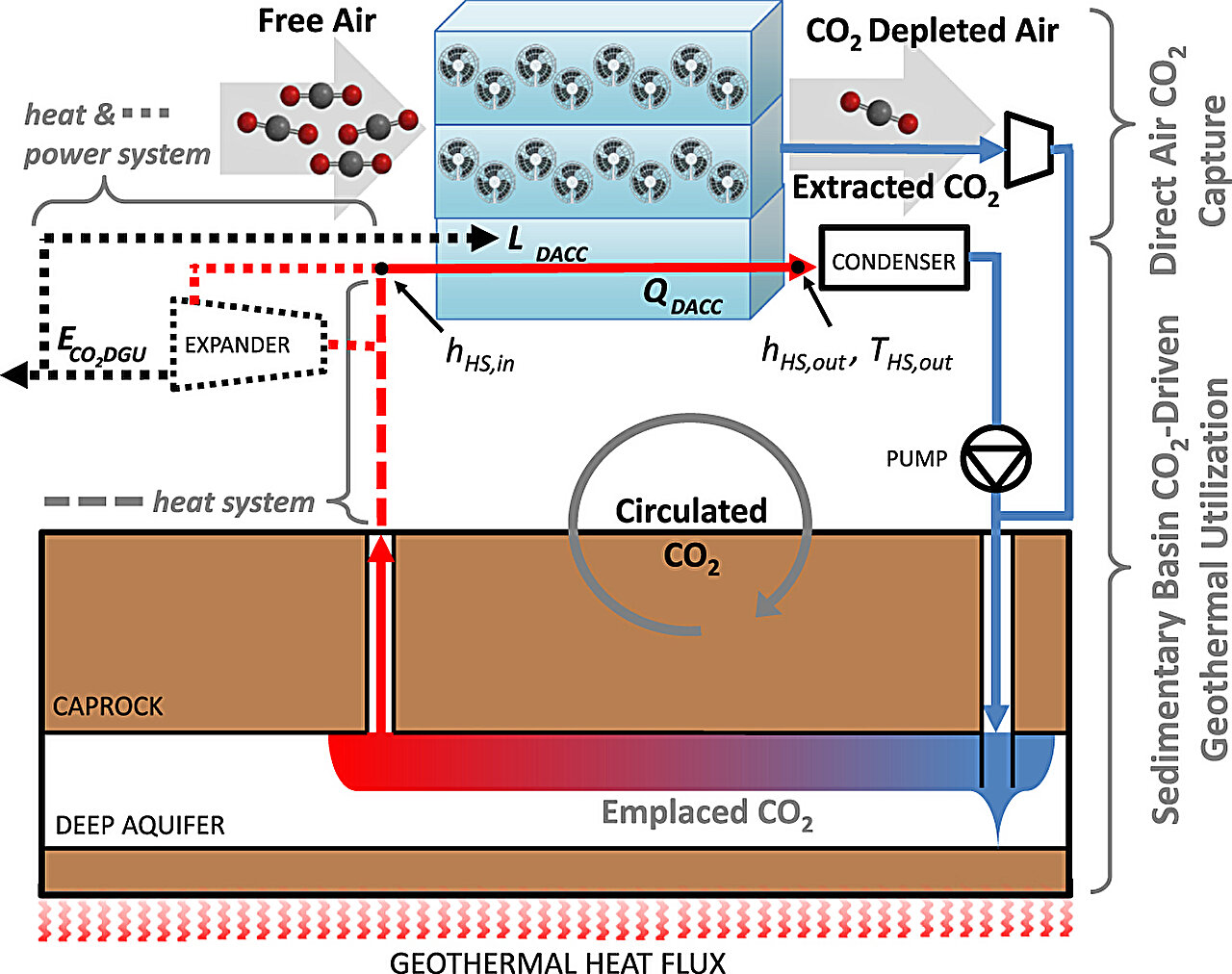
Called Direct Air CO2 Capture with CO2 Utilization and Storage (DACCUS), Leveni’s proposed method uses the natural heat stored beneath the Earth’s surface within deep saline aquifers—underground geologic formations containing sedimentary rock and saltwater—to continuously produce renewable energy for DACC systems.
The carbon dioxide captured from the air is isolated in these geologic formations, and part of it can be circulated to extract the geothermal heat. This circulation brings the heat to the surface, where it can either be used directly or converted to electricity to power the system.
Such a system requires a lot of energy, which can often mean more pollution. But it’s an issue their work accounts for, said Jeff Bielicki, co-author of the study and an associate professor in civil, environmental and geodetic engineering and the John Glenn College of Public Affairs at Ohio State.
Geothermal energy in general has a very small carbon footprint, and this particular approach is even lower because it uses carbon dioxide, Bielicki said.
More information:
Martina Leveni et al, A potential for climate benign direct air CO2 capture with CO2-driven geothermal utilization and storage (DACCUS), Environmental Research Letters (2023). DOI: 10.1088/1748-9326/ad0924
The Ohio State University
Read the full article here


