


Electrolytes are key battery components that transfer charge carrying particles (i.e., ions) back and forth between two electrodes, ultimately allowing batteries to repeatedly charge and discharge. Engineering and identifying promising electrolytes can help to improve the performance and properties of batteries, allowing them to better support the needs of the electronics industry.
Lithium-metal batteries (LMBs) are a promising class of batteries that have been found to have numerous advantageous properties, including longer battery use per single charge. However, electrodes in these batteries are prone to become corroded when exposed to some chemicals, which makes the design of suitable liquid electrolytes for these batteries challenging.
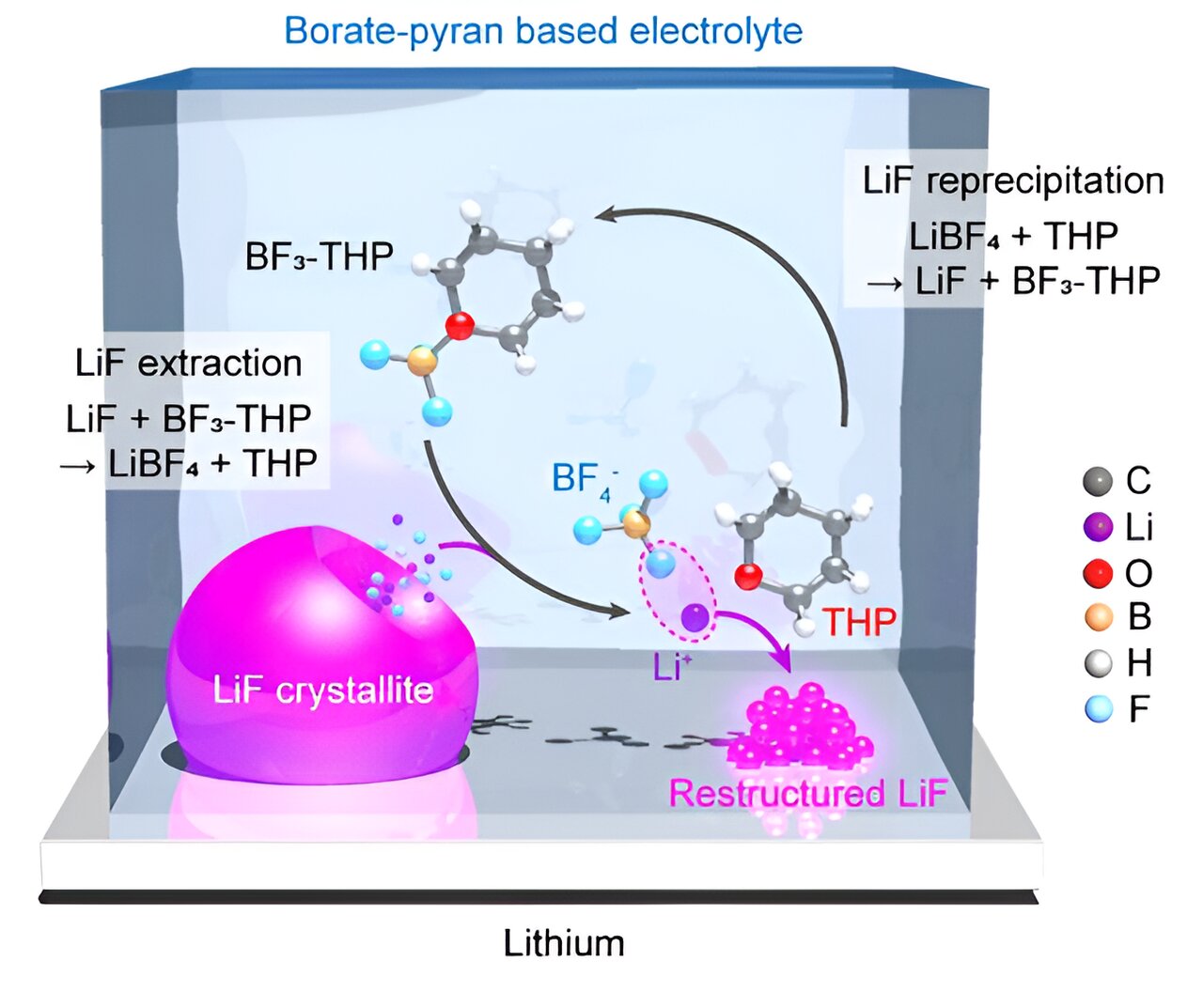
Researchers at the Korea Advanced Institute of Science and Technology (KAIST) and LG Energy Solution in South Korea recently engineered a new liquid electrolyte for LMBs based on lean borate-pyran. Their paper, published in Nature Energy, shows that this electrolyte could minimize corrosion in LMBs, while retaining their performance.
“Lithium metal batteries are undergoing development with the aim of maximizing battery energy density,” Hee-Tak Kim, one of the researchers who carried out the study, told Tech Xplore. “However, the current obstacle lies in the electrolyte, which currently represents the second-highest weight fraction in the battery. To effectively implement high energy density, it is imperative to reduce the amount of electrolyte used.”
The recent work by Kim and his colleagues draws inspiration from an earlier paper by a research team at Stanford University, published in Science. The authors of this paper found that the swelling of the solid electrolyte interphase (SEI), a protective layer created on the surface of anodes in lithium batteries, ultimately prompts the reversibility of Li metal electrodes.
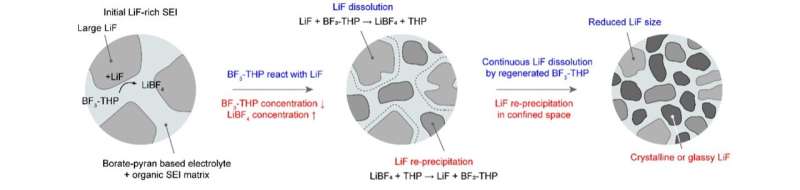
“Motivated by the finding, we tried to devise a strategy to build a SEI with minimal liquid electrolyte swelling and consequently minimal Li corrosion,” Kim said. “To make Li-metal batteries work, two requirements should be met, namely uniform Li plating/stripping and minimal Li corrosion. Our electrolyte design achieves both requirements by inducing the densely packed, nanocrystalline, and inorganic-rich SEI.”
The borate-pyran based electrolyte engineered by this team of researchers produces the anti-Oswald ripening of LiF crystallites in the SEI. This process in turn prompts the formation of the SEI, while also reducing the protective layers’ swelling and thus minimizing the electrodes’ corrosion.
In the future, the new promising liquid electrolyte identified by Kim and his colleagues could be tested in further experiments and integrated in other LMBs with varying designs. In addition, this recent work could inform the engineering of additional electrolytes, thus contributing to ongoing efforts aimed at introducing better performing battery designs.
“Our recent paper emphasizes the critical role of the microstructure of SEI in addressing the problem of Li corrosion,” Kim added. “Furthermore, the microstructure can be strategically restructured by the unique design of the electrolyte. The ultimate goal of Li metal battery technology is to achieve an anode-free lithium metal battery and to enable high-rate charging. Our efforts are dedicated to resolving the pivotal challenges associated with making these cutting-edge technologies a reality.”
More information:
Hyeokjin Kwon et al, Borate–pyran lean electrolyte-based Li-metal batteries with minimal Li corrosion, Nature Energy (2023). DOI: 10.1038/s41560-023-01405-6
© 2023 Science X Network
Read the full article here


