


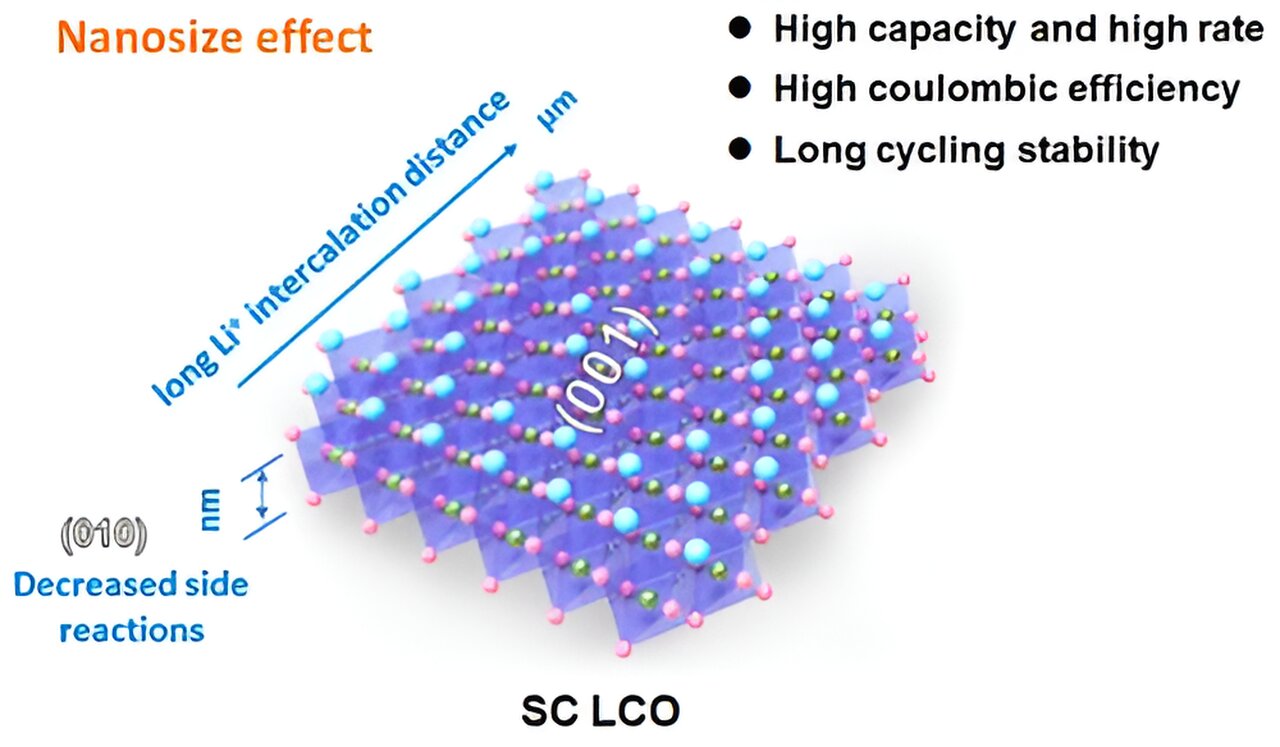
A team led by Prof. Wu Zhongshuai has developed novel 2D atomically thin (001)-oriented single-crystalline LiCoO2 nanosheets with longer Li+ intercalation distance and (001) planes dominated surface for high-performance battery-supercapacitor hybrid devices. This study was published in ACS Energy Letters.
Shorter Li+ intercalation distance or lower intercalation energy barrier enables fast diffusion in Li+ intercalation process. However, it has been found that nanosize effect in nanocrystalline LiCoO2 affects surface-redox and Li+ intercalation processes simultaneously.
As the crystallite size decreases, more Li+ intercalation processes are replaced by surface-redox processes, which brings about decreased platform capacity, low initial coulombic efficiency, and poor cycle performance. Therefore, the nanosize effect restricts the application of nanostructured LiCoO2 in “double high” battery-supercapacitor hybrid devices.
To solve this problem, Prof. Wu’s team attempted to regulate the nanosize effect by precisely controlling the Li+ intercalation process and surface-redox process.
The team synthesized micro-sized atomically thin single-crystalline LCO nanosheets (SC-LCO) and nanocrystalline LCO nanosheets (NC-LCO).
Compared with NC-LCO, SC-LCO presented longer Li+ intercalation distance and decreased side reactions. Both coulombic efficiency and discharge capacity of SC-LCO at 1C (194 mAh g-1, 92%) were higher than those of NC-LCO (173 mAh g-1, 86%).
The specific capacity of SC-LCO maintained 151 mAh g-1 (83%) after cycling for 500 cycles, which preceded NC-LCO (84 mAh g-1, 63%).
Moreover, the team fabricated a battery-supercapacitor hybrid device with SC-LCO, which achieved high-energy and high-power, demonstrating the practical applicability of this nanosheets.
More information:
Feifei Xing et al, Regulating the Nanosize Effect of LiCoO2 for High-Performance Battery-Supercapacitor Hybrid Devices, ACS Energy Letters (2024). DOI: 10.1021/acsenergylett.3c02196
Chinese Academy of Sciences
Read the full article here


