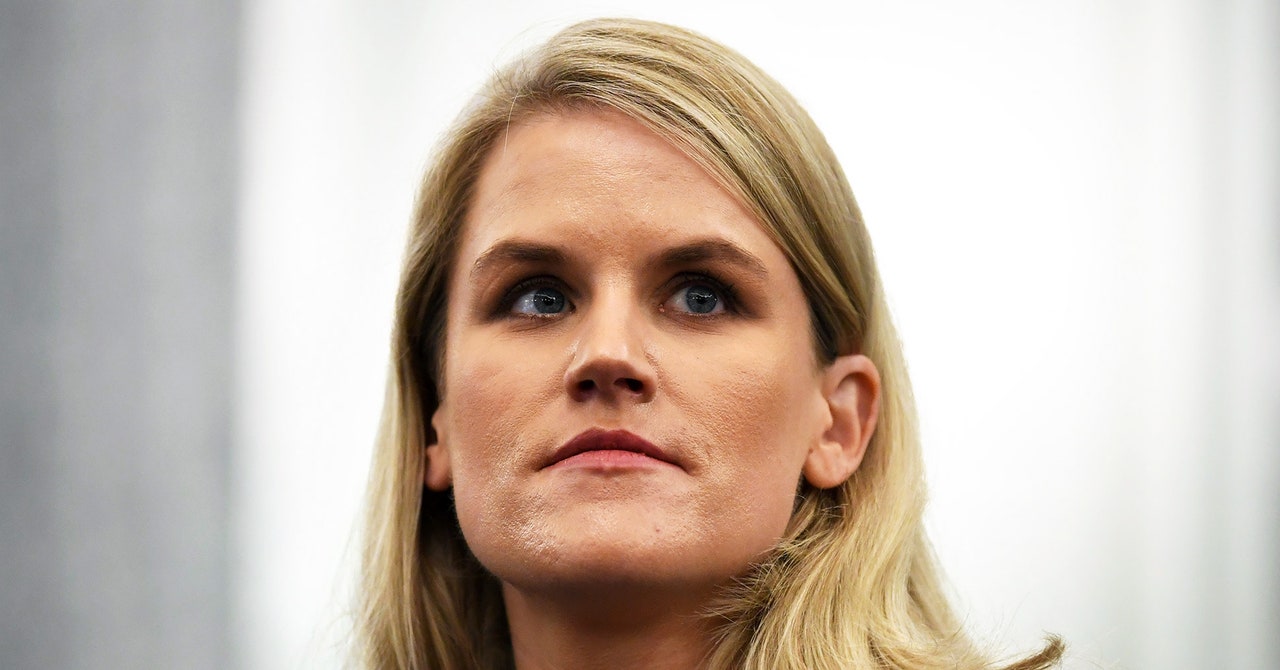
Frances Haugen will forever be known as Facebook’s whistleblower. In her final weeks at the company, she worked daily with a Wall Street Journal reporter to drain Facebook’s servers of damning documents that showed how the platform and its leader, Mark Zuckerberg, refused to address major problems despite well-documented pleas from employees.
On September 13, 2021, the Journal began publishing “The Facebook Files”—an expose that surfaced, among other things, the mental health toll Instagram was taking on teenage girls, Facebook’s secret program giving special status to millions of influential users, and the algorithms that promoted the worst kind of content. At the time, the source of that shocking cache was unnamed. Three weeks later, Haugen revealed herself as the whistleblower when she appeared on 60 Minutes. Haugen, then a 37-year-old data scientist, had worked in Silicon Valley for 15 years after a bucolic childhood in Iowa. She was precise and unsparing in her decoding of complex Facebook documents.
The headlines came from the contents of the files, but an untold story was why Haugen did what no other employee of Facebook, now called Meta, had ever dared. Haugen drew her courage to blow that fateful whistle after a cathartic decade in which she confronted personal, medical, and financial woes, She’d also seen a friend swept into the rabbit hole of misinformation. When she came face to face with what she considered Facebook’s intolerable refusal to fix its problems, she was ready to turn on her employer to alert the public.
Haugen has now published a book telling that story: The Power of One: How I Found the Strength to Tell the Truth and Why I Blew the Whistle on Facebook. It’s both a call to fix social media and a memoir of her journey through Silicon Valley, describing her difficult path to adulthood while working at Google, Yelp, Pinterest, and ultimately, Facebook. It also tells the story of how she became one of her former employer’s most potent public critics, uniquely qualified because of her technical grasp and inside experience. She’s since launched a nonprofit called Beyond the Screen to educate people about social media.
I first met Haugen in 2007 when I was embedded in an around-the-world business trip with Google’s young associate product managers, and I was struck by her moral sense—she bristled at instances when the world wasn’t working as it should. I also noticed her struggle to fit into her cohort of mainly male engineers a couple of years her senior.
Now, with the arrival of her memoir, I took an opportunity to discuss not just her book, but also her current life as a crusader for safer social media and the possible liberation of Mark Zuckerberg, who she sees as a prisoner much in the way Brittney Spears once was. The interview is edited for length and clarity.
Steven Levy: You’ve already blown the whistle on Facebook, done a lot of media, and testified to and advised legislators and regulators. What did you hope to do with this book?
Read the full article here