


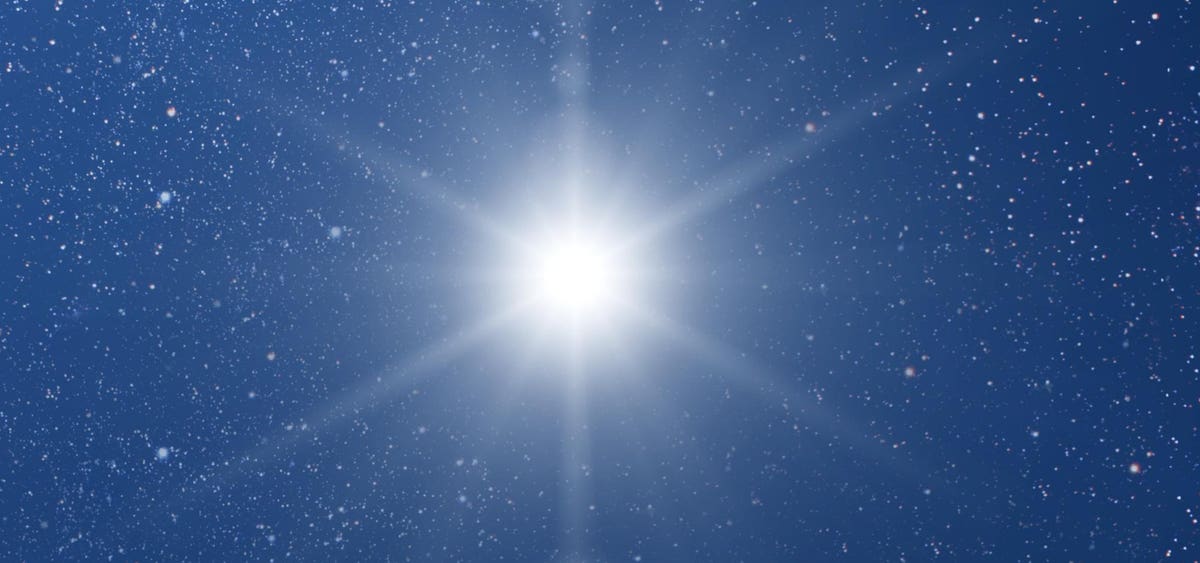
New research has revealed that the children’s song “Twinkle, Twinkle, Little Star” contains some cutting-edge astrophysics.
We see stars twinkle in the night sky because winds in Earth’s atmosphere bends and distorts starlight. However, new research published today in Nature Astronomy reveals that stars have a twinkle all of their own that’s caused by the rippling waves of gas on their surfaces.
“Motions in the cores of stars launch waves like those on the ocean,” said lead author Evan Anders, a postdoctoral researcher at Northwestern University. “When the waves arrive at the star’s surface, they make it twinkle in a way that astronomers may be able to observe.”
Second Twinkle
This second twinkle is caused by the waves rippling to the surface where they compress and decompress plasma, causing brightening and dimming of the star’s light. It’s thought that the waves can take hundreds of thousands of years to reach the surface.
It’s not something that can currently be seen by ground-based telescopes. It was picked up by astrophysicists making computer simulations from observations of stars’ brightness.
“For the first time, we have developed computer models which allow us to determine how much a star should twinkle as a result of these waves,” said Anders.
Listen to a Star Twinkle
After mapping the gas waves to workout how much stars should twinkle because of this process, the researchers then converted the data to music—specifically “Jupiter” from Gustav Holst’s orchestral suite “The Planets” and, fittingly, “Twinkle, Twinkle, Little Star.”
It’s hoped that future space telescopes will be able to sense a star’s innate twinkling—a signature of its core—specifically the rapid spinning of a giant star around its axis. It will help astronomers learn more about the very inner regions of stars, which is important because it’s in the cores of stars where the elements we depend upon to live and breathe are forged.
Wishing you clear skies and wide eyes.
Read the full article here



