


If you were ever to see sewage sludge up close, you might be hard-pressed to find any redeemable value; however, researchers at UBC’s Bioreactor Technology Group see it another way.
Using a combination of heat, water and phase separation, UBC researchers have developed a cost-effective method to concentrate phosphorous—which can be efficiently recovered by extraction—from wastewater sludge.
“Phosphorous is a non-renewable, but essential, element for life and has many industrial uses,” explains Huan Liu, a doctoral student with UBCO’s School of Engineering and lead author of a new study investigating this method.
Phosphorus is a natural mineral crucial for human health and essential to food security as a commercial fertilizer; however, it’s also listed as a critical raw material because many countries rely on imports.
“The uneven distribution of phosphate rock has created political and economic risks,” he says. “On the other hand, phosphorus discharge from waste sources, such as wastewater, is a major contributor to aquatic eutrophication, causing severe environmental challenges including algae blooms and dead zones in lakes.”
Liu and his supervisor, principal investigator Dr. Cigdem Eskicioglu, are investigating a promising process that integrates hydrothermal liquefaction.
The process converts organic components of the municipal wastewater sludge into a petroleum-like bio-crude and concentrates the phosphorous into a solid residue called hydrochar. The hydrochar can have 100 times higher total phosphorus than raw sludge, making it comparable to the phosphate rock used in commercial fertilizers.
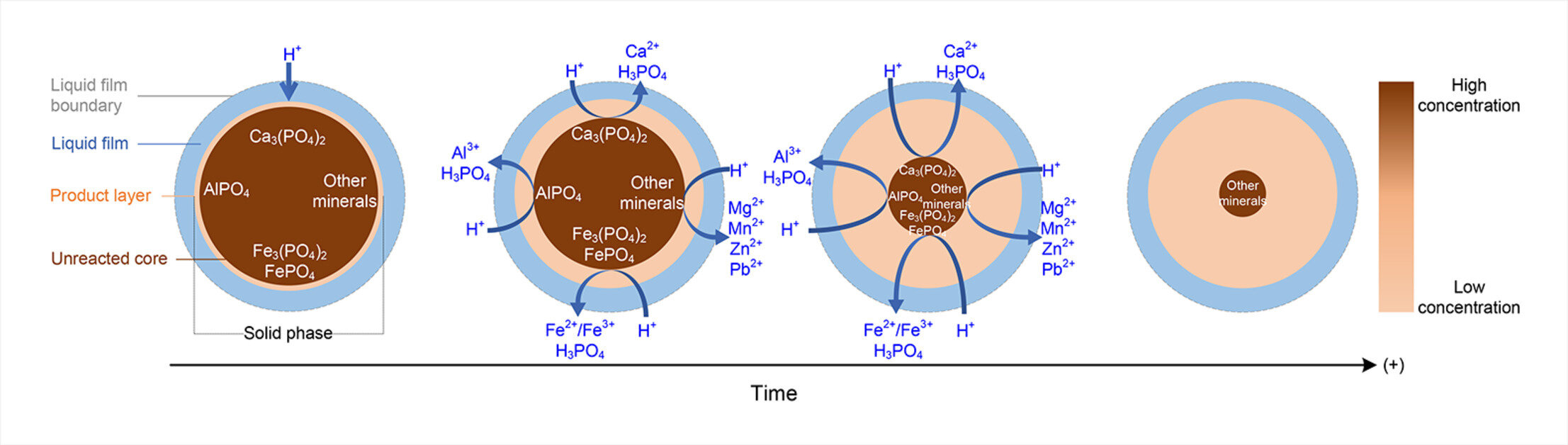
Liu describes the extraction process as mirroring what happens when you mix minerals and acids. “We were able to identify, for the first time, the kinetic reactions of phosphorus leaching from hydrochar to optimize the recovery of useful materials, such as what is needed for fertilizer,” says Liu.
According to Dr. Eskicioglu, their latest findings are essential for wastewater utilities aiming to develop a process to recover usable nutrients from the system.
“At a time when we are seeking to be more sustainable and looking for alternative fuels, extruding useable materials from waste is essential,” she says. “Recovery and recycling is the solution that also provides the double benefit of providing a secondary source of phosphorus that can be globally distributed and also help with environmental conservation.”
The work is published in the journal Water Research.
More information:
Huan Liu et al, Phosphorus recovery from municipal sludge-derived hydrochar: Insights into leaching mechanisms and hydroxyapatite synthesis, Water Research (2023). DOI: 10.1016/j.watres.2023.120138
University of British Columbia
Read the full article here


