


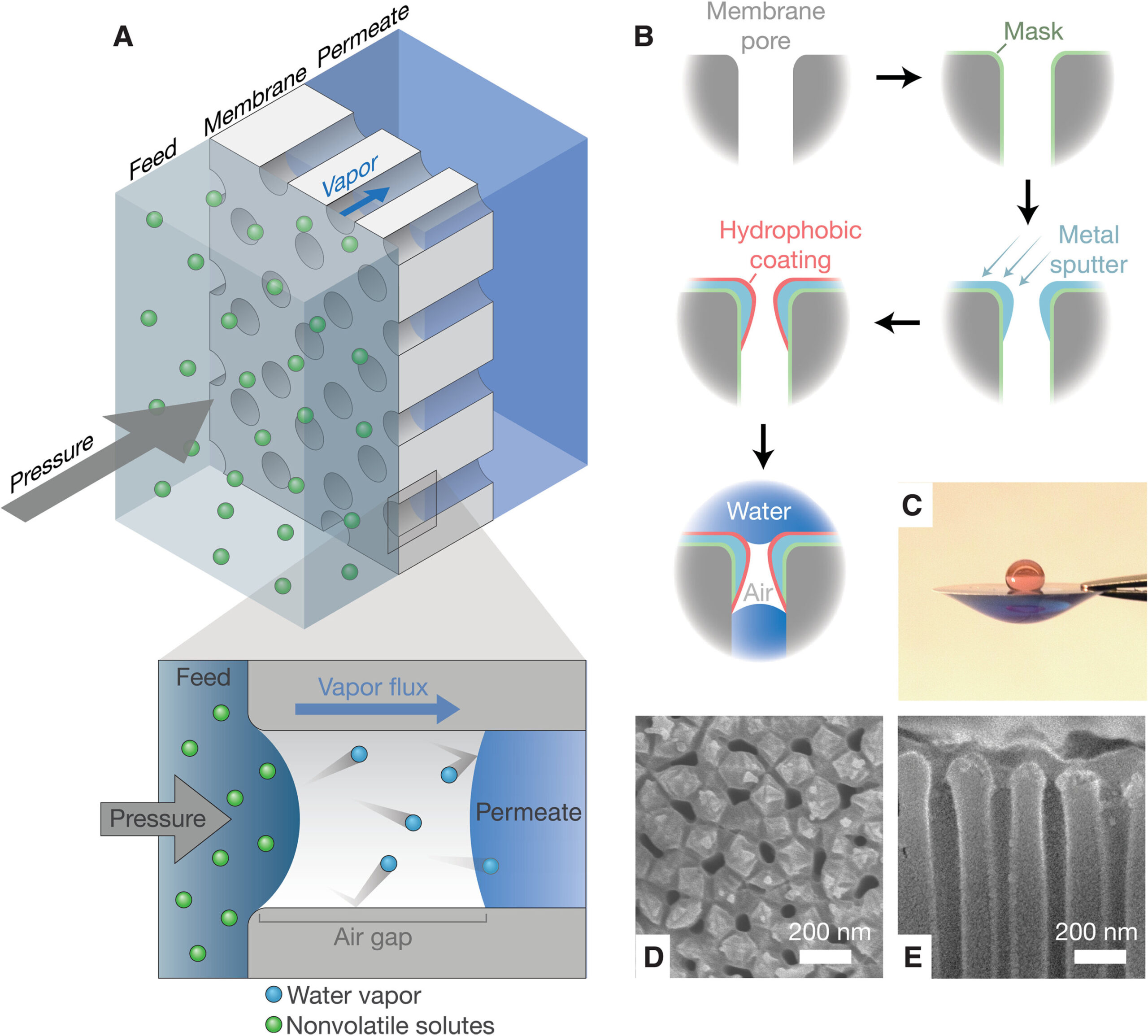
Researchers at CU Boulder have developed a new membrane water filtration system based around air bubbles that can help address water scarcity issues around the world.
Membrane filters generally use pressure to force water through a sieve to separate out unwanted particles and contaminants. The new membrane system is unique in that it uses a tiny layer of air bubbles to distill the water rather than sieve it. This change makes the system more permeable and better at removing unwanted impurities than the common reverse osmosis systems working today.
The new technology is described in a recently published journal article in Science Advances, and the work on campus was led by Civil, Environmental and Architectural Engineering Assistant Professor Anthony Straub with Ph.D. student Duong Nguyen contributing as first author.
Straub said his team’s membrane could be used in advanced water treatment systems and other applications.
“These can be utilized to purify water to a very high degree when it comes to desalination of seawater and in wastewater reuse efforts,” Straub said. “We also have ongoing work with NASA to use these membranes to recycle water during space exploration and research missions.”
Current state-of-the-art engineered membranes are all limited in their use by a universal trade-off where those with high water permeability also struggle to remove salt. That is, membranes that can process a high volume of water are also inherently limited in their ability to clean that water.
“They are also vulnerable to degradation from chemicals used in water treatment,” Straub said. “So, there are a lot of advantages to pursuing this technology and possibly integrating it into existing treatment process.”
Nguyen is originally from the coastal area near Hanoi in Vietnam where maintaining clean water supplies is still a big challenge because of contamination from industrial activities. He said he has personally seen how a lack of efficient water treatment technologies and poor water infrastructure negatively impacted people in the area.
“A passion for both securing water resources and improving water quality for my community—and globally—is what led me to pursue a degree and research into water purification membranes at CU Boulder,” he said. “The university has a strong reputation in this field with many faculty that are the top researchers in water treatment and reuse, including my advisor professor Straub. I have learned a lot from him, both in conducting research and in terms of professional development during my Ph.D. training here.”
Straub said the university has a strong history in water reuse research—primarily through the Membrane Science Engineering and Technology Center on campus and ongoing activity in the Environmental Engineering Program. He added that the team used the Colorado Shared Instrumentation in Nanofabrication and Characterization facility on campus to complete the highly interdisciplinary work.
“We have been trying to create this type of membrane for years,” he said. “We will now look at ways to scale it up and potentially integrate it into existing approaches to water treatment.”
More information:
Duong T. Nguyen et al, Pressure-driven distillation using air-trapping membranes for fast and selective water purification, Science Advances (2023). DOI: 10.1126/sciadv.adg6638
University of Colorado at Boulder
Read the full article here


