


It’s not an exaggeration to say that the speed at which an enterprise can analyze business-critical data directly impacts its ability to compete. Time matters when it comes to mission-critical analytics.
However, one of the challenges of analyzing data is that much of an enterprise’s data isn’t actually found in a database. It would amaze you to see how much business-critical data lives outside the database. This is one reason that object storage is one of the fastest-growing segments of the storage market, with a CAGR of 10-15% (depending on which analyst you believe). Object storage is increasingly where an organization’s working data lives.
Companies would, ideally, get the most nuanced business insights from querying mission-critical operational data alongside CSV, IoT, and web files in object storage. The problem is that transforming file data before loading it into the database for analysis is complex, time-consuming, and expensive—overwhelmingly leading to stale insights and or data that remains untouched.
Oracle is providing a solution to this challenge with the release of its new MySQL HeatWave Lakehouse. Let’s look at what that is.
MySQL HeatWave Lakehouse
MySQL HeatWave, if you’re not familiar, is Oracle’s fully managed MySQL database service powered by the company’s unique HeatWave in-memory query accelerator technology. Heatwave is the only cloud service that combines transactions, real-time analytics across data warehouses and data lakes, and machine learning in one MySQL Database. It does this without the complexity, latency, risks, and cost of ETL duplication.
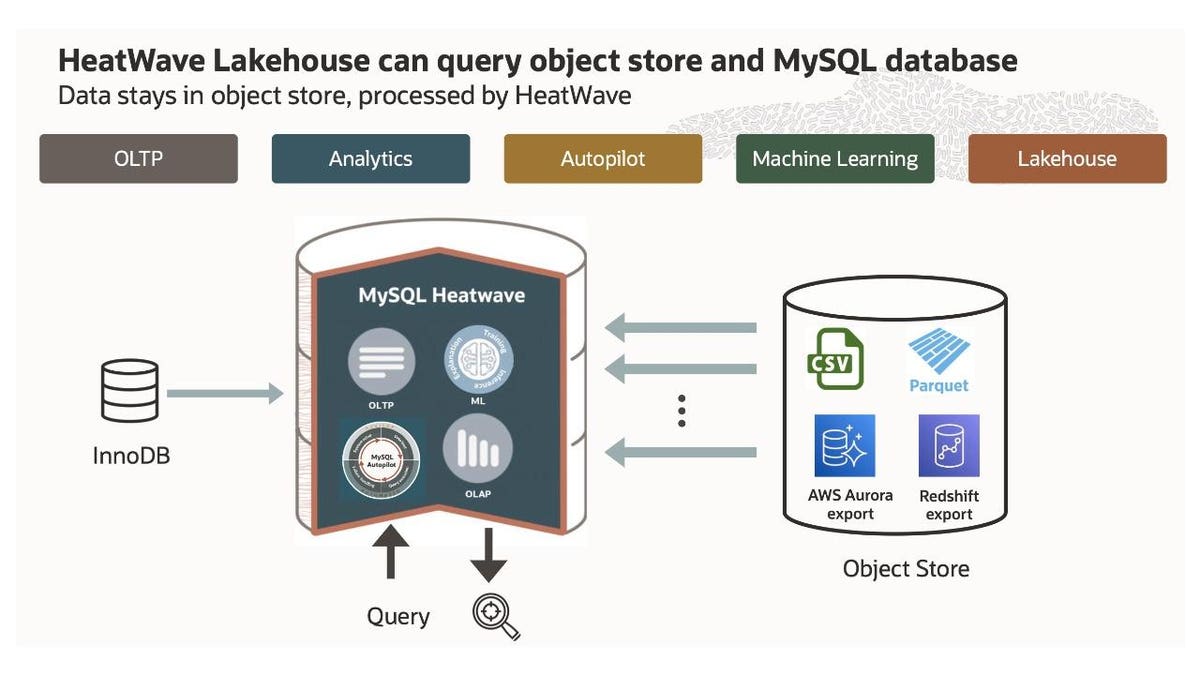
Oracle’s MySQL HeatWave Lakehouse extends MySQL HeatWave to meet the complexity of modern enterprise data. HeatWave Lakehouse enables users to query data stored outside the database, allowing you to run analytics on data stored in various file formats (CSV, Parquet, etc.) as if that data were stored directly within the MySQL database, all without penalty.
Users can query up to a half-petabyte of non-database data, optionally combined with transactional data from a MySQL database, without copying data from the object store into the MySLQ database. This reduces the latency that would be introduced by the copy. HeatWave Lakehouse also uses a new unified query engine that allows data stored in object storage to be queried without a performance penalty.
The ability to query and run analytics on data in an object store dramatically boosts the speed and ease with which you can cost-effectively analyze data across both data warehouses and data lakes. MySQL HeatWave Lakehouse lets you stay ahead of the competition by taking swift action on meaningful business insights. This is a great capability.
Leading Performance
MySQL HeatWave has been a performance leader since its introduction, continuing with HeatWave Lakehouse. Oracle demonstrated that MySQL HeatWave Lakehouse is demonstrably faster than its closest competition on a benchmark derived from the industry-standard TCP-H.
Oracle demonstrated that its new offering is 9x faster than Amazon Redshift, 17x faster than Databricks and Snowflake, and 36x faster than Google BigQuery.
Autopilot for HeatWave Lakehouse
MySQL Autopilot is Oracle’s solution for automating MySQL Heatwave. Autopilot uses machine learning algorithms and automation to optimize the performance of the MySQL HeatWave service. It monitors the usage patterns and resource consumption of the MySQL HeatWave service and automatically adjusts the service configuration to maximize performance and reduce costs.
Oracle has enhanced Autopilot to support the unique needs of MySQL HeatWave Lakehouse. There are enhancements to Autopilot’s auto-provisioning and auto query planning capabilities, along with changes to its auto parallel loading engine, to understand and leverage data stored in an object store.
Beyond changing MySQL AutoPilot to work with object stores, Oracle introduced new capabilities for Lakehouse. The new capabilities include:
· Auto-schema inference, which samples data from object storage to makes inferences about the data within a within a CSV file.
· Adaptive data sampling, which intelligently samples files to derive information needed for automation.
· Adaptive data flow, which learns and coordinates network bandwidth utilization to the object store across a cluster of nodes, dynamically adapting to the performance of the underlying object store. This yields optimal performance and availability.
· Auto query plan improvement, which improves query planning by learning from previously executed queries.
Analyst’s Take
It’s no secret that I’m a fan of MySQL HeatWave. It’s simply one of the best managed-database offerings available from any cloud provider.
Oracle raises the bar even higher with MySQL Lakehouse, taking on the complexities of analyzing enterprise data outside the database, but as if that data were stored natively within the database. MySQL HeatWave Lakehouse does this without sacrificing performance. It offers the best load performance and query times in the industry. Throw in the enhancements MySQL Autopilot for automating data management; the story is unbeatable.
The MySQL HeatWave team at Oracle is on a mission to simplify enterprise data-centric workflows, executing at a breakneck pace. Earlier this year, Oracle allowed users to run AI models directly in the database. Now MySQL HeatWave Lakehouse goes further, with Lakehouse allowing enterprises to tackle the complexity of mission-critical analytics, regardless of the location of the data being queried. That’s a powerful story.
Disclosure: Steve McDowell is an industry analyst, and NAND Research an industry analyst firm, that engages in, or has engaged in, research, analysis, and advisory services with many technology companies, which may include those mentioned in this article. Mr. McDowell does not hold any equity positions with any company mentioned in this article.
Read the full article here



