


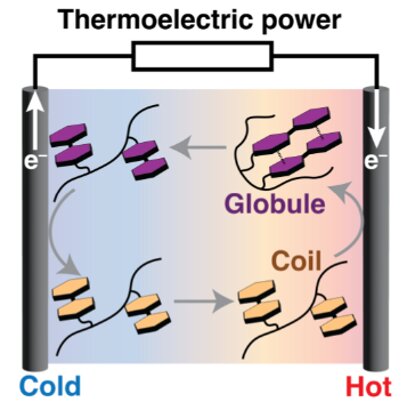
Researchers at the University of Tokyo have generated electricity from latent heat, the energy created when a substance transitions from a solid, liquid or gas into another state. This achievement could push forward the possibilities of thermocells, devices which use temperature changes to create electricity, known as thermoelectric conversion.
As all materials are able to undergo phase transitions under the right circumstances, this research supports the idea that a wide variety of materials have the potential to be used for thermoelectric conversion. Latent heat that once was wasted could instead be used to enable devices to create their own energy while cooling themselves down, reducing the reliance on other energy sources.
We hit the hottest recorded day on Earth this summer. Rising summer temperatures and growing technology use mean that the demand for cooling systems for both home and industry is increasing. Air conditioning and refrigeration technologies are already major energy users, so meeting this growing demand is a challenge for countries trying to reach their United Nations’ Sustainable Development Goals aimed at improving the environment and people’s lives.
But what if we could use at least some of the waste generated by these cooling systems to help generate the electricity needed to power them, in a low-cost, low-carbon way?
Researchers at the University of Tokyo became interested in the potential of latent heat energy created when a substance phase transitions from one state into another, for example, when the water inside an air conditioner evaporates and condenses to create the cooling effect. Unlike the hot air that you feel blasting outside from an aircon unit, the latent heat created by the water inside is almost imperceptible. Thermoelectric conversion uses heat to generate electricity, and one device that can do that is the thermocell. The work is published in the journal Advanced Materials.
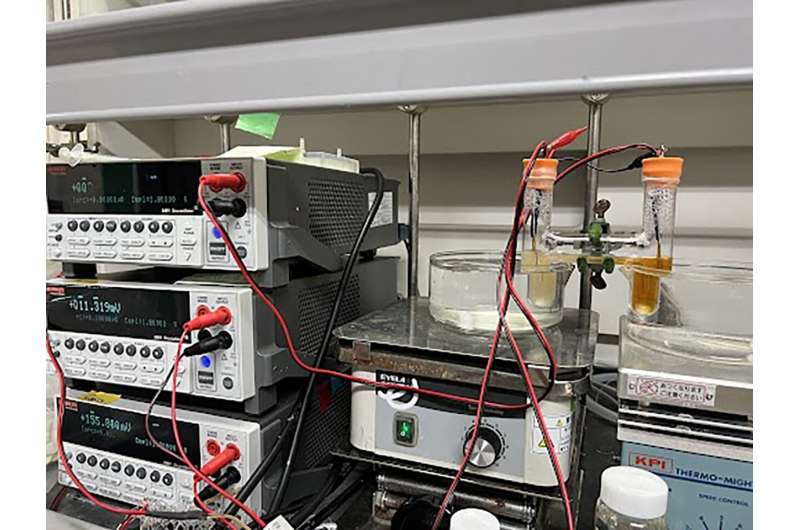
The team created their own thermocell using a hydrogel—a water-rich polymer material—called PNIPAM, which they modified with a compound called viologen. This modified hydrogel contained a thermo-responsive polymer, meaning that the polymer reacted to temperature change, in this case being soluble in cool water but insoluble in hot water. With this thermocell, they were successfully able to use the very small amount of latent heat energy generated by the phase transition—between soluble and insoluble—to create electricity.
“For the first time, we’ve confirmed that latent heat has the potential to be used for thermoelectric conversion,” said Professor Teppei Yamada from the Department of Chemistry at the University of Tokyo’s Graduate School of Science.
“We believe we can use various kinds of materials for thermocells. Every substance in the world can phase transition under the right conditions: for example, cream into ice-cream, sand into glass, water into steam, etc. With this method, in principle, it is possible to extract electrical energy from even the slightest temperature difference, greatly increasing the number of situations in which thermoelectric conversion can be used.”
The performance of a thermocell is assessed by how much voltage can be generated from a small temperature difference, which is called the Seebeck coefficient. The higher the Seebeck coefficient, the more electrical energy can be extracted.
The Seebeck coefficient of thermocells using organic compounds is usually less than 1 microvolt (one-millionth of a volt) per Kelvin unit of temperature, but in this test they exceeded 2 microvolts per kelvin. “This is a remarkable achievement,” said Yamada. “Although we have previously created thermocells which produce 2 microvolts per Kelvin by using a change in pH, this is the first time that the energy from a phase transition was directly used.”
The researchers hope that this work will help to improve refrigeration technology, temperature management devices and other temperature sensors. “We have already reached the stage where we can consider practical applications of thermocells. For example, we expect it would be possible to generate electricity while cooling a server room or the engine of a car,” said Yamada.
“The real challenge now is that this technology is not well known, so we need industry, government and academia to work together to achieve rapid social implementation.”
More information:
Hongyao Zhou et al, Direct Conversion of Phase‐Transition Entropy into Electrochemical Thermopower and Peltier Effect, Advanced Materials (2023). DOI: 10.1002/adma.202303341
University of Tokyo
Read the full article here


