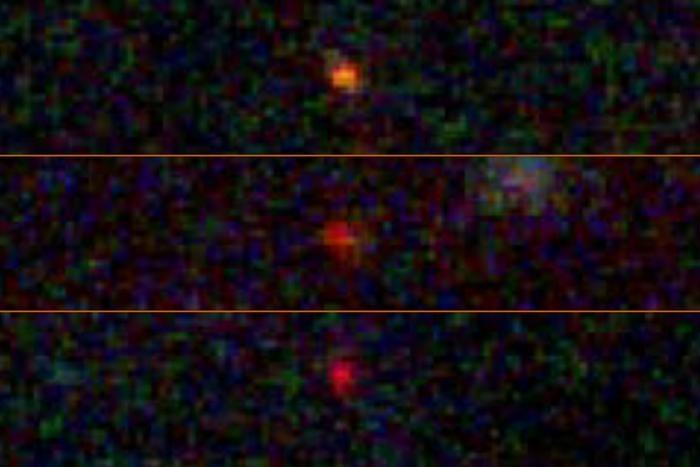
Astrophysicists looking at images from the James Webb Space Telescope have found three bright objects that might be supermassive “dark stars”—the first-ever stars to exist in the universe.
Until now “dark stars” have been theoretical. Up to 10 billion times as bright as our sun, they are thought to have existed early in the universe before the kinds of stars we see today could form.
Published in the Proceedings of the National Academy of Sciences, the research reveals three objects that at first appear to be galaxies, but on closer inspection look like diffuse puffy objects resembling “dark stars.”
“Dark stars” mark the beginning of the cosmic dawn, but they take on extra significance because they are, goes the theory, powered by particles of dark matter.
Dark Matter Revealed?
One of the deepest unsolved problems in all of physics, dark matter is thought to account for about 85% of matter in the universe and to interact only with gravity.
Scientists believe it consists of a new type of elementary particle that is invisible. It absorbs, reflects and emits no light or energy, according to NASA. Dark matter is therefore undetectable directly, so hypothetical, though it’s existence can be inferred by its effect on other things.
Follow-up observations are required, but a confirmed discovery of “dark stars” could reveal the nature of dark matter.
“Discovering a new type of star is pretty interesting all by itself, but discovering it’s dark matter that’s powering this—that would be huge,” said co-author Katherine Freese, director of the Weinberg Institute for Theoretical Physics and the Jeff and Gail Kodosky Endowed Chair in Physics at UT Austin.
Solving the Mystery
If the three candidate “dark stars” are real—JADES-GS-z13-0, JADES-GS-z12-0 and JADES-GS-z11-0—then as well as revealing dark matter it would help cosmologists solve a riddle about JWST’s images of “cosmic dawn.” It’s finding lots of galaxies that are too big to exist so soon after the Big Bang, if the standard model of cosmology is to be believed.
“It’s more likely that something within the standard model needs tuning, because proposing something entirely new, as we did, is always less probable,” said Freese. “But if some of these objects that look like early galaxies are actually dark stars, the simulations of galaxy formation agree better with observations.”
Last week, researchers using JWST found the most distant supermassive black hole so far, existing just 570 million years after the Big Bang.
Wishing you clear skies and wide eyes.
Read the full article here