


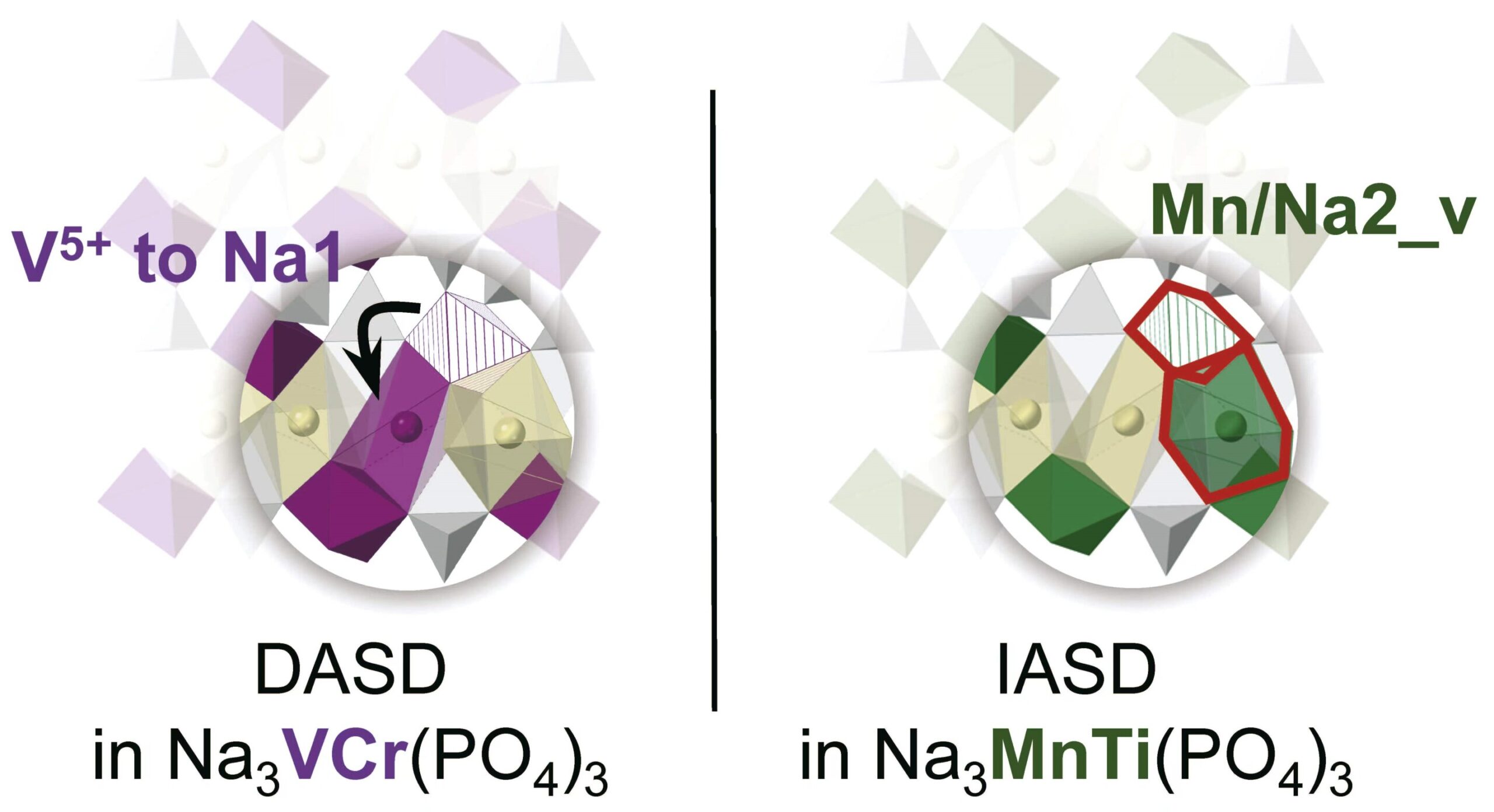
Manganese-rich NASICON-type materials have attracted widespread attention for developing advanced polyanionic cathodes, primarily driven by their abundant reserves, promising cycling performance, and potentially high operating voltage.
Unfortunately, their charge/discharge profiles exhibit significant voltage hysteresis, which leads to a limited reversible capacity, thereby preventing their application.
Now, however, the situation may be changing due to research by scientists at the Institute of Process Engineering (IPE) and the Institute of Physics of the Chinese Academy of Sciences. They recently identified the structural origin of voltage hysteresis in manganese-rich NASICON-type cathodes [Na3MnTi(PO4)3] and developed a new strategy for decreasing the defect concentration, thus enhancing the electrochemical performance of Na3MnTi(PO4)3 cathodes in Na-ion batteries.
The study was published in Nature Energy.
The research team demonstrated that voltage hysteresis in Na3MnTi(PO4)3 was closely related to a certain intrinsic anti-site defect formed during synthesis. The Mn-occupied-Na-vacancy anti-site defect blocked Na+ diffusion channels and hampered the redox reaction Mn2+/3+/4+, resulting in voltage polarization and capacity loss.
They also revealed the relationship between voltage hysteresis, phase separation, delayed charge compensation, sluggish Na+ diffusion, and the structure of the intrinsic anti-site defect.
Based on this understanding, the researchers developed a Mo-doping strategy to decrease defect concentration. Theoretical calculations indicated that Mo-doping in the transition metal site would increase the formation energy of the intrinsic anti-site defect, thus generating a well-ordered crystal structure and facilitating kinetics and electrochemical performance.
This strategy enhanced initial Coulombic efficiency from 76.2% to 85.9% and improved reversible capacity from 82.1 mA h g−1 to 103.7 mA h g−1.
“Our work sheds light on the voltage hysteresis in NASICON-type cathodes and provides guidelines for designing high-performance polyanionic electrodes,” said Prof. Zhao Junmei from IPE, corresponding author of the study.
More information:
Identifying the intrinsic anti-site defect in manganese-rich NASICON-type cathodes, Nature Energy (2023). DOI: 10.1038/s41560-023-01301-z
Chinese Academy of Sciences
Read the full article here


