


A research team led by Prof. Ma Cheng from the University of Science and Technology of China (USTC) of the Chinese Academy of Sciences (CAS) has developed a new type of solid-state electrolyte. The study was published in Nature Communications.
All-solid-state lithium batteries (ASSLBs) are a game changer for electric vehicles since they not only overcome the serious safety issues of the current commercial lithium-ion batteries but also possess larger room for energy-density improvement. Identifying an appropriate solid-state electrolyte is essential for the construction of ASSLBs. Nevertheless, the high-performance solid-state electrolytes are presently generally too expensive for commercialization.
In this study, the researchers developed a new solid-state electrolyte named lithium zirconium oxychloride (LZCO). LZCO can be synthesized from the commonly affordable compounds such as lithium hydroxide monohydrate, lithium chloride, and zirconium chloride. Consequently, its cost is as low as $11.60 per kilogram. This is lower than the $50 per kilogram threshold for commercialization, and is also much lower than the high-performance sulfide and chloride solid-state electrolytes (generally above $190 per kilogram).
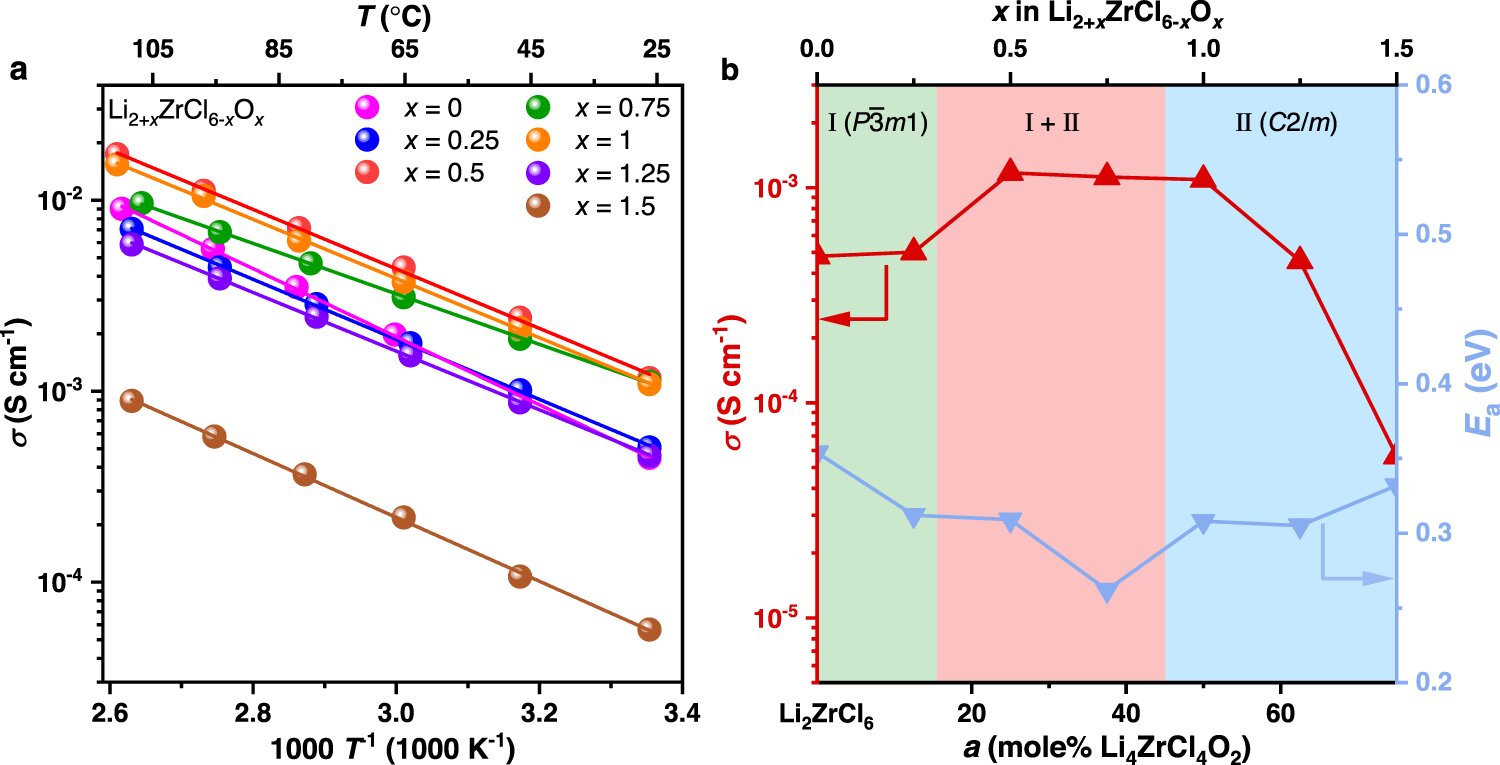
With such a cost-competitiveness, LZCO delivers state-of-the-art performance. It has a room-temperature ionic conductivity of up to 2.42 mS cm-1, which is among the highest of all types of solid-state electrolytes reported thus far. Besides, this material excels in the compressibility. It can achieve 94.2% density under 300 MPa, which is superior to the easily compressible sulfide and chloride solid-state electrolytes (below 90% at the same pressure).
The comprehensive performance of LZCO is experimentally proven to be comparable to the most advanced sulfide and chloride solid-state electrolytes available. The ASSLB formed by LZCO and the nickel-rich layered cathode shows exceptional performance: the battery is cycled stably at room temperature for more than 2,000 cycles under 12-minute fast charging conditions.
This new material marks a significant breakthrough in the performance and cost-effectiveness of solid-state electrolytes, opening up new possibilities for the commercialization of ASSLBs.
More information:
Lv Hu et al, A cost-effective, ionically conductive and compressible oxychloride solid-state electrolyte for stable all-solid-state lithium-based batteries, Nature Communications (2023). DOI: 10.1038/s41467-023-39522-1
Chinese Academy of Sciences
Read the full article here


