


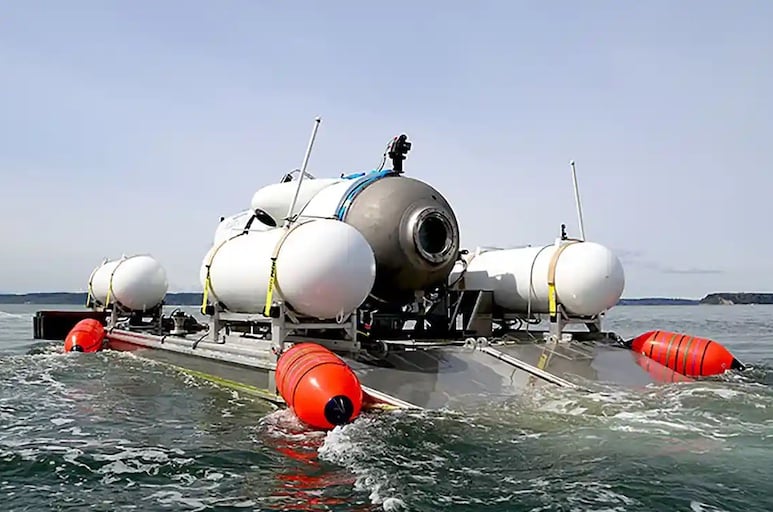
The loss of the OceanGate submersible Titan appears to be an example of warnings ignored.
“We have heard the baseless cries of ‘you are going to kill someone’ way too often,” OceanGate chief executive Stockton Rush wrote in 2018, after being told he was putting lives at risk using his experimental submersible Titan to ferry customers to view the wreck of the Titanic almost 4,000 metres below sea level. “I take this as a serious personal insult.”
Rush, who died along with four others with the Titan’s “catastrophic failure” last week, was warned by marine technology experts as well as at least one employee (subsequently dismissed) that the carbon-fibre vessel risked potentially “catastrophic” problems without rigorous testing and assessments.
Those boarding the Titan had to sign a waiver stating it was “an experimental submersible vessel that has not been approved or certified by any regulatory body which could result in physical injury, emotional trauma or death”. That should have been warning enough.
But this is not about being wise after the event. Consulting firm Institute for Crisis Management compiles statistics on crises across the globe every year. It rates 46% of these as “smoldering” in nature – that is, likely to have occurred after red flags or warning signs.
“In every crisis I have every studied,” says United States crisis management expert Ian Mitroff who has authored more than 20 books on the subject, “there were always a few key people on the inside of an organisation, or on its edge, who saw the early warning signs and tried to warn their superiors.”
“In every case, the signals were either ignored or blocked from getting to the top or having any effect.”
US academics Erika James and Lynn Wooten agree:
Smouldering crises nearly always leave a trail of red flags and warning signs that something is wrong. These signals often go unheeded by management.
Why red flags get ignored
Why are red flags not always acted on?
Sometimes the warning signs simply aren’t recognised.
This happened with French bank Société Générale, which in 2009 lost about €4.9 billion through unauthorised transactions by a single rogue futures trader, who created fictitious trades to cover losses on a falling market. An independent inquiry found the bank failed to act on 75 red flags over a period of 18 months.
Sometimes the problem gets reported but is blocked from moving up to management.
In one of Australia’s worst disasters, the Black Saturday bushfires in Victoria in 2009 that killed 173 people, some of the fires were caused by fallen power lines sparking fires in hot windy weather.
Subsequent inquiries revealed clear warnings about the risk of fires.
Sometimes top decision-makers are aware of the problem but don’t see it as a priority.
This appeared to be the case at the Pike River coal mine in New Zealand, where a gas explosion in 2010 caused a mine collapse, killing 29. The ensuing royal commission found that in the previous seven weeks the financially stressed company had “failed to heed numerous warnings of a potential catastrophe at the mine”.
The commission concluded:
In the drive towards coal production the directors and executive managers paid insufficient attention to health and safety and exposed the company’s workers to unacceptable risks. Mining should have stopped until the risks could be properly managed.
And sometimes warning alarms are literally turned off.
Following the disastrous explosion and fire on the ill-fated Deepwater Horizon oil rig in the Gulf of Mexico, killing 11 workers, in 2010, a US government investigation was told vital safety warning systems had been deliberately disabled to spare workers being awoken by false alarms.
Experts will try to resolve exactly how and why the Titan joined the Titanic on the bottom of the Atlantic Ocean – and whether the disaster could have been avoided if the many prior safety concerns had not been “explained away”.
The best crisis management is to prevent the crisis in the first place. Whether it is companies or governments or communities or individuals, when there are warning signs of impending disaster speak up, and keep speaking up, until someone takes action.
This article is republished from The Conversation under a Creative Commons license. Read the original article.
Read the full article here


