


Lithium-ion batteries (LIBs), rechargeable batteries that store energy via the reversible reduction of lithium ions, are used to power countless devices and technologies, ranging from laptops and smartphones to electric cars. While LIBs have several advantages over other battery technologies, their current energy densities restrict the distances that electric vehicles can travel before they need to be recharged.
Studies show that the formation of the solid electrolyte interphase (SEI), a layer that forms on the anode inside battery cells, can consume a significant amount of lithium ions. This adversely impacts initial Coulombic efficiency (the efficiency with which electrons are transferred in batteries before their first cycle), reducing a battery’s energy density.
A strategy that could help to counteract this effect, reducing the loss of active lithium inside LIBs and thus boosting their energy density, is prelithiation. This strategy essentially consists of pre-treating electrodes, adding lithium to the battery cell before its first operation cycle.
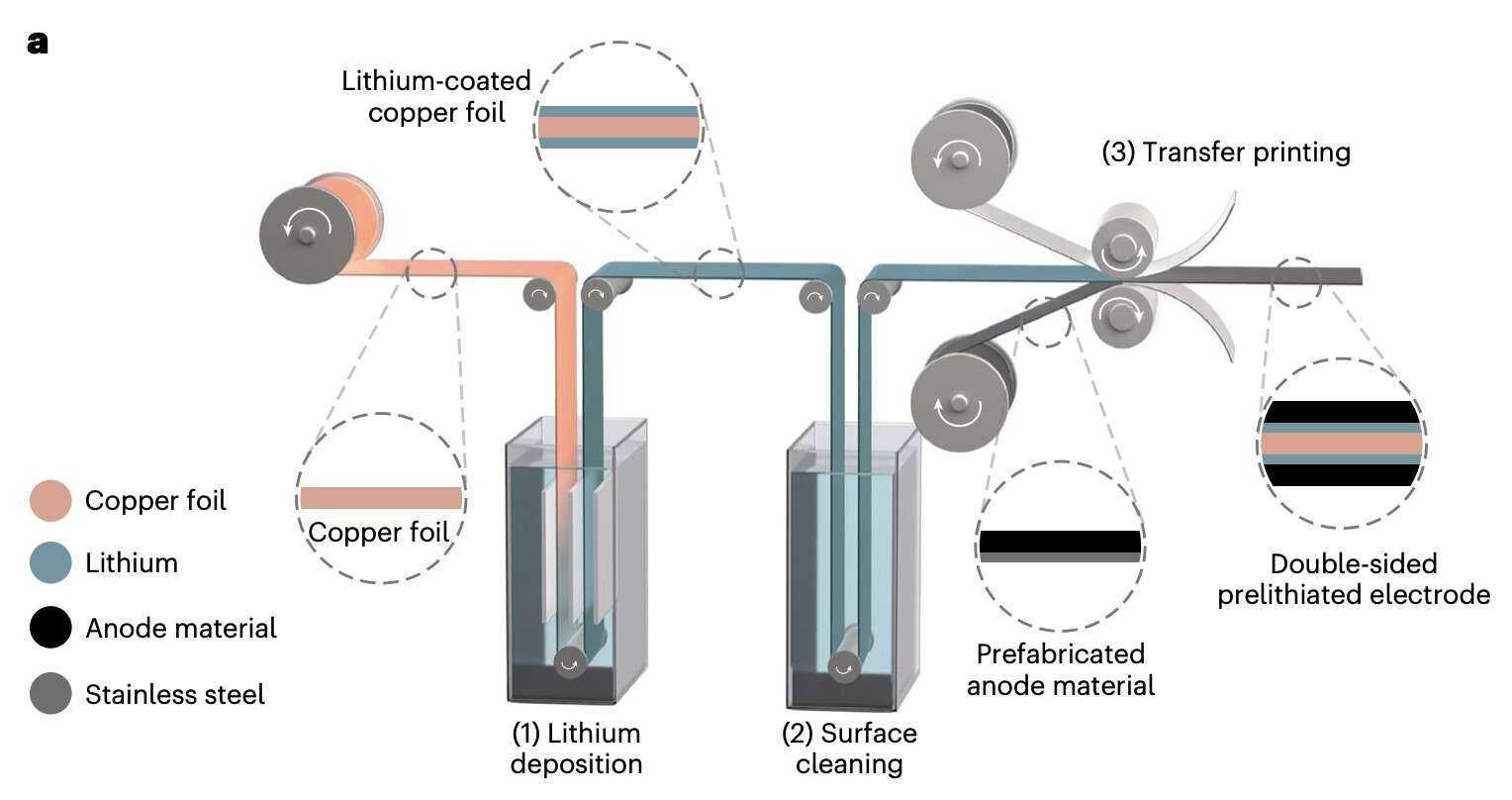
Researchers at Tsinghua University have recently introduced a promising approach to perform the prelithiation of anodes for LIBs on a large scale. Their prelithiation strategy, introduced in Nature Energy, is based on transfer printing, a method to print patterns onto an intermediate medium to then apply them onto a final substrate or material.
“A cost-effective prelithiation strategy with high quality and high industrial compatibility is urgently required,” Cheng Yang, Huachun Ma and their colleagues wrote in their paper. “We developed a roll-to-roll electrodeposition and transfer-printing system for continuous prelithiation of LIB anodes. By roll-to-roll calendering, pre-manufactured anodes could be fully transfer-printed onto electrodeposited lithium metal. The interface separation and adhesion during transfer printing were related to interfacial shear and compressive stress, respectively.”
The researchers evaluated their approach by running a series of simulations and electrochemical tests. They found that it performed remarkably well, as it could improve the initial Coulombic efficiencies of both graphite-based and silicon/carbon-based electrodes for LIBs, raising them to almost 100%.
Notably, in addition to enabling these high initial Coloumbic efficiencies, the team’s approach improved the stability of the SEI films created on anodes. Yang, Ma and their colleagues found that when combined with NMC and LFP cathodes, two of the most commonly used cathodes for LIBs, the prelithiated electrodes could significantly increase the energy density of fuel cells.
“With the facile transfer-printing prelithiation, high initial Coulombic efficiencies of 99.99% and 99.05% were achieved in graphite and silicon/carbon composite electrode half cells, respectively,” Yang, Ma and their colleagues wrote in their paper. “The initial Coulombic efficiencies and energy densities in full cells were observed to be significantly improved with the prelithiated electrodes. The roll-to-roll transfer printing provides a high-performance, controllable, scalable and industry-adaptable prelithiation in LIBs.”
The transfer printing strategy introduced by Yang, Ma and their colleagues has so far achieved very promising results, suggesting that it could eventually enable the large-scale and reliable prelithiation of electrodes for LIBs. Their paper could soon inspire other research teams to devise similar approaches aimed at improving the energy density of LIBs. Collectively, these approaches could facilitate the widespread adoption of electric vehicles.
More information:
Cheng Yang et al, Roll-to-roll prelithiation of lithium-ion battery anodes by transfer printing, Nature Energy (2023). DOI: 10.1038/s41560-023-01272-1.
© 2023 Science X Network
Read the full article here


