


Although most of the media’s attention has been on the total solar eclipse occurring on Monday, April 8, most people in North America will experience a partial solar eclipse.
In fact, according to Timeanddate, 652 million people will see something of this eclipse, with just 43.8 million experiencing totality. Even from within the 115-mile-wide path of totality, the total phase is but the centerpiece. Either side of the brief darkness are the same partial phases that the rest of Mexico, the U.S., and Canada will see.
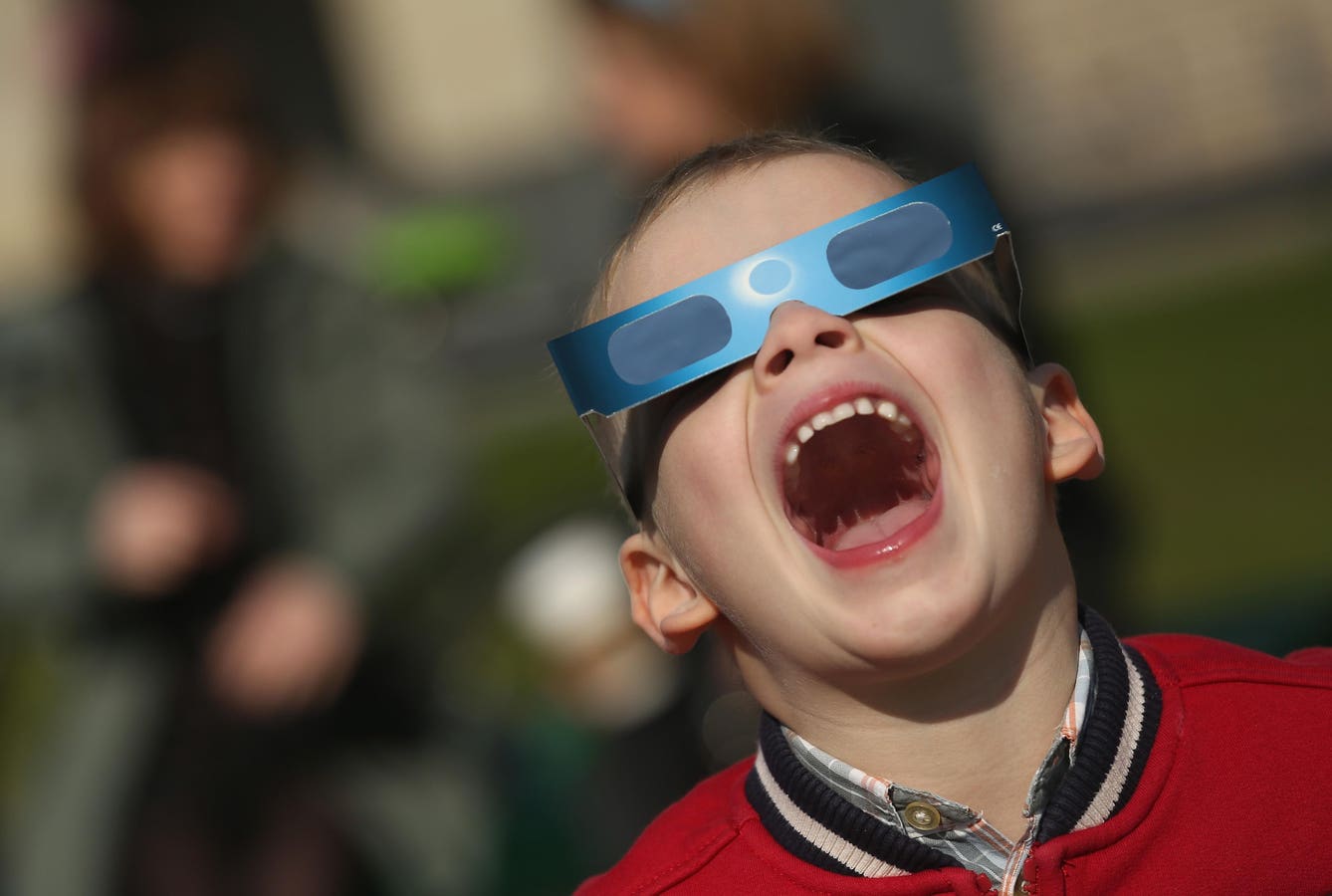
If you watch this event as a partial solar eclipse, you will have to use solar eclipse glasses the entire time. It will not be safe to take them off when viewing the eclipse. However, included here are some ways to indirectly view the moon’s progress across the sun
Here’s what to expect during the partial solar eclipse, what to see and how to stay safe.
Get A Partial Eclipse Timetable For Your Location
The eclipse will begin at “first contact,” when the moon appears to take a bite from the sun, move across its bright face, and then depart at “fourth contact.” You can get a simulation of exactly what you’ll see on Eclipse2024.org, while a timetable for your location can be found here. Depending on your exact location, the event will take between two hours and 2.5 hours.
Have A Look For Sunspots
Since the sun is getting close to “solar maximum”—the height of its magnetic activity during its 11-year solar cycle—there are black sunspots on its surface almost every day right now. You’ll not only see them through your solar eclipse glasses, but you may also see them covered by the moon during the partial eclipse.
Make Pinhole Projections
Once the sun is eclipsed by about 15% to 20%, you can make pinhole projections. The easiest way is to find anything with perfectly round holes in it, such as a colander or spaghetti spoon. As the eclipsed sunlight enters the hole, it’s focused, projecting an image of the eclipsed sun onto the ground beneath. A good way to see them is to use a white wall or place a white piece of card or paper beneath the colander. You could also make a pinhole projection camera if you have time.
Feel The Cold, Watch The Clouds
Cumulus clouds over land begin to disappear when a partial solar eclipse begins because they’re caused by heat rising from the land. That mechanism is interrupted during a solar eclipse when the temperature drops by as much as 10 degrees Fahrenheit. Bring an extra layer! Although this relationship is well known, NASA wants your help recording it.
Watch For Strange Animal Behavior
The gradual onset of a dusk-like light after the sun is about 50% eclipsed can make animals think that night is approaching. For example, cows often wander back to the barn. Cue a NASA callout to citizen scientists to help it measure the multisensory effect of the eclipse on environmental sounds and animal behavior.
Look For Venus
If the eclipse reaches about 60% of your location, you may be able to see the bright planet Venus during the day. Venus is the third-brightest object in the sky after the sun and moon. It will be about 15 degrees to the lower right of the eclipsed sun.
Salute The Moon
As the last bit of the moon departs the sun’s bright face, “fourth contact” is achieved as our natural satellite continues on its 29-day orbit of Earth. The spectacle is over, and there’s only one thing to say: when is the next eclipse?
For the latest on all aspects of April 8’s total solar eclipse in North America, check my main feed for new articles each day.
Wishing you clear skies and wide eyes.
Read the full article here