


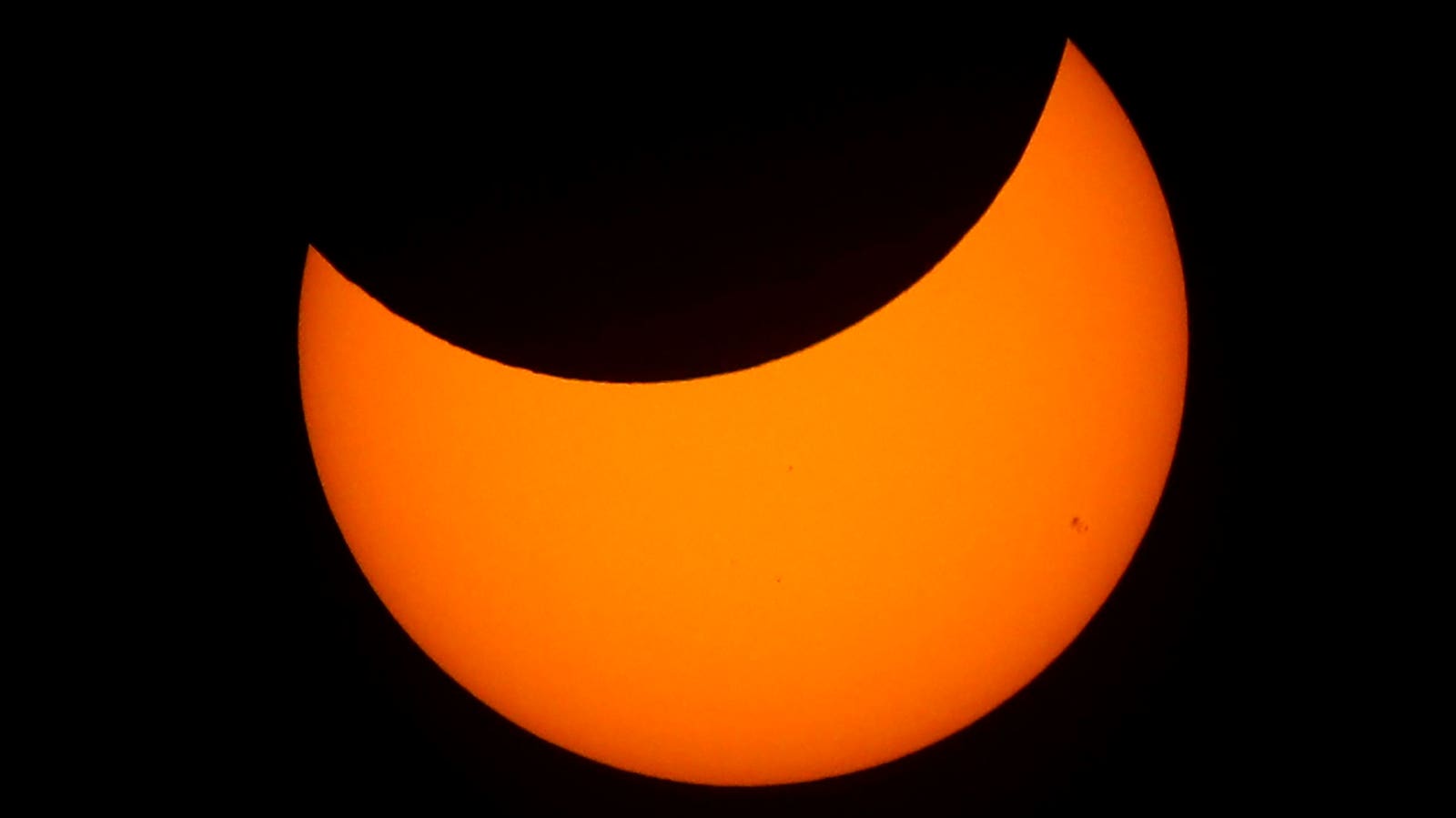
This Saturday, April 8, a solar eclipse will be seen across North America. From inside a 115-mile-wide path stretching across Mexico, the U.S., and Canada, a total solar eclipse will see the sun’s corona glimpsed with the naked eye for a few minutes as a “supermoon” covers all of the sun.
In the U.S., the “lucky” states crossed by the path of totality are Texas, Oklahoma, Arkansas, Missouri, Illinois, Kentucky, Indiana, Ohio, Pennsylvania, New York, Vermont, New Hampshire, and Maine. From everywhere outside of the path—including those states and across the rest of the country—a partial solar eclipse will be seen.
Here, I’ve gathered together 26 partial solar eclipse viewing events. For those in the western U.S., the partial eclipse will be slight, while those in northeastern states will see much more of the sun disappear behind the sun.
Location Is Everything
What you will see from where you are will depend on your exact location, but this eclipse lookup engine will show you exactly when the eclipse will start and finish and how much of the sun will be blocked at the peak of the event.
Thinking of taking a trip to see a bigger partial eclipse? Don’t waste your time. Either travel into the path of totality or stay at home. Traveling towards the path of totality to “increase the level of totality”—as I’ve heard people say—is misguided and misinformed. See the “Map of Nope.” If you’re happy to see the moon cross part of the sun (and miss out on the splendor of totality), it doesn’t make any difference to what extent the moon covers the sun. So the best advice is to simply go to the event nearest to you—no eclipse-chaser travels to see a partial solar eclipse.
- Exploratorium, San Francisco, California (34%)
- Las Vegas Astronomical Society, North Las Vegas, Nevada (51%)
- Fleet Science Center, San Diego, California (53%)
- Griffith Observatory, Los Angeles (57%)
- Arizona Science Center, Phoenix, Arizona (64%)
- Denver Astronomical Society, Chamberlin Observatory, Denver, Colorado (65%)
- Lowell Observatory, Flagstaff, Arizona (68%)
- Discovery Place Science Museum, Charlotte, North Carolina (80%)
- Udvar-Hazy Center, Chantilly, Virginia (88%)
- Turner Farm House, Great Falls, Virginia (88%)
- Shirley Chisholm State Park, Brooklyn, New York (89%)
- The Franklin Institute, Philadelphia (89%)
- Bear Mountain State Park, Tomkins Cove, New York (92%)
- Boston Harbor Islands, Boston, Massachusets (92%)
- Space Center Houston, Houston, Texas (92%)
- National Air and Space Museum, National Mall, Washington D.C. (87%)
- Yotel Washington DC Deck 11 Rooftop, Capitol Hill, Washington D.C. (87%)
- Primland Observatory, Blue Ridge Mountains, Virginia (87%)
- Science Museum Oklahoma, Oklahoma City, Oklahoma (93%)
- Adler Planetarium, Chicago, Illinois (93%)
- Museum of Science and Industry, Chicago, Illinois (93%)
- Triton College’s Cernan Earth and Space Center, Chicago, Illinois (93%)
- A Partial Eclipse at the Park, Pullman National Historical Park, Chicago (93%)
- Adler Planetarium, Chicago, Illinois (93%)
- Museum of Science and Industry, Chicago, Illinois (93%)
- Air Zoo Aerospace and Science Center, Kalamazoo, Michigan (96%)
Avoid ‘Edge’ Cities
I’ve specifically excluded all viewing events for a 99% partial solar eclipse in “edge” cities like Louisville in Kentucky, San Antonio in Texas, and Cincinnatti in Ohio. These cities should be making it very clear to their residents how close they are to the path of totality—and a truly mind-blowing experience—rather than promoting events that are, frankly, in the “wrong” place.
Get To The Path
If you’re getting beyond 95%, you really should get in a car/bus/train/Uber and get to the path of totality—however inconvenient or uncomfortable you may think it is. Totality is seriously that spectacular, and—with sympathy to those who simply cannot travel—seeing a partial solar eclipse when you’re so close to experiencing totality is a tragic loss to your life’s story.
Remember: there is no “99% totality”—there’s totality in the path and no totality out of it.
For the latest on all aspects of April 8’s total solar eclipse in North America, check my main feed for new articles each day.
Wishing you clear skies and wide eyes.
Read the full article here