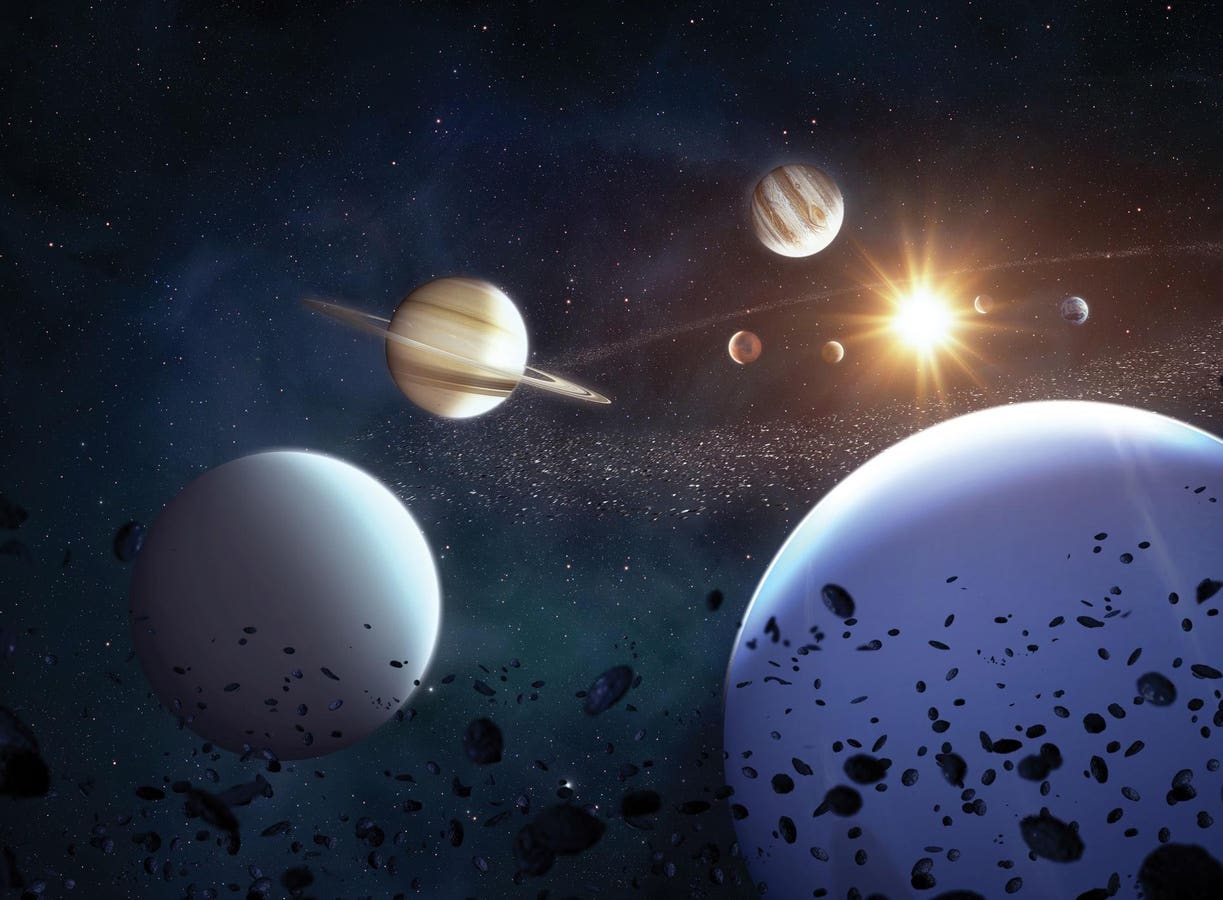
If you’re in the path of totality on April 8, you’ll see planets. In fact, every planet—and every moon—in the solar system will be in the sky during the eclipse. However, that doesn’t mean you’ll see them all.
Contrary to what you might have read, only two will be easily visible—and three if you “cheat.” Start looking for Venus about 15 minutes before totality. It will be about 15 degrees west-southwest of the sun. As totality begins, Jupiter will become visible, though much farther from the sun—about 30 degrees east-northeast.
However, a reality check is necessary for anything else.
Planetary Neighbors
“On April 8, Uranus, Jupiter, Mercury, Venus, Neptune, Saturn and Mars will all sit relatively close to the sun in the sky,” said Dr. Ryan French, a solar physicist at the National Solar Observatory (NSO) in Boulder, Colorado and the author of The Sun: Beginner’s Guide To Our Local Star, in an email.
However, although the sky will darken during the total solar eclipse, it’s more like twilight than darkness. “It will not get dark enough to see all our planetary neighbors,” said French. “Jupiter and Venus will certainly be visible and appear strikingly obvious in the eclipsed sky [and] for those closer to the center of the path of totality, Saturn and Mars could also be visible.”
Invisible Planets
The closest planet to the sun during the eclipse—and almost always—is tiny Mercury. That will be too faint to see during totality. “Ditto Uranus and Neptune, which are not visible during the nighttime sky to the naked eye, let alone during a twilight-like totality.
During totality, comet 12P/Pons–Brooks will be close to Jupiter, so it may be relatively easy to find in theory if you are somewhere with zero light pollution. But don’t get your hopes up. “Although estimates may change as the comet continues on its path towards the inner solar system, comet Pons-Brooks is currently not predicted to be bright enough to see during the eclipse,” said French. “It’s predicted brightness is similar to Mercury’s on eclipse day.”
If Pons–Brooks is a dud during totality, try looking for it on the evenings after the eclipse—looking due west, close to the horizon immediately after dark. You may well need binoculars to spot it. It will be closest to the sun on April 21, making that the best time to look for it.
Wishing you clear skies and wide eyes.
Read the full article here