


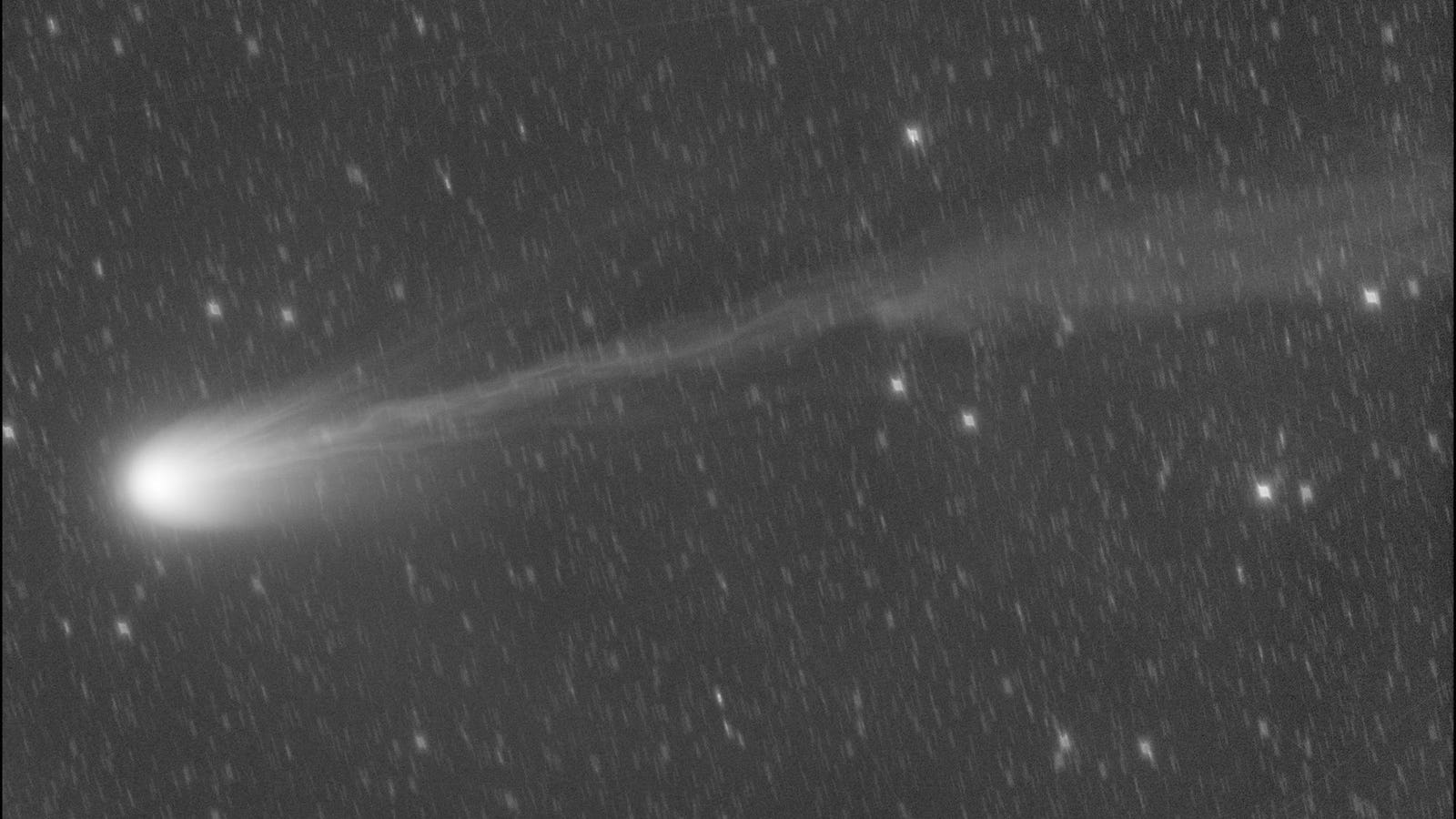
A comet may be visible during totality during April 8’s total solar eclipse. Comet 12P/Pons-Brooks, a regular visitor to the inner solar system that appears every 71 years, may even be bright enough to be seen with the naked eye.
But it definitely won’t “block the eclipse.”
How do we know that? It will be on the other side of the sun to Earth.
Other Side Of The Sun
A good way to confirm this is to look at The Sky Live’s excellent 3D rendering of the comet in the solar system. Pan around, and you can see the comet in space for whatever date and time you want. Set it to April 8, and you will see exactly where it will be.
The comet will be about 1.6 astronomical units from Earth during this apparition. An astronomical unit is the Earth-sun distance. There’s no way it could possibly block anyone’s view of the eclipsed sun.
It’s too far away and on the other side of the our star, as seen from Earth.
If it did block the eclipse, the comet would need to be closer to Earth than the moon. That’s 238,855 miles (384,400 kilometers). If a comet came that close to Earth we’d have a lot more to think about than getting a clear view of a total solar eclipse!
‘Eclipse Comet’
Whether the comet will be seen during totality on April 8 is doubtful. For those in the 115-mile-wide path of totality, it will get dark for a few minutes but not pitch black. So, despite the fact that the comet may reach about magnitude 5—roughly naked-eye visibility—that refers to a dark night sky, not twilight-like totality. It’s much more likely that photographers will see the comet in their long-exposure images.
At least it will be straightforward to find because during totality, comet 12P/Pons–Brooks will be close to Jupiter—have a quick look northwest of the sun when it’s totally eclipsed.
Ball Of Ice
Comet 12P/Pons–Brooks is a ball of rock, ice, and dust about 18 miles (30 kilometers) in diameter that orbits the sun every 71 years. It was first discovered in 1812 by Jean Louis Pons in France and later confirmed in America in 1883 by William R. Brooks, which led to its current name.
Its odd nickname comes from an outburst in mid-2023 when the comet suddenly brightened and appeared to have a pair of “horns” protruding from its nucleus.
Wishing you clear skies and wide eyes.
Read the full article here