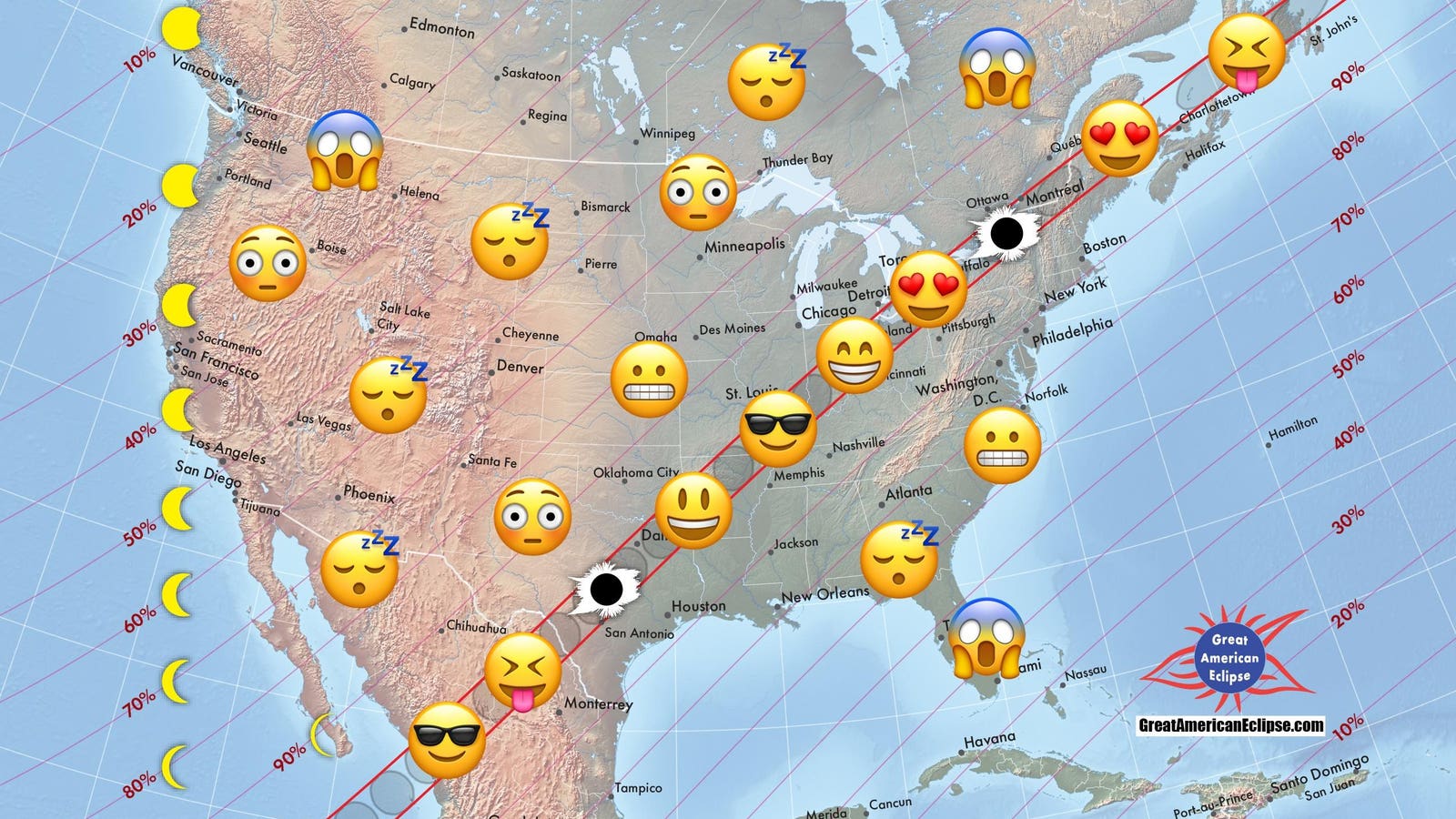
Can April 8’s total solar eclipse be explained using emojis? Of course! First came the “Map of Nope” meme to explain the intricacies of the rare celestial event. It proved hugely popular when I shared it on this page. In its wake comes the “Emoji Map” that successfully turns complicated science into a simple visual.
Much Needed
With so many cities split into two by the edges of the path and a common misconception that a 99% partial solar eclipse is 99% as good as totality, maps like this are much-needed ahead of the landmark event that will occur in parts of just 15 U.S. states.
The brainchild once again of expert eclipse cartographer Michael Zeiler at GreatAmericanEclipse.com, the “Emoji Map” of the total solar eclipse puts smiley faces within the path of totality and sad faces, sleepy faces and alarmed faces outside of its boundaries.
“People love to use emojis to express their emotions,” said Zeiler, in an interview. “This eclipse map predicts what people outside and inside might experience this April 8.”
Eclipses Are Complicated
Total solar eclipses are complicated and counterintuitive. They’re talked about as a national event, but they’re actually intensely local. While North America will see a total solar eclipse on Monday, April 8—its first since 2017 and its last until 2033—the key experience of totality will be restricted only to a narrow path of totality.
Just 115 miles wide, that path—a projection of the moon’s shadow on Earth that moves at 1,500 mph—can be a difficult concept to appreciate. Stand inside it, and you witness the partial phases of the eclipse but also a few minutes of totality—a breathtaking experience—during which you get to gaze at the sun’s mesmerizing corona with your naked eyes.
Partial Phases
Stand outside of that path, and you will see only the partial phases. Although interesting in its own way, watching the moon cover part of the sun is something that can only be safely viewed through solar eclipse glasses or a solar viewer.
A partial solar eclipse is nowhere near as immersive an experience—or as emotional—as a total solar eclipse. That’s why the at-a-glance “Emoji Map” works so well.
For the latest on all aspects of April 8’s total solar eclipse in North America, check my main feed for new articles each day.
Wishing you clear skies and wide eyes.
Read the full article here