


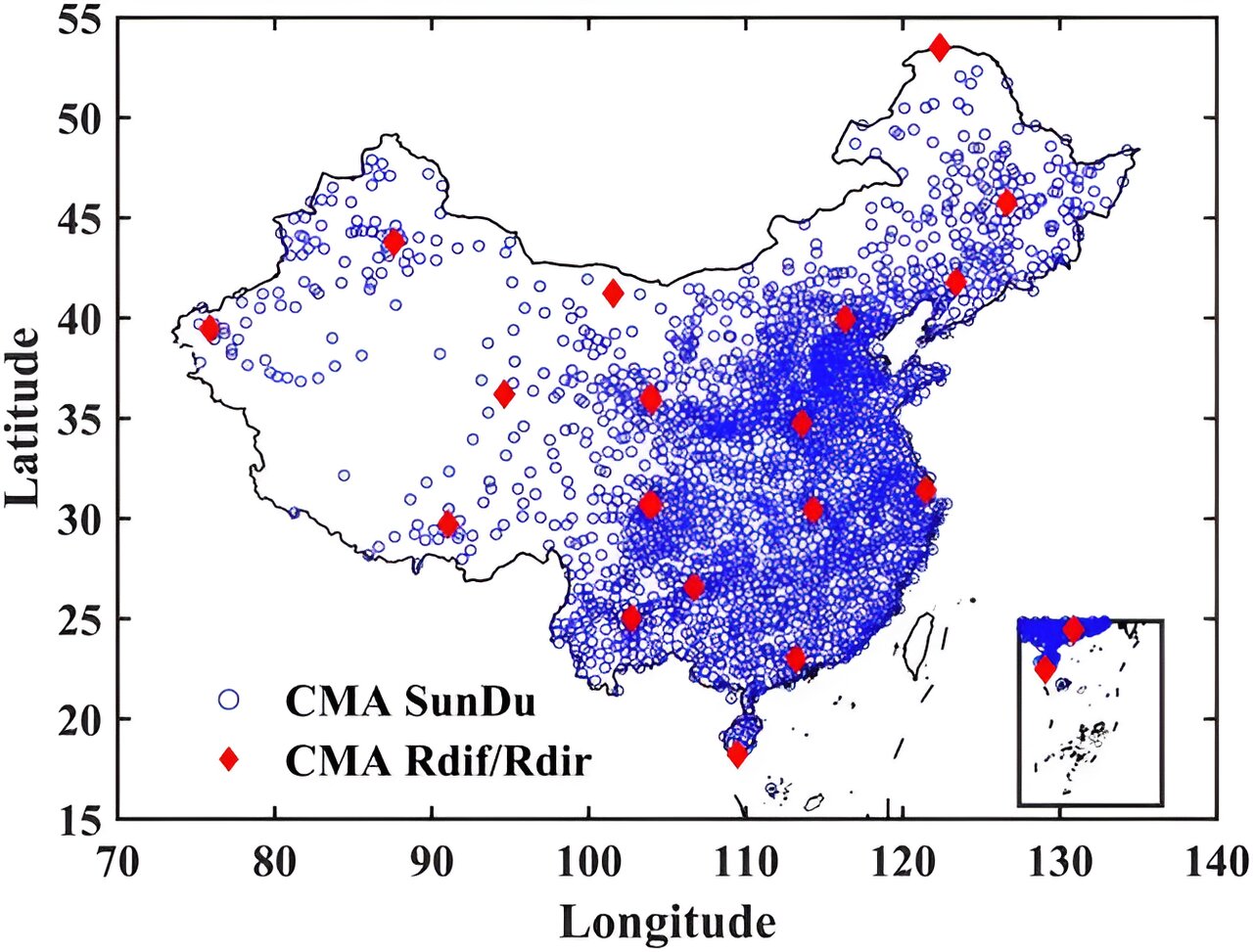
In a new study published in the Journal of Remote Sensing in February 2024, researchers utilized data augmentation alongside the LightGBM machine learning model for the estimation of both diffuse and direct solar radiation. By leveraging sunshine duration data collected from over 2,453 weather stations throughout China, this research overcomes the limitations posed by sparse and unevenly distributed ground-based observations.
This approach ingeniously utilizes sunshine duration data gathered from more than 2,453 weather stations, effectively bypassing the traditional obstacles of sparse and irregularly distributed ground-based observations.
The core of this research lies in its novel application of machine learning algorithms, which are trained on augmented datasets to predict solar radiation components with unprecedented accuracy. The methodology is particularly groundbreaking because it does not rely on local ground truth data for calibration, making it a universally applicable solution.
The validation of this model against independent datasets not only confirmed its effectiveness within China but also indicated its potential for global application. Moreover, the creation of a new satellite-based dataset as a result of this study stands out for its superior accuracy over existing datasets, providing a detailed spatial distribution of solar radiation components.
This dataset is instrumental for advancing solar energy research and deployment, offering insights that can lead to more efficient and optimized solar energy production.
Professor Kun Yang, the lead researcher from Tsinghua University, stated, “Our method significantly enhances the accuracy and applicability of solar radiation component estimates, paving the way for optimized solar energy utilization across China and potentially worldwide.”
This innovative approach not only establishes a new standard for estimating solar radiation but also presents a globally scalable solution, signaling a groundbreaking shift in solar energy research and implementation. The newly developed satellite-based dataset excels in precision over prior datasets and delivers an exhaustive spatial analysis of solar radiation components.
This advancement is vital for the solar energy sector, enabling more strategic site selection and system optimization, especially in areas with high solar energy potential.
More information:
Changkun Shao et al, Data Augmentation-Based Estimation of Solar Radiation Components without Referring to Local Ground Truth in China, Journal of Remote Sensing (2024). DOI: 10.34133/remotesensing.0111
Provided by
TranSpread
Read the full article here


