


New research shows that the next generation of lithium-sulfur (Li||S) batteries may be capable of being charged in less than five minutes, instead of several hours as is currently the case. The paper is published in the journal Nature Nanotechnology.
The University of Adelaide’s Professor Shizhang Qiao, Chair of Nanotechnology, and Director, Center for Materials in Energy and Catalysis, at the School of Chemical Engineering, led a team which examined the sulfur reduction reaction (SRR) which is the pivotal process governing the charge-discharge rate of Li||S batteries.
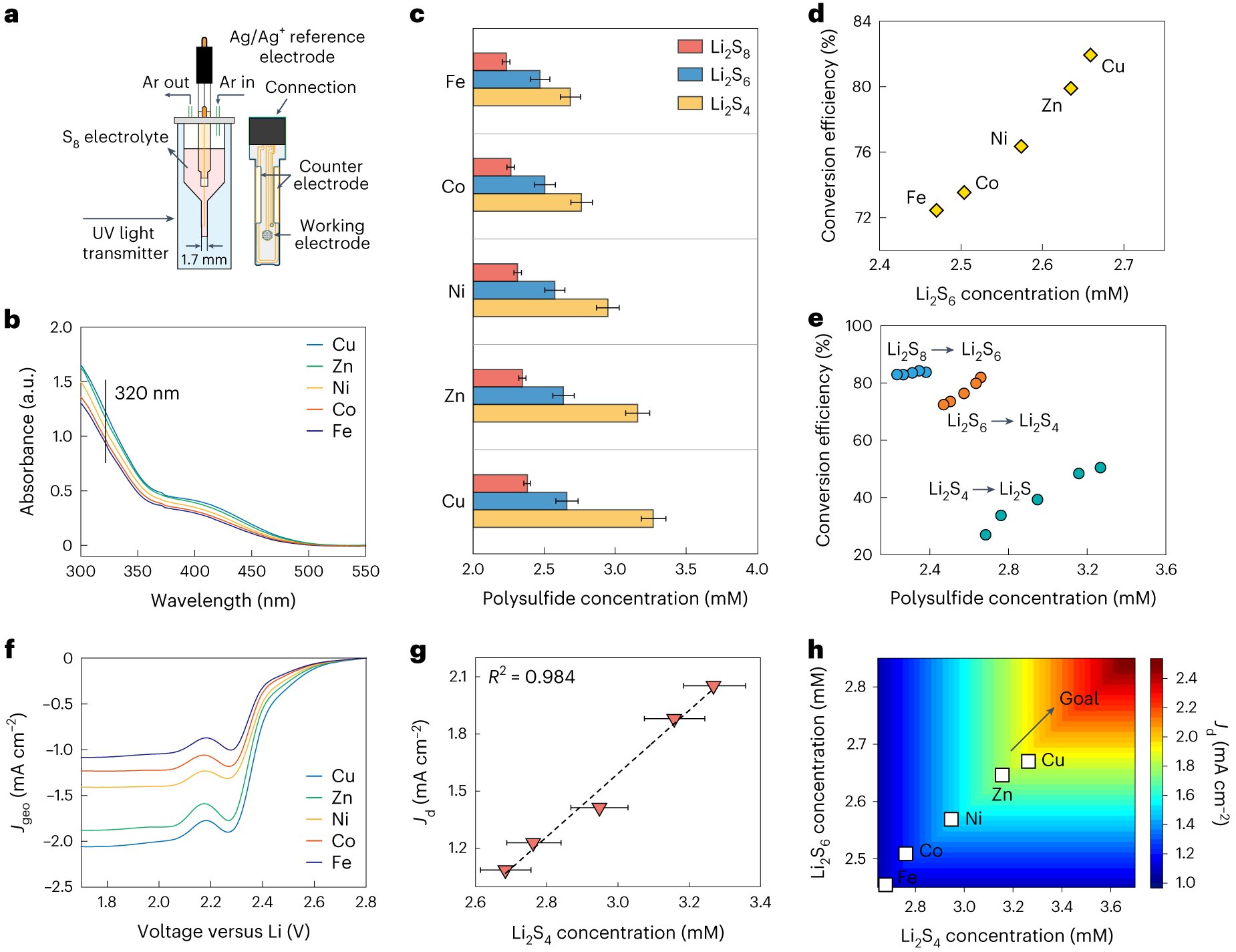
“We investigated various carbon-based transition metal electrocatalysts, including iron, cobalt, nickel, copper and zinc during the SRR,” said Professor Qiao who is an ARC Australian Laureate Fellow.
“Reaction rates increased with higher polysulfide concentrations, as polysulfide serves as the reactive intermediates during SRR.”
The team designed a nanocomposite electrocatalyst, comprising a carbon material and cobalt-zinc (CoZn) clusters.
“When the electrocatalyst CoZn is used in lithium-sulfur batteries, the resulting battery achieves an exceptional power-to-weight ratio of 26,120 W kgS-1,” said Professor Qiao.
“Our research shows a significant advancement, enabling lithium-sulfur batteries to achieve full charge/discharge in less than five minutes.”
High-power lithium-sulfur batteries are used in various devices such as mobile phones, laptops, and electric vehicles.
Current state-of-the-art lithium-sulfur batteries suffer from low charge-discharge rates, typically requiring several hours—typically from one to 10 hours—for a single full charge-discharge cycle.
The team’s study is the first comprehensive approach to tackling the problem of slow charge/discharge rates in lithium-sulfur batteries and has significant impact for scientists designing electrocatalyst materials and experts examining the reaction mechanisms of lithium-sulfur batteries.
“Our breakthrough has the potential to revolutionize energy storage technologies and advance the development of high-performance battery systems for various applications,” said Professor Qiao.
The high-power capabilities of these batteries make them well-suited for applications requiring rapid charging and discharging, offering enhanced performance and reliability for both consumer electronics and large-scale energy storage solutions in grid applications.
More information:
Huan Li et al, Developing high-power Li||S batteries via transition metal/carbon nanocomposite electrocatalyst engineering, Nature Nanotechnology (2024). DOI: 10.1038/s41565-024-01614-4
University of Adelaide
Read the full article here


