


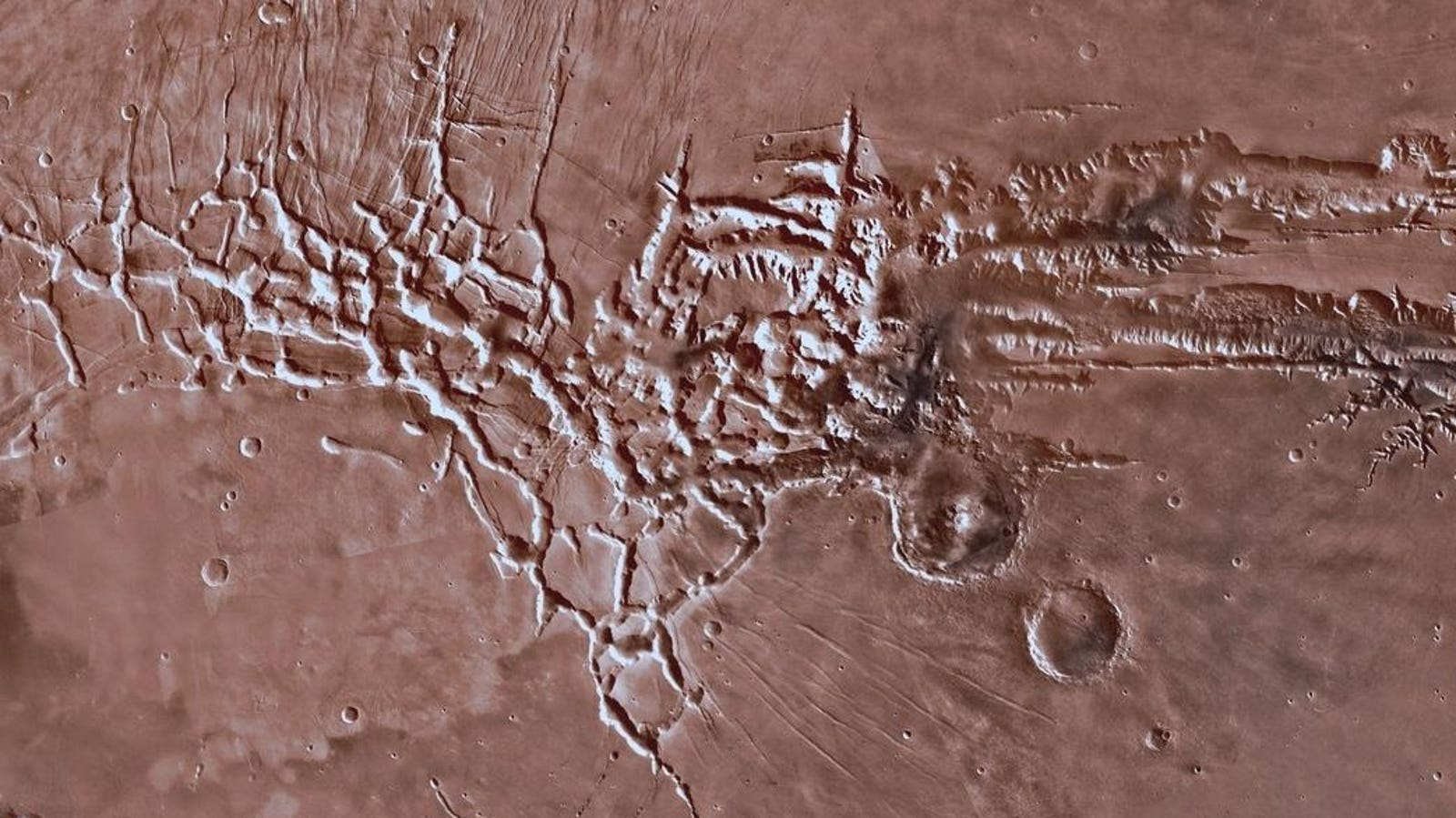
Here’s a recipe for hiding a massive volcano on Mars. Take one giant volcano. Tuck in into a dramatic, fractured landscape. Add a long history of extreme erosion. Give it time to meld with the surrounding terrain. That’s what scientists think happened to a suspected Martian volcano that is just now coming to light.
The volcano has the preliminary name of Noctis volcano, in honor of its location at the edge of scenic Noctis Labyrinthus (Labyrinth of the Night) near Mars’ equator. The area is known for its wild, maze-like landscape. The volcano is in the red planet’s Tharsis region, a place famous for volcanic activity.
Planetary scientist Pascal Lee with the SETI Institute and the Mars Institute at NASA Ames Research Center is the lead author of a study on the volcano. Lee and planetary geologist Sourabh Shubham are working on submitting the full study to a peer-reviewed publication. In the meantime, the researchers announced their discovery on Wednesday at the Lunar and Planetary Science Conference in Texas.
It’s not just the jumbo volcano that attracted attention. The researchers also suspect there’s a sheet of buried glacier ice nearby. “This combined giant volcano and possible glacier ice discovery is significant, as it points to an exciting new location to study Mars’ geologic evolution through time, search for life, and explore with robots and humans in the future,” the SETI Institute said in a statement.
The scientists practically stumbled across the volcano while studying the suspected glacier remnants and a candidate human landing site nearby. “But when it came time to look more carefully at volcanic deposits around and partially hiding the glacier, we started analyzing the region’s topography,” says Lee over email. “That’s when we saw the arc of high points defining the summit. And then the rest was almost obvious.”
Some of the clues appeared in imagery and data captured by orbiting spacecraft, including NASA’s Mars Reconnaissance Orbiter. What’s missing is a classic volcano cone. A topographic map points out the inner and outer zones of the volcano and a circular depression the scientists are interpreting as a caldera remnant. A caldera is a hollow left behind after a volcanic eruption. These also form on Earth. Yellowstone National Park, for example, encompasses a massive caldera.
Lee and Shubham were unable to come up with a competing hypothesis that could explain what they were seeing. “Nothing else came to mind that wasn’t bizarre. The combination of features we observe is really quite unique to volcanoes (and glaciers),” says Lee. “Plus we are in volcano country, so a volcano actually makes sense contextually.”
It’s not unusual for very large volcanoes to not look like stereotypical volcanoes, says volcanologist Christopher Hamilton of the University of Arizona. Hamilton wasn’t involved in the Noctis volcano research. He says the discovery is “interesting if true.” Extreme erosion could account for the suspected volcano’s current appearance. “This could have been facilitated by melting of ground-ice, so the volcanic hypothesis definitely warrants more exploration, and I look forward to seeing the peer-reviewed paper,” Hamilton says.
There are plenty of mysteries left to investigate, including uncertainties about the volcano’s size, composition and original height and shape. The volcano could still be active. The combination of volcanic heat and water ice makes this an intriguing place to look for signs of ancient microbial life. If glacier ice is found near the surface, then water could potentially be accessed for use by future human visitors.
This won’t be the last we hear of Noctis volcano. If the interpretation holds up, it should get a formal name. It could also become a target for exploration, whether human or robotic. Eventually, it will give up its secrets.
Read the full article here