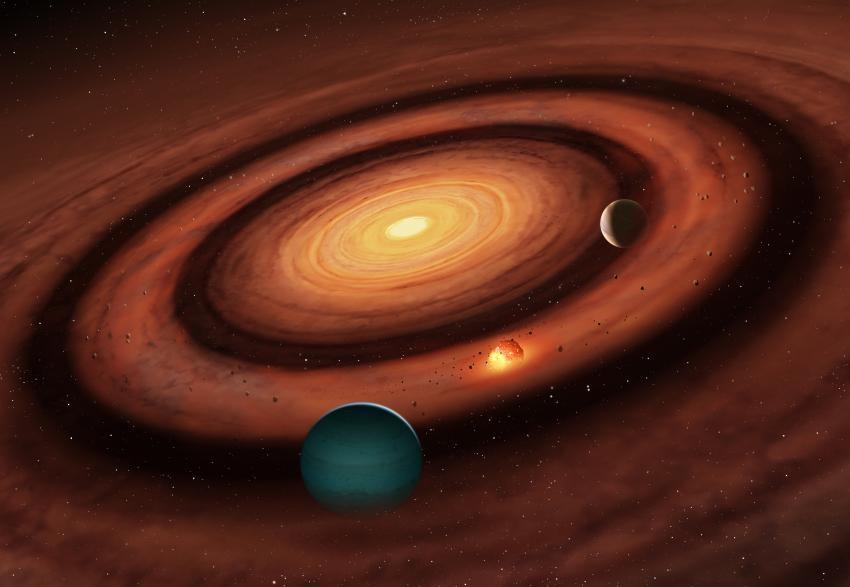
Scientists have made a new discovery that could explain why small planets often exist between two large planets.
It’s known that planets form in what are called proto-planetary discs around stars—gas and dust leftover from the formation of the star that eventually clump together. However, the conventional theory is that planets form sequentially from the inside to the outside of the disc, with small planets close to a star and larger planets farther out.
‘Sandwich Planets’
Researchers at the University of Warwick—speaking at the National Astronomy Meeting at Cardiff University in Wales, U.K—said they found many examples of star systems with “middle” planets that are smaller than larger neighbors either side. The explanation offered—submitted to the journal Monthly Notices of the Royal Astronomical Society—is that small planets form in rings ands gaps within proto-planetary discs that are themselves created by those larger planets.
This newly observed process of two large planets in a star system creating rings of dust where small planets can form is called “sandwiched planet formation.”
Gaps and Rings
The findings come from new images of proto-planetary discs that reveal, for the first time, that gaps and rings exist within them. “The gaps are where we expect planets to be, and we know from theory work that planets cause dust rings to form just exterior to them,” said Farzana Meru, Associate Professor and Dorothy Hodgkin Fellow from the Department of Physics at the University of Warwick in the UK. “We propose the rings as sites of planet formation … there are sandwiched planets currently being formed in those rings.”
The finding is part of a revolution in the last decade in our knowledge of how planets are formed, largely fuelled by high resolution images of planet-forming disks around planets taken by the ALMA Observatory (Atacama Large Millimeter/submillimeter Array) in Chile.
Wishing you clear skies and wide eyes.
Read the full article here