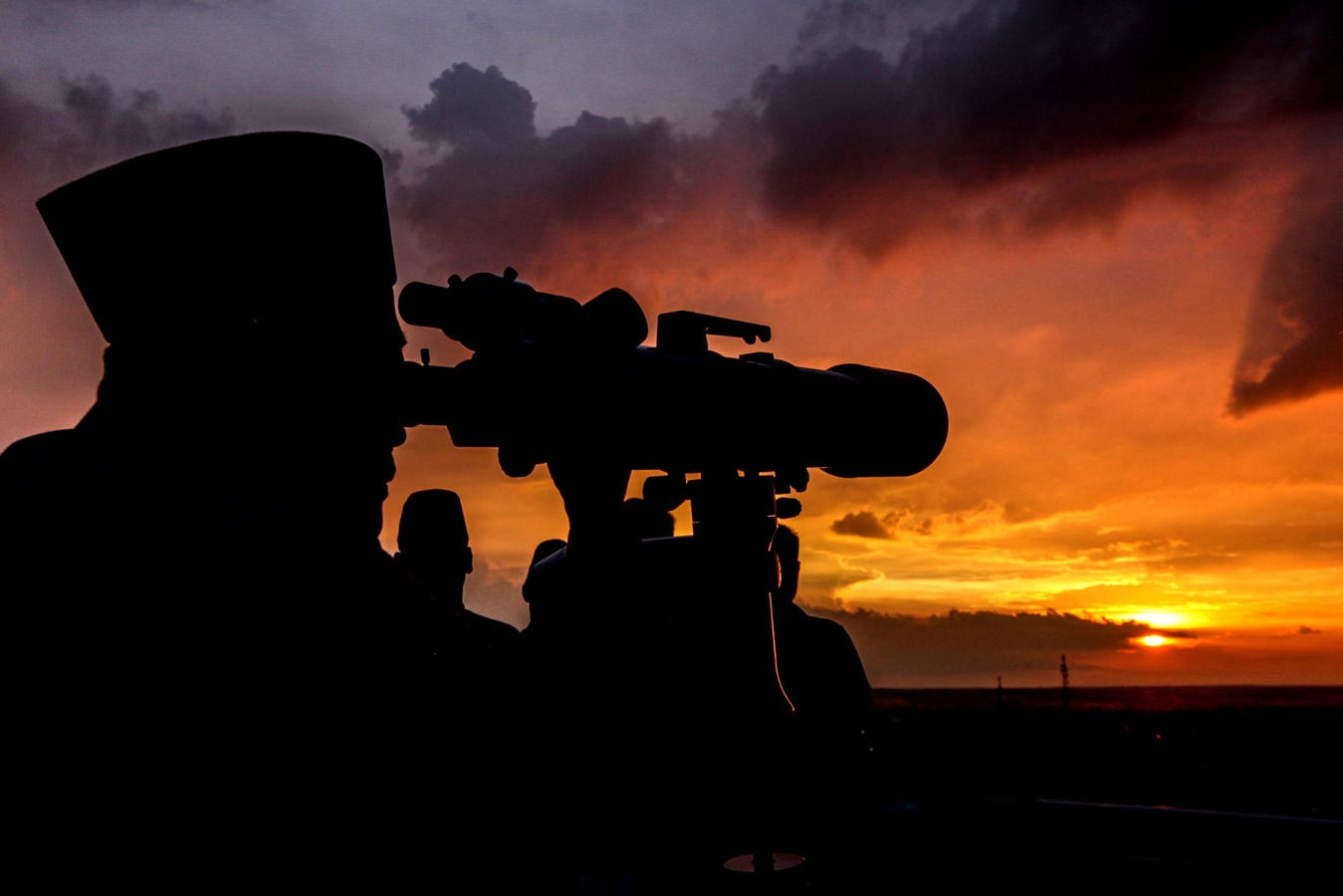
When does Ramadan begin? There’s a new moon coming, but it’s a more significant one than usual. The moment when the moon is between Earth and the sun sees the far side of the moon illuminated. On Sunday, March 10, no one on Earth will see anything of the moon.
However, a few hours after new moon, when our satellite has moved away from that point in space between the Earth and Sun, its limb is suddenly lit-up, as seen from Earth.
The result is a super-slim crescent moon, which will also be a “super new moon” this month.
When that’s sighted for the first time this month, it will signal the beginning of something significant—Ramadan, the month-long sunrise-to-sunset fast observed by devout Muslims worldwide. That’s because in the Islamic Hijri calendar, the emergence of the moon after its new moon phase defines the beginning of all the months in the Islamic calendar.
However, the March new moon will also set in motion both a lunar eclipse and a stunning total solar eclipse, the latter of which will be celebrated just as Ramadan ends with the festival of Eid al-Fitr.
Here’s everything you need to know about Ramadan, the super new moon and the two eclipses coming up:
When Is The ‘Super New Moon?’
The exact time of the new moon in March will be 09:00 Coordinated Universal Time (UTC) on Sunday, March 10, 2024, which translates to:
- 09:00 a.m. in London on March 10
- 04:00 a.m. in New York City on March 10
- 01:00 a.m. in Los Angeles on March 10
It’s deemed a “Super New Moon” because it will be close to its perigee, its closest position to Earth in its monthly orbit.
When Is Ramadan?
When does Ramadan start and end? Some countries and cultures begin Ramadan when the crescent moon is first sighted, while others use a date and time known in advance, such as the date and time of the New Moon.
The decisive first sighting of the young moon will likely be after sunset on Monday, March 11, since it will be 3.6% lit between Mercury (below) and Jupiter (above). However, it may be sighted after sunset on Sunday, March 10, though since it will be less than 1% lit, that’s unlikely. So, the first fasting day will be Tuesday, March 12, with fasting commencing at dawn.
When Is The ‘Worm Moon Lunar Eclipse?’
During Ramadan, the full moon (“Worm Moon”) will also be a penumbral lunar eclipse. On Monday, March 25, the third full moon of 2024 and the first of spring in the northern hemisphere will move through the Earth’s outer shadow in space. A slight penumbral lunar eclipse will result for the night side of Earth, including North and South America, Europe, East Asia, Australia and New Zealand. It will be best seen from North America between 03:12 and 05:32 a.m. EDT on Monday, March 25.
When Will Ramadan End?
The end of Ramadan is also decided astronomically with the sighting of the next young moon, known as the “Shawwal Moon.” The next new moon occurs on Monday, April 8 at 2:20 p.m. EDT. The young moon’s emergence just after sunset on April 9 or, more likely, April 10—after the next new moon—will signal the end of Ramadan and the beginning of the festival of Eid al-Fitr (“feast of breaking the fast”), one of two holy days of the year for the Islamic world. Eid al-Fitr marks the end of the month of Ramadan and the first day of the month of Shawwal.
When Is The Total Solar Eclipse?
The very instance of a new moon will, for some in North America, also be a total solar eclipse—when the new moon blocks the sun to cause darkness in the day. It will also be a “supermoon.”
It’s a rare event that only happens once every 375 years, on average, but North America is lucky enough to experience two total solar eclipses in just seven years. The total solar eclipse on April 8 will last up to 4 minutes and 26 seconds, but it can only be seen within a 125-mile wide path of totality. This path will stretch from the Pacific coast of northwestern Mexico to Atlantic Canada, passing through parts of 15 U.S. states: Texas, Oklahoma, Arkansas, Missouri, Illinois, Kentucky, Tennessee, Michigan, Indiana, Ohio, Pennsylvania, New York, Vermont, New Hampshire and Maine. If you don’t try to travel to this path of totality, you’ll only see a partial solar eclipse.
However, totality won’t end Ramadan—only the new moon’s sighting in the few evenings after can do that.
Wishing you clear skies and wide eyes.
Read the full article here