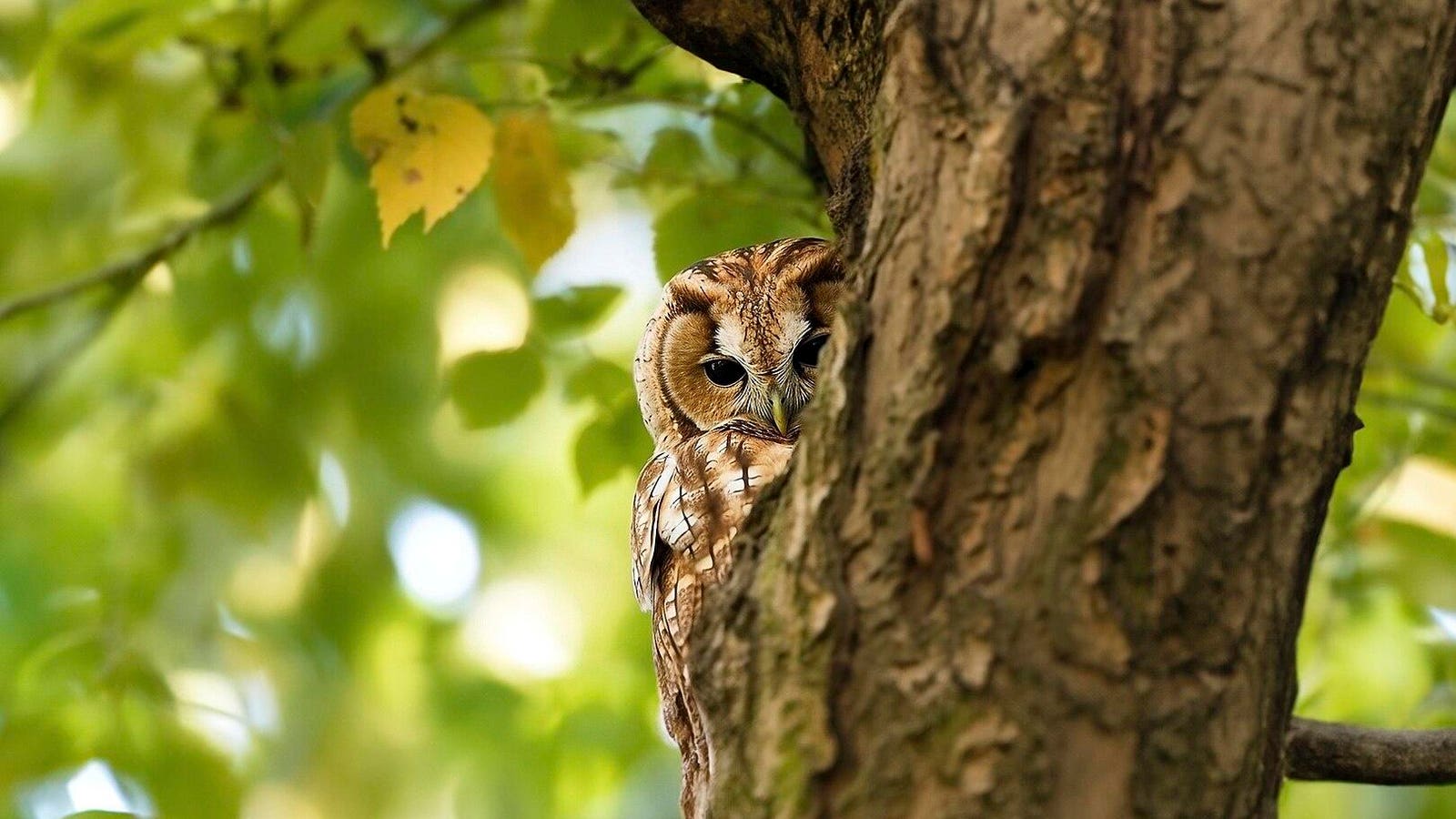
A recent genetic study reveals that the pale grey plumage of the tawny owl could be linked to the bird’s ability to survive in cold environments
© Copyright by GrrlScientist | hosted by Forbes | LinkTr.ee
A recently published study finds that the silver plumage of the tawny owl, Strix aluco, is related to its ability to thrive in extremely cold environments. Color is an evolutionary adaptation that helps animals in a number of ways: camouflage, mate attraction and, as we’re seeing here, color can even be related to physiological abilities and behavioral traits conferred by the pigments themselves. But the presence of more than one color polymorphism, or ‘morph’, in a population is probably one of the most enigmatic of evolutionary questions.
Tawny owls commonly occur in woodlands across all of Europe and into portions of western Siberia. Tawny owls are medium-sized nocturnal birds who have two plumage color morphs, pale gray and dark brown. It has long been suspected that these two plumage color morphs are consistent with the owls’ physiological adaptations to their environment: reddish-brown individuals are found in warmer and more humid environments, mostly in southern Europe and in parts of northern Africa, whilst pale grey individuals mainly live in cold, dry and snowy habitats, primarily in northern Europe. Since diversity in behavior and other complex traits have been shown to segregate with plumage color in other species, it is reasonable to expect to also discover genetic evidence of such associations in tawny owls.
“Based on this assumption, it has been predicted that the warming climate and snow scarcity may lead to a shift towards darker feather coloration in cold regions that have been dominated by gray owls,” said the study’s lead author, evolutionary biologist Miguel Baltazar-Soares, a postdoctoral researcher at the University of Turku. Dr Baltazar-Soares specializes in population genetics and genomics, with a deep interest in the application of evolutionary theory to management.
Dr Baltazar-Soares and collaborators investigated the genomic links between polymorphisms in feather color and different environments occupied by these owls. To do this work, Dr Baltazar-Soares and collaborators sequenced and assembled the complete genome from the species for the first time, and conducted a comprehensive genome-wide-association screening for particular gene variants of 370 tawny owls — 220 grey morphs and 150 brown morphs — from a population in southern Finland.
Dr Baltazar-Soares and collaborators found putative genetic evidence of cold adaptation that is strongly associated with the grey phenotype (Figure 1). The presence of these two genetic variants can predict gray plumage coloration in tawny owls with an accuracy of 70-100%.
The gene variants that link plumage color polymorphism are probably also linked to adaptations to extreme cold, despite less melanin pigmentation in the grey morph owls’ plumage reducing their ability to transform sunlight into heat. These adaptations, which include energy homeostasis, fat deposition and control of starvation responses, may be interpreted as adaptations to local environmental conditions. These findings suggest a genetic regulatory mechanism for grey coloration in this population of tawny owls as well as some gene variants underlying the expected adaptation to their local environment.
According to Dr Baltazar-Soares, the functionality of these genetic variants will be further verified in future studies (Figure 2). Nevertheless, these initial results suggest that these co-occurring color morphs may indeed be an adaptive response to climate conditions.
Source:
Miguel Baltazar-Soares, Patrik Karell, Dominic Wright, Jan-Åke Nilsson, and Jon E. Brommer (2024). Genomic basis of melanin-associated phenotypes suggests colour-specific environmental adaptations in tawny owls, Molecular Ecology 33(4) | doi:10.1111/mec.17247
Socials: Bluesky | CounterSocial | Gab | LinkedIn | Mastodon Science | Post.News | Spoutible | SubStack | Threads | Tribel | Tumblr | Twitter
Read the full article here